
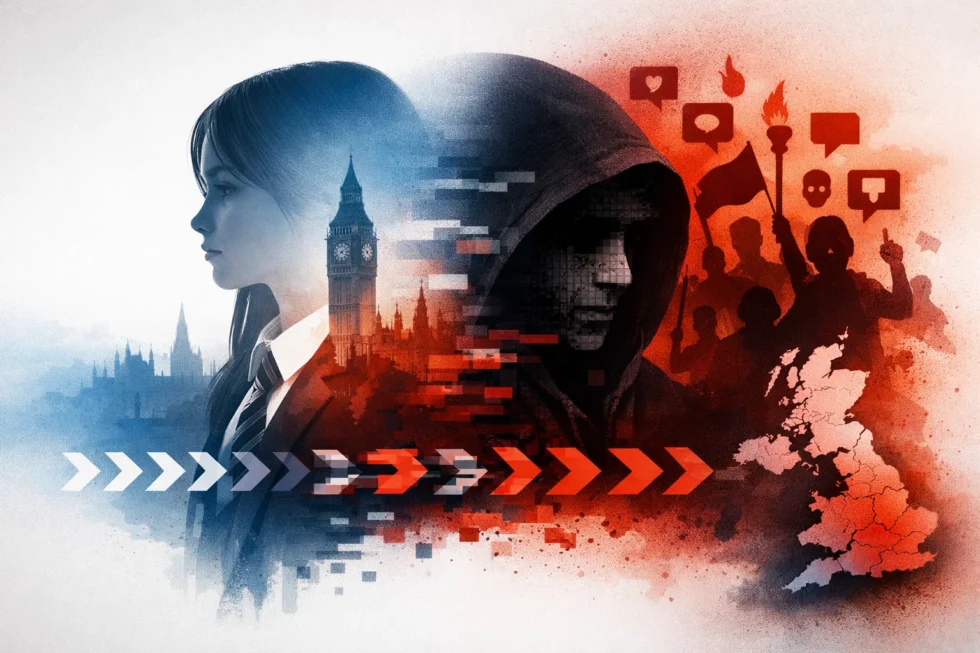
AI-generated schoolgirl avatar from a UK counter-extremism game has been repurposed into a fast-spreading far-right meme, after an artificial intelligence character created for a government-funded educational programme aimed at preventing youth radicalisation was lifted from its original classroom context and widely reused online. According to monitoring and reporting cited by The Guardian, the material has circulated across mainstream platforms in altered images and videos carrying extremist messaging, a trend observed and documented by The WP Times.
The avatar, known as “Amelia”, was introduced as part of Pathways: Navigating the Internet and Extremism, a classroom-facing interactive resource linked to the UK’s Prevent counter-extremism programme. In recent weeks, thousands of modified images and videos featuring the character have circulated across major social media platforms, often stripped of their original educational framing and combined with racist slogans, parody formats and monetised spin-offs.
What is confirmed so far
Available monitoring data and public statements outline the following confirmed elements:
| Item | What is known |
|---|---|
| Avatar | “Amelia”, an AI-generated character styled as a British schoolgirl |
| Original source | Pathways: Navigating the Internet and Extremism |
| Programme link | Funded by the Home Office; connected to Prevent educational resources |
| Format | Interactive, scenario-based game using multiple-choice decisions |
| Primary platforms | Facebook and X identified as major vectors |
| Initial trigger | An early “seed” post on X identified by monitoring groups |
| Scale | Daily posts rose from ~500 to ~10,000; one peak day recorded 11,137 posts on X |
| Monetisation | Emergence of a meme cryptocurrency linked to the character |
The volume figures and identification of the early seed post come from monitoring data shared with The Guardian by researchers tracking online extremism and meme ecosystems.
What Pathways was designed to do
Pathways: Navigating the Internet and Extremism was developed as an educational tool for supervised classroom use. Its stated aim is to help students recognise online radicalisation techniques, manipulation and social pressure. The game places players in everyday college-style scenarios and asks them to decide how to respond to online content, invitations to events or peer influence.
Some narrative branches culminate in a simulated safeguarding escalation under the Prevent framework. According to material linked to the programme, this design choice was intended to reflect how early intervention can occur in real-world settings when concerns arise.
The project forms part of broader Prevent-linked educational efforts, which focus on identifying and diverting individuals at risk of being drawn into violent extremism.
Who “Amelia” is within the game narrative
Within Pathways, Amelia functions as an antagonist character. She expresses anti-immigration views and introduces grievances framed around national identity and social change. The game’s instructional premise is that extremist narratives often appear not as explicit calls to violence, but as socially embedded arguments built on identity, belonging and perceived “common sense”.
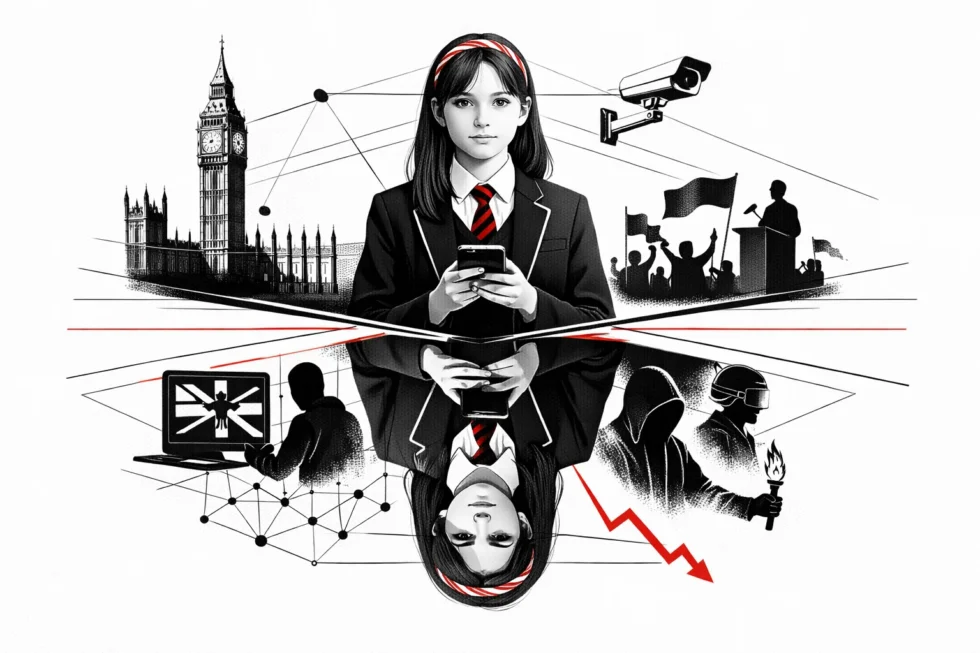
The character’s design — visually distinctive, stylised and recognisable — was intended to support engagement in a controlled educational environment. However, that same recognisability later facilitated her extraction from the game and reuse across social platforms without the original narrative framing.
How the meme spread online
According to analysis referenced by The Guardian, the Amelia meme began circulating after an anonymous account associated with far-right messaging posted an edited version of the character on X. That post reportedly achieved high engagement, triggering rapid imitation.
Researchers describe a familiar platform dynamic: once a character becomes a recognisable template, users compete to produce faster and more eye-catching variations. Algorithmic systems that reward engagement and posting frequency then amplify the trend.
Monitoring data cited by The Guardian indicates that daily posts featuring Amelia rose from approximately 500 per day to around 10,000 per day as the meme reached international audiences. On one recorded day, 11,137 Amelia-related posts appeared on X alone.
Why generative AI changed the scale
Analysts emphasise that this case differs from earlier propaganda imagery because the character is entirely synthetic and easily reproducible. Three technical features are highlighted:
- Synthetic: There is no real person associated with the image, removing barriers related to consent, identity verification or personal harm.
- Modular: The avatar can be placed into different environments — Westminster, London streets or news-style settings — with minimal technical skill.
- Re-runnable: Consumer-grade AI tools allow near-instant generation of new variants, enabling volume that can outpace moderation systems.
The Guardian reported that users on X employed the platform’s built-in AI tools to generate large numbers of Amelia variants, accelerating dissemination beyond niche communities.
Examples of circulating content
According to reporting, many images and videos show the character walking through London or appearing near the House of Commons while delivering nationalist slogans or warnings about immigration. Other variants place Amelia into parody or crossover formats, including manga-style artwork, animation pastiches and references to well-known British media properties.
These remixes often combine humour, irony and explicit political messaging — a format researchers say is characteristic of contemporary far-right online culture.
Monetisation and coordinated activity
One notable development has been the appearance of a cryptocurrency themed around the Amelia character. Social media posts promoting the coin framed it as a speculative opportunity linked to the meme’s visibility. Shout Out UK founder and chief executive Matteo Bergamini told The Guardian that the episode illustrates what he described as the “monetisation of hate”. He said Telegram groups were observed coordinating promotion of the meme coin and discussing tactics to inflate its value, a pattern consistent with previous meme-driven speculative activity.
Response from those involved in the project
Bergamini argued that Pathways was never intended to circulate publicly as a standalone digital artefact. He said it was designed for structured classroom use alongside teaching materials and professional guidance.
He also rejected suggestions that the game treats all discussion of migration as extremist, stating that the programme does not claim that questioning migration policy is inherently wrong. Instead, he said, the focus is on recognising manipulative framing and recruitment tactics. According to this view, the controversy reflects a disconnect between the controlled educational setting in which the game was designed to operate and the dynamics of open social media platforms, where characters can be detached from context and repurposed.
Why the far-right ecosystem adopted the character
An analyst from the Institute for Strategic Dialogue, quoted by The Guardian, described an online “dissident” far-right ecosystem that blends provocation, irony and meme aesthetics. In this environment, international spread is treated as a feature rather than an unintended consequence. The same analysis noted that sexualised or stylised imagery often plays a role in engagement strategies and that the primary audience for such content is “almost exclusively young men” — a demographic repeatedly identified in UK research as vulnerable to identity-based radicalisation narratives.
The Home Office position
The Home Office said the Prevent programme has diverted nearly 6,000 people away from violent ideologies and stated that projects such as Pathways are designed to address local radicalisation risks. It added that such projects are created and delivered independently of government, despite public funding.
The department’s statement emphasised that Prevent remains a safeguarding programme rather than a law-enforcement initiative. The Amelia episode has been cited by researchers as an example of how public-sector communications can behave unpredictably in a generative AI environment. While the educational content itself may be accurate within its intended setting, the creation of a visually distinctive, easily replicable character allowed third-party actors to redefine its meaning at scale.
For policymakers, educators and technology platforms, the case highlights a structural challenge: once a campaign asset becomes meme-ready, control over its narrative is limited. In an online ecosystem driven by speed, replication and engagement metrics, the first group to weaponise such an asset can shape how it is perceived far beyond its original purpose.
Read about the life of Westminster and Pimlico district, London and the world. 24/7 news with fresh and useful updates on culture, business, technology and city life: What is known about stormy UK and London weather on Monday, 26 January 2026