
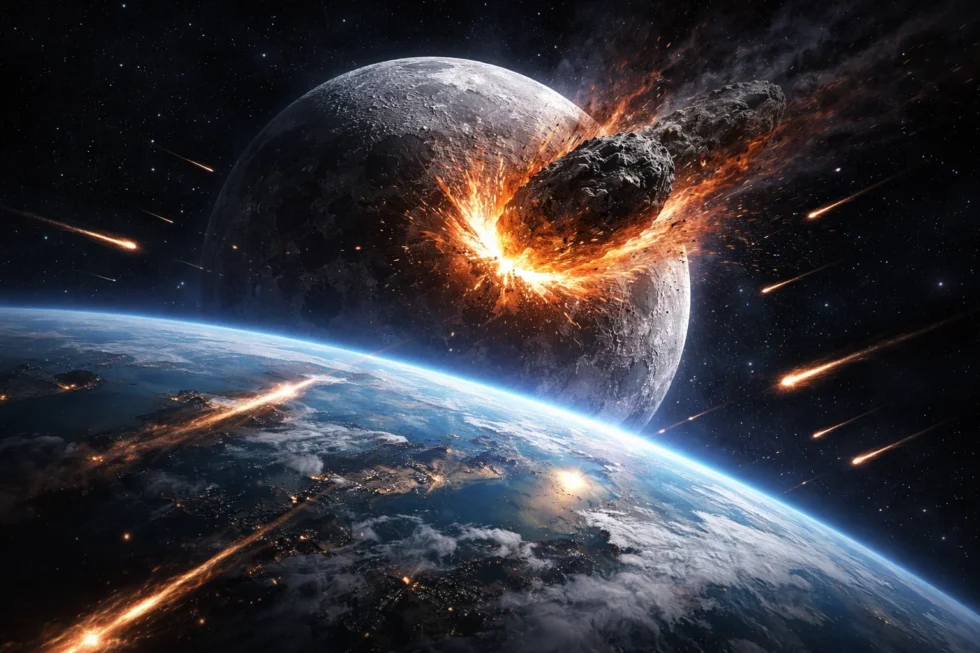
Asteroid 2024 YR4 — a rare asteroid impact could trigger the most energetic lunar event ever witnessed in human history, releasing energy equivalent to 6.5 megatons of TNT and potentially sending meteor showers towards Earth, reports The WP Times.
According to recent simulations, asteroid 2024 YR4 has a small but significant chance of colliding with the Moon on 22 December 2032, an event scientists say would produce a kilometre-wide crater, trigger a global moonquake and eject debris capable of reaching Earth’s atmosphere. The asteroid, estimated to be around 60 metres in diameter, was first detected in late 2024 and initially raised concerns over a possible Earth impact. Follow-up observations have since ruled out a direct collision with Earth, but attention has shifted to the Moon, where the probability of impact is currently estimated at around 4 percent.
If the collision occurs, researchers say the kinetic energy released would be comparable to that of a medium-scale thermonuclear explosion, making it the most powerful lunar impact ever observed in the modern scientific era. Modelling suggests the strike would carve out a crater roughly one kilometre wide and up to 260 metres deep, with a pool of molten rock forming at the centre of the impact site.
The force of the collision is expected to generate a magnitude-5 moonquake, strong enough to propagate across the lunar surface. Such a seismic event would be detected by current and upcoming lunar seismometers, offering scientists a rare opportunity to study the Moon’s internal structure without relying on artificial impacts. Astronomers also warn that the explosion would eject vast quantities of lunar material into space. Simulations indicate that up to 400 kilograms of debris could survive entry through Earth’s atmosphere, producing intense meteor showers visible to the naked eye — particularly over South America, North Africa and the Arabian Peninsula.
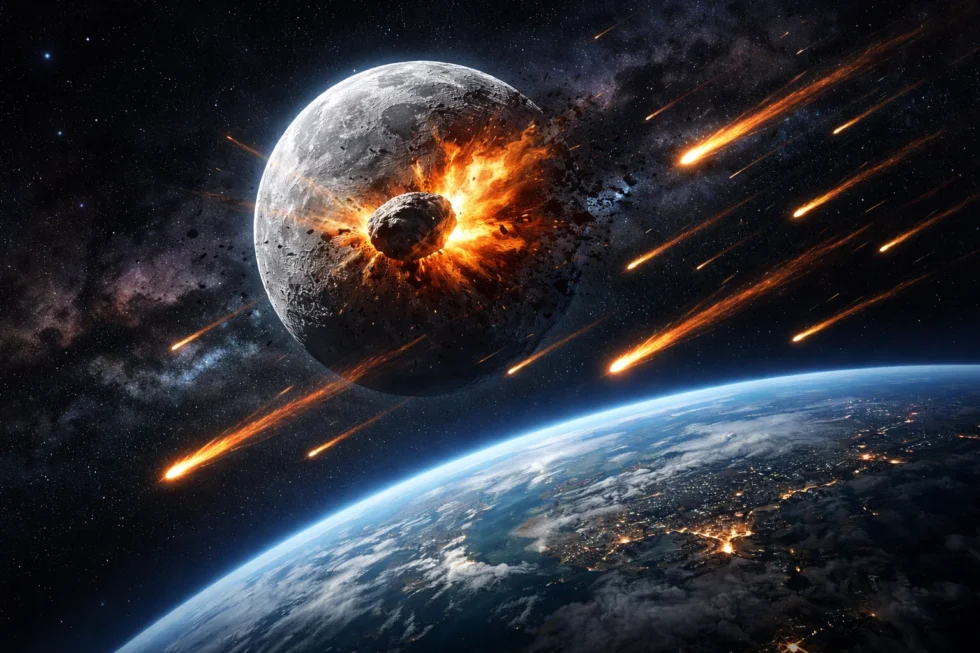
At peak activity, scientists estimate as many as 20 million meteors per hour, accompanied by hundreds of brighter fireballs. While most fragments would burn up harmlessly, researchers caution that the greater risk may lie in orbit, where high-velocity debris could threaten satellites and increase the likelihood of a cascading collision scenario known as Kessler syndrome.
Despite the potential hazards, scientists describe the event as a once-in-a-generation research opportunity. Infrared and space-based observatories could track molten lunar material for days after the impact, providing unprecedented real-time data on crater formation and high-energy planetary collisions. Space agencies are now assessing whether a deflection mission would be justified. For now, researchers stress that the probability of impact remains low — but not negligible — and that continued monitoring of asteroid 2024 YR4 will be critical in the years ahead.
Read about the life of Westminster and Pimlico district, London and the world. 24/7 news with fresh and useful updates on culture, business, technology and city life: What Britons will see in the night sky in 2026: eclipse, supermoons and meteor storms