
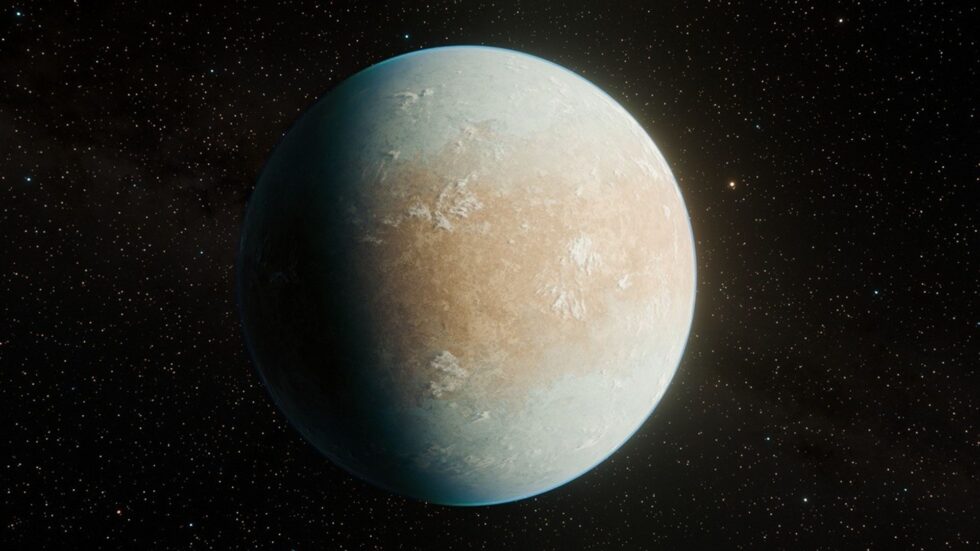
Astronomers have identified a new Earth-sized planet candidate, HD 137010 b, as one of the nearest and most promising long-period worlds suitable for detailed follow-up studies, based on archived data from NASA’s Kepler/K2 mission. Although early climate models suggest the planet may be closer to a frozen, Mars-like world than a true Earth analogue, its year-long orbit places it near the outer boundary of the habitable zone — a region where liquid water could exist under the right atmospheric conditions, reports The WP Times.
The planet lies around 146 light-years from Earth and appears to orbit its host star roughly every 355 days, a timescale remarkably similar to Earth’s year. Such long-period, Earth-like orbits are notoriously difficult to detect using the transit method. What elevates HD 137010 b beyond a routine catalogue entry is that its host star is relatively bright and nearby by exoplanet standards, raising the prospect that future telescopes could test whether the planet has an atmosphere — and, in theory, whether liquid water might exist under suitable conditions.
The basics: what astronomers think they’ve found
The object is designated HD 137010 b and is currently classified as a planet candidate, not yet a confirmed planet. The signal is based on a single observed transit — one passage of the planet across its star, producing a small but statistically significant dip in starlight. NASA refers to it as a “cold Earth” candidate: likely rocky, close to Earth in size, and orbiting a K-type dwarf star that is cooler and dimmer than the Sun. Key parameters reported by the research team and summarised by NASA include:
- Distance: ~146 light-years
- Estimated orbital period: ~355 days (with uncertainty)
- Transit duration: ~10 hours (Earth’s would be ~13 hours from the same geometry)
- Stellar energy received: ~0.29× that of Earth
- Planet size: approximately Earth-sized (~1.06 Earth radii, with uncertainty)
This combination — Earth-like size, Earth-like year and a star bright enough for follow-up — is exactly what astronomers look for when identifying worlds that could eventually be characterised, not just detected.
“Potentially habitable” does not mean “habitable”
The term “potentially habitable” is often misunderstood. In astronomical usage, it refers to a planet’s position relative to the habitable zone — the region around a star where liquid water could exist on a planet’s surface if the atmosphere is right.
In the case of HD 137010 b, models place it near the outer edge of that zone. NASA cautions that the planet receives less than a third of the energy Earth does, meaning surface conditions could be extremely cold without substantial greenhouse warming. Some estimates suggest maximum surface temperatures of around −68°C, comparable to Mars’ average of roughly −65°C. That proximity underlines why the label “habitable zone” is a scientific classification rather than a promise of life-friendly conditions.
Why one transit still matters
Most confirmed exoplanets detected by the transit method rely on multiple repeated dips in brightness. HD 137010 b, by contrast, was identified from a single transit event recorded during the Kepler K2 mission in 2017.
The research team reports that the signal was shallow but high in signal-to-noise, and that additional checks — including imaging and archival data — support a planetary interpretation. Even so, they stress that confirmation will require further observations, as single-transit signals can occasionally be mimicked by other astrophysical phenomena. NASA’s Discovery Alert highlights the challenge: with a roughly one-year orbit, transits are rare, making follow-up observations a matter of careful planning and patience.
Earth, Mars and HD 137010 b — a quick comparison
| Metric | Earth | Mars | HD 137010 b (candidate) |
|---|---|---|---|
| Year length (days) | 365 | 687 | ~355 |
| Average surface temperature | ~15°C | ~−65°C | up to ~−68°C (estimate) |
| Stellar energy received | 1.0× | ~0.43× | ~0.29× |
| Status | Confirmed planet | Confirmed planet | Candidate (single transit) |
| What “habitability” requires | Stable liquid water | Major engineering | Thick warming atmosphere (hypothetical) |
Why scientists are still excited
Cold does not automatically mean irrelevant in planetary science. Researchers note that a denser, CO₂-rich atmospherecould, in theory, trap enough heat to raise surface temperatures. Modelling assigns non-negligible probabilities to the planet sitting within conservative or optimistic definitions of the habitable zone, while also acknowledging a real chance it lies beyond it.
Equally important is accessibility. The host star’s brightness makes HD 137010 b one of the more practical long-period candidates for atmospheric study, compared with many Earth-sized planets found much farther away.
What comes next is likely to be slow and technically demanding. Astronomers first need to confirm that HD 137010 b is a genuine planet rather than a false positive, which will require observing another transit or securing corroborating evidence through alternative detection methods. Because the planet’s orbit appears to be close to one Earth year, opportunities for repeat observations are rare and difficult to predict. NASA has indicated that future monitoring could involve missions such as TESS or the European Space Agency’s CHEOPS, but even with modern instruments, confirmation may take several years.
If the planet is confirmed, attention will then shift to its physical nature. Scientists will seek to determine whether HD 137010 b is truly rocky and whether it can retain an atmosphere capable of producing sufficient greenhouse warming. Without atmospheric data, habitability remains hypothetical. Any progress on this front is expected to come gradually, through carefully planned follow-up observations and the next generation of high-precision instruments rather than rapid breakthroughs.
HD 137010 b: is the “potentially habitable” planet really Earth-like
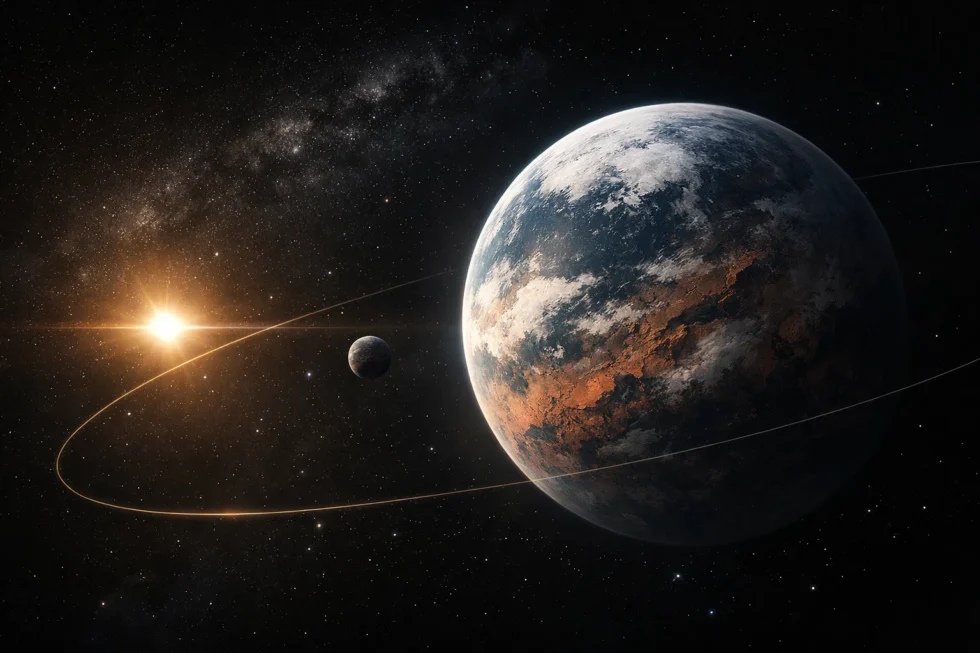
Astronomers have drawn attention to HD 137010 b after NASA highlighted it as a rare Earth-sized planet candidate with a near one-year orbit. While headlines often frame it as “potentially habitable”, scientists stress that the label reflects orbital geometry rather than proven surface conditions. Here is what is actually known — and what remains uncertain — about this distant world.
Is HD 137010 b another Earth?
No. Although HD 137010 b is close to Earth in size and has an Earth-like orbital period of about one year, current models suggest it receives far less stellar energy than Earth. Without a thick, heat-trapping atmosphere, the planet would likely be extremely cold. It also remains a planet candidate rather than a confirmed world.
Why do astronomers call it “potentially habitable” if it may be frozen?
In astronomy, “potentially habitable” refers to a planet’s position within or near the habitable zone — the region where liquid water could exist if the planet has a suitable atmosphere. HD 137010 b appears to sit near the outer edge of this zone, meaning habitability depends heavily on atmospheric composition, not just distance alone.
How was HD 137010 b detected?
The candidate was identified through a single, high-quality transit event lasting roughly 10 hours in archived data from NASA’s Kepler K2 mission. The transit caused a subtle dip in the star’s brightness, consistent with an Earth-sized planet passing in front of it.
What is needed to confirm HD 137010 b?
Astronomers must observe another transit or obtain supporting evidence using other detection methods. Because the planet’s orbit is close to one year, follow-up observations are difficult and may require long-term monitoring by missions such as TESS or ESA’s CHEOPS.
Read about the life of Westminster and Pimlico district, London and the world. 24/7 news with fresh and useful updates on culture, business, technology and city life: Could asteroid 2024 YR4 hit the Moon in 2032 and send meteor showers towards Earth
Image credit: NASA