
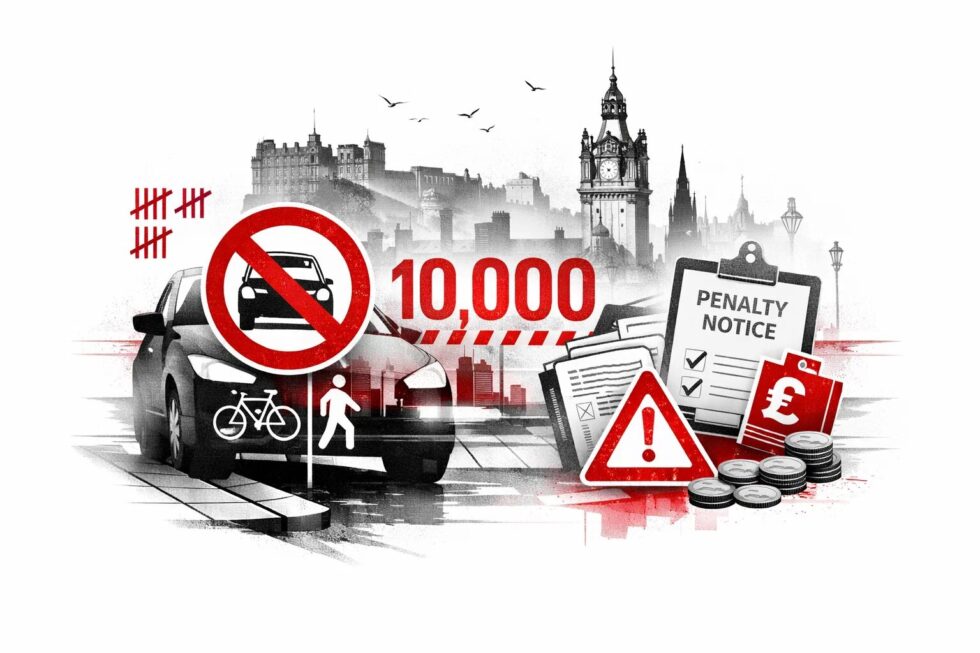
Nearly 10,000 drivers in Edinburgh have been penalised since the introduction of Scotland’s first citywide pavement parking ban two years ago, reflecting a significant shift in local driving and parking behaviour. The City of Edinburgh Council reported that 9,467 Penalty Charge Notices (PCNs) have been issued since enforcement began on January 29, 2024, covering offences such as pavement parking, parking across dropped kerbs, and double parking. The council highlighted that the measures are intended to improve pedestrian safety, particularly for people with disabilities, parents with prams, and individuals with visual impairments. The WP Times reports, with supporting information from the City of Edinburgh Council.
Overview of Edinburgh’s pavement parking ban
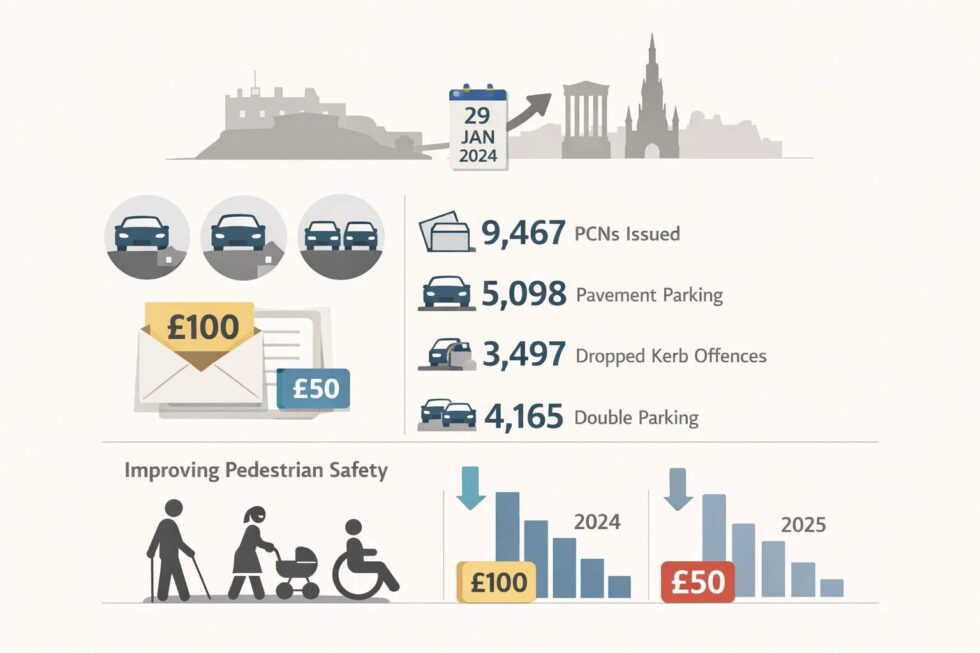
The ban, introduced on January 29, 2024, makes it illegal to park vehicles on pavements, across dropped kerbs, or in a manner that blocks pedestrian access. Edinburgh, alongside London, is one of only two cities in the UK to enforce a citywide prohibition on pavement parking. Drivers found in violation can be issued a £100 fine, reduced to £50 if paid within 14 days.
Council officials emphasised that the ban is part of a broader strategy to ensure streets remain safe and accessible. “We introduced these changes to provide a safe environment for everyone, particularly those with mobility challenges,” said Councillor Stephen Jenkinson, Transport and Environment Convener.
Penalty statistics since enforcement began
According to the council’s records:
| Offence Type | 2024 | 2025 | Total |
|---|---|---|---|
| Pavement parking | 5,098 | 4,369 | 9,467 |
| Dropped kerb violations | 1,765 | 1,732 | 3,497 |
| Double parking | 2,123 | 2,042 | 4,165 |
The data indicates a gradual decline in fines, particularly for pavement parking, suggesting drivers are adapting to the new regulations. Enforcement in 2024 recorded 5,098 PCNs for pavement parking, decreasing to 4,369 in 2025—a reduction of more than 700 notices year-on-year.
Impact on driving behaviour
Council analysis shows the ban has influenced local driving and parking practices. Streets previously affected by obstructive parking have experienced fewer incidents, allowing safer pedestrian passage. Drivers are reportedly seeking alternative parking solutions, including legal on-street bays and designated off-street parking facilities.
Councillor Jenkinson stated: “While our ultimate goal is zero fines, the consistent downward trend demonstrates compliance is improving. Residents and motorists are adjusting their habits to accommodate safer pedestrian access.”
Legal framework and payment options
The City of Edinburgh Council enforces pavement parking regulations under its Traffic Regulation Orders (TROs). Violations can result in:
- £100 PCN for pavement or dropped kerb parking
- £50 discounted PCN if paid within 14 days
- Appeals can be submitted within 28 days via the council’s website at www.edinburgh.gov.uk/pcn
Drivers are encouraged to check local signage before parking, particularly in residential areas where dropped kerbs are common. Guidance on contesting PCNs and required evidence, such as photographs, is available on the council portal.
Regional differences and comparison
Edinburgh’s comprehensive ban is unique in Scotland. London similarly enforces citywide restrictions, while other UK cities, including Glasgow and Manchester, have limited or no formal prohibitions. Key differences include:
| City | Coverage | Fine amount | Payment discount |
|---|---|---|---|
| Edinburgh | Entire city | £100 | £50 within 14 days |
| London | Entire city | £130 | £65 within 14 days |
| Glasgow | Select streets | £60-£100 | 50% discount early payment |
| Manchester | Select zones | £60-£80 | 50% discount early payment |
The comparison indicates Edinburgh and London offer the most stringent enforcement and highest penalty levels, reflecting a stronger commitment to pedestrian safety and accessibility.
Steps for drivers to comply
To avoid fines, motorists are advised to follow these steps:
- Check signage before parking; pay attention to pavement and kerb markings.
- Use designated parking bays or off-street car parks where available.
- Avoid dropped kerbs to maintain pedestrian and wheelchair access.
- Pay PCNs promptly to receive the reduced fee if applicable.
- Submit appeals within 28 days with evidence if you believe a PCN is incorrect.
These measures help ensure legal compliance and prevent unnecessary penalties.

Enforcement and monitoring mechanisms
Edinburgh Council employs Traffic Wardens and mobile CCTV units to monitor compliance. Enforcement is carried out on both scheduled patrols and reports from residents. Data collected is used to identify problem areas and allocate resources effectively.
The council also monitors trends in fine issuance to determine if additional measures, such as road redesigns or increased signage, are required.
Broader implications for public safety
The ban has had notable effects on pedestrian safety. Parents with prams, wheelchair users, and visually impaired individuals can navigate pavements with reduced obstruction. Emergency services and delivery vehicles also report improved access in residential streets.
Officials note that these measures are not intended to punish drivers but to enhance accessibility and reduce risks for vulnerable pedestrians.
Public resources and information
Citizens seeking guidance or wishing to report violations can access:
- City of Edinburgh Council Parking Portal: www.edinburgh.gov.uk/parking
- PCN appeals and payment: www.edinburgh.gov.uk/pcn
- Local ward contact: Traffic and environment teams can be contacted via 0131 529 3030
Regular updates on regulations, penalties, and changes to enforcement schedules are published on the council website.
Future plans and projections
Council officials have indicated that enforcement will continue, with the long-term objective of reducing fines to zero. Planned initiatives include:
- Expanding public awareness campaigns
- Increased monitoring of streets with high historic violation rates
- Reviewing parking infrastructure to provide more compliant spaces
These measures are intended to maintain progress while accommodating Edinburgh’s growing population and traffic volume.
For Edinburgh residents, the ban means adapting to stricter parking rules and using alternative parking solutions. Motorists need to be aware of local signage, potential fines, and proper channels for dispute resolution. Pedestrians, particularly vulnerable groups, can now access pavements more safely, while overall street accessibility has improved.
Read about the life of Westminster and Pimlico district, London and the world. 24/7 news with fresh and useful updates on culture, business, technology and city life: What is known about police using AI chatbots to handle non-emergency calls in the UK