
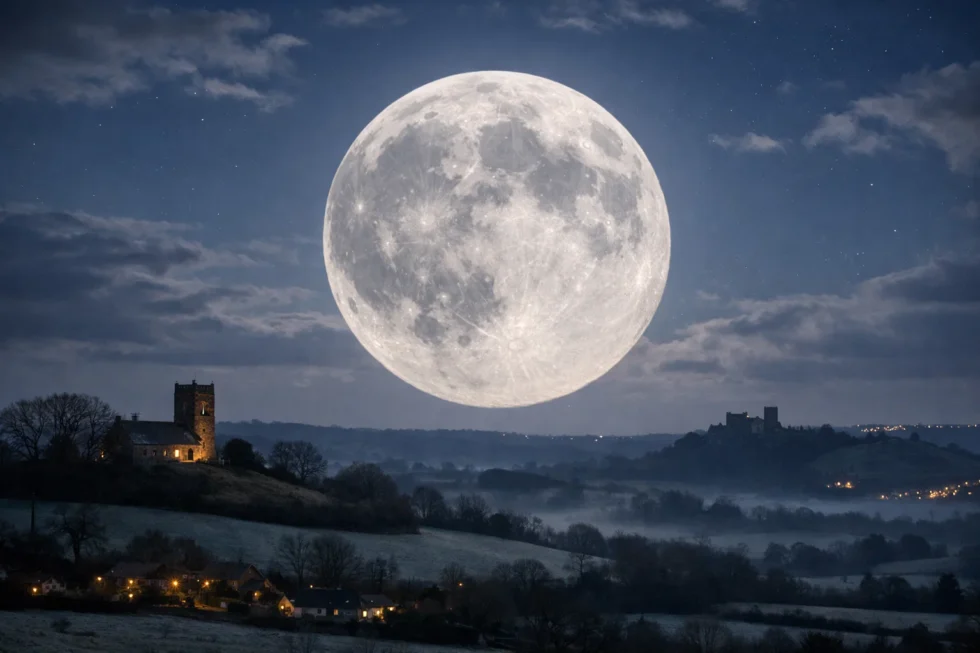
The full Snow Moon will rise over the UK on Sunday, 1 February 2026, marking the second full moon of the year and the final full moon of meteorological winter, according to astronomical data reviewed by the Renewz editorial team. Precise lunar calculations show that the Moon reaches its exact full phase at 10:09 GMT, a moment when it remains below the horizon for Britain. By the time of moonrise later that afternoon, the Snow Moon will already appear fully illuminated, dominating the night sky across the UK until dawn, weather permitting, reports The WP Times.
For observers across the UK, this timing creates favourable conditions. Unlike some full moons that peak in the early hours or daylight, the Snow Moon of February 2026 will be visible throughout the entire evening and night, weather permitting. Its appearance coincides with a particularly striking astronomical detail: a close visual alignment with the Beehive Cluster, one of the brightest and most historically significant star clusters visible from Earth.
This combination makes the February full moon not only a seasonal marker, but also a notable sky event for both casual stargazers and experienced observers.
When to see the full Snow Moon in the UK
The best time to observe the full Snow Moon in the UK is shortly after sunset on Sunday, 1 February 2026, when the Moon rises low in the eastern sky. At this stage, the Moon often appears larger and warmer in colour, taking on noticeable orange or amber tones.
This effect is purely optical. As the Moon sits close to the horizon, Earth’s atmosphere scatters shorter blue wavelengths of light, allowing longer red and orange wavelengths to dominate. The result is the well-known Moon illusion, which makes the Snow Moon appear unusually large and vividly coloured, despite no change in its actual size.
When to see the full Snow Moon in the UK
The best time to observe the full Snow Moon in the UK is shortly after sunset on Sunday, 1 February 2026, when the Moon rises low in the eastern sky. At this stage, the Moon often appears larger and warmer in colour, taking on noticeable orange or amber tones.
This effect is purely optical. As the Moon sits close to the horizon, Earth’s atmosphere scatters shorter blue wavelengths of light, allowing longer red and orange wavelengths to dominate. The result is the well-known Moon illusion, which makes the Snow Moon appear unusually large and vividly coloured, despite no change in its actual size.
Snow Moon moonrise and moonset times across the UK
Approximate moonrise and moonset times on the night of 1–2 February 2026 are as follows:
- London: moonrise 16:13 GMT / moonset 08:06 GMT
- Birmingham: moonrise 16:08 GMT / moonset 08:00 GMT
- Manchester: moonrise 16:03 GMT / moonset 07:54 GMT
- Edinburgh: moonrise 15:48 GMT / moonset 07:35 GMT
- Belfast: moonrise 16:10 GMT / moonset 08:02 GMT
Viewing times may vary slightly depending on exact location, local elevation, and horizon obstructions such as buildings, hills or trees. For the clearest view of the Snow Moon at moonrise, observers are advised to choose an open area with an unobstructed eastern or south-eastern horizon.
Where in the sky to look
On the evening of 1 February, the Snow Moon will be positioned in the constellation Leo, one of the most recognisable constellations of the winter and early spring sky. Leo is associated with the shape of a crouching lion and is easiest to identify by its bright leading star, Regulus, which will appear close to the Moon throughout the night. Just above the Moon’s position will lie the Beehive Cluster, also catalogued as M44 or NGC 2632. Under dark skies, this cluster appears as a faint misty patch to the naked eye. With binoculars or a small telescope, it resolves into dozens of tightly packed stars, giving it its traditional “beehive” appearance.
Because the Moon will be at full brightness, the cluster may be difficult to see without optical aid. Even so, the proximity of the two objects creates a visually compelling alignment that adds depth and context to the lunar view.
The Beehive Cluster: what it is and why this alignment matters
The Beehive Cluster is one of the nearest and most prominent open star clusters to the Solar System, located around 577 light-years from Earth. Composed of several hundred stars held together by gravity, it has been observed and documented since antiquity, centuries before the invention of the telescope.
Early astronomers described the cluster as a faint, cloud-like patch in the night sky, and it later became a key reference object in the first stellar catalogues. Today, the Beehive Cluster remains a popular target for amateur astronomers due to its brightness, wide spread and ease of observation with binoculars or small telescopes.
Under normal conditions, star clusters are best viewed on moonless nights, when dark skies allow faint objects to stand out. What makes this particular event noteworthy is the visual contrast created by the nearby full Snow Moon. The intense lunar brightness set against the softer, diffuse glow of the Beehive Cluster offers a rare and intuitive demonstration of astronomical perspective, allowing even casual observers to see how objects separated by vast cosmic distances can appear closely aligned in the night sky.
Why February’s full moon is called the Snow Moon
The name Snow Moon comes from traditional lunar naming systems that long predate the modern calendar. In much of the northern hemisphere, February was historically the coldest and most difficult month of winter, marked by deep snowfall, frozen ground and limited access to food. The full moon of this period became closely associated with survival conditions rather than symbolism or folklore. Historical sources and later documentation by NASA show that February’s full moon has carried several alternative names across different cultures and regions, each reflecting environmental realities of late winter. These include:
- Hungry Moon, referring to food shortages as winter supplies ran low
- Storm Moon, linked to frequent snowstorms and harsh weather
- Candles Moon, used in parts of Europe to mark the gradual return of daylight
Across Indigenous cultures in North America, additional names such as Bear Moon, Eagle Moon and Goose Moon were used, drawing on animal behaviour, migration patterns and seasonal cycles. These names served a practical function, helping communities track time, plan hunting and prepare for changing conditions.
Taken together, these traditions show that lunar naming was once a tool for understanding the natural world, not simply a poetic convention. The Snow Moon remains a reminder of how closely human life was once tied to seasonal rhythms, weather patterns and the challenges of winter long before modern forecasting and artificial light.
Weather outlook and visibility across Britain
Early forecasts indicate variable cloud cover across the UK on Sunday evening, potentially affecting visibility of the full Snow Moon. Parts of England and Wales are likely to see more persistent cloud, while clearer conditions are more probable in:
- Northern Ireland
- western Scotland
- exposed coastal areas
Even in cloudier regions, short clear intervals around moonrise may provide brief but striking views as the Snow Moon rises above the horizon. These moments typically produce the strongest colour contrast and visual impact, particularly during the first 30–60 minutes after moonrise.
Full moon effects on sleep and wellbeing
Scientific research has found no confirmed direct physiological effects of a full moon on human health. However, surveys consistently show that some people experience lighter sleep, restlessness or increased alertness during full moon nights.
Sleep specialists recommend practical adjustments during bright lunar phases, including limiting caffeine intake in the afternoon, reducing screen exposure before bedtime, and using blackout curtains. In urban environments, where artificial light already disrupts circadian rhythms, additional moonlight can intensify sleep disturbance for sensitive individuals.
Practical tips for observing the Snow Moon
Observing the Snow Moon requires minimal preparation. February evenings are cold, so warm clothing is essential. Locations with an unobstructed eastern horizon offer the best viewing conditions at moonrise. For photography, a tripod, flash disabled, and manual or night mode settings help capture surface detail and colour. Unlike solar events, no eye protection is required when viewing the Moon.
What comes next in the lunar calendar
Key upcoming lunar events following the Snow Moon include:
- New Moon — 17 February 2026, bringing darker skies and an annular solar eclipse, visible only from Antarctica
- Full Moon — 3 March 2026, the Worm Moon, coinciding with a total lunar eclipse often described as a “blood moon”
The February 2026 full Snow Moon stands out for its timing at the end of winter, all-night visibility, and close visual alignment with the Beehive Cluster. Together, these factors make it one of the most visually distinctive and seasonally significant full moons of the year. Even a brief view at moonrise is enough to capture the transition from winter toward longer, brighter nights.
Read about the life of Westminster and Pimlico district, London and the world. 24/7 news with fresh and useful updates on culture, business, technology and city life: What is happening with M5 traffic today and why are delays still affecting Bristol and the airport