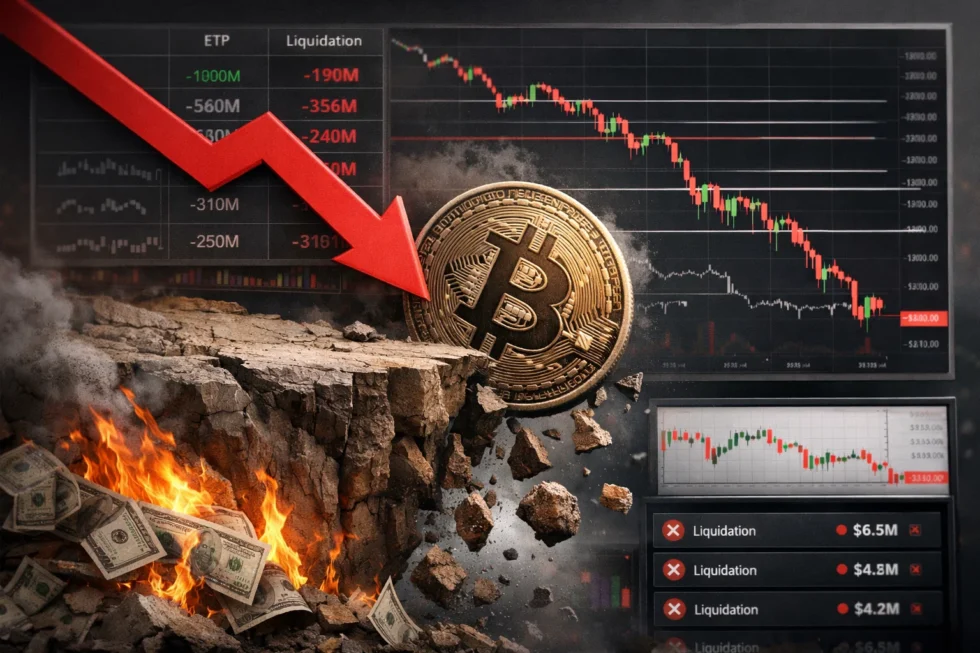
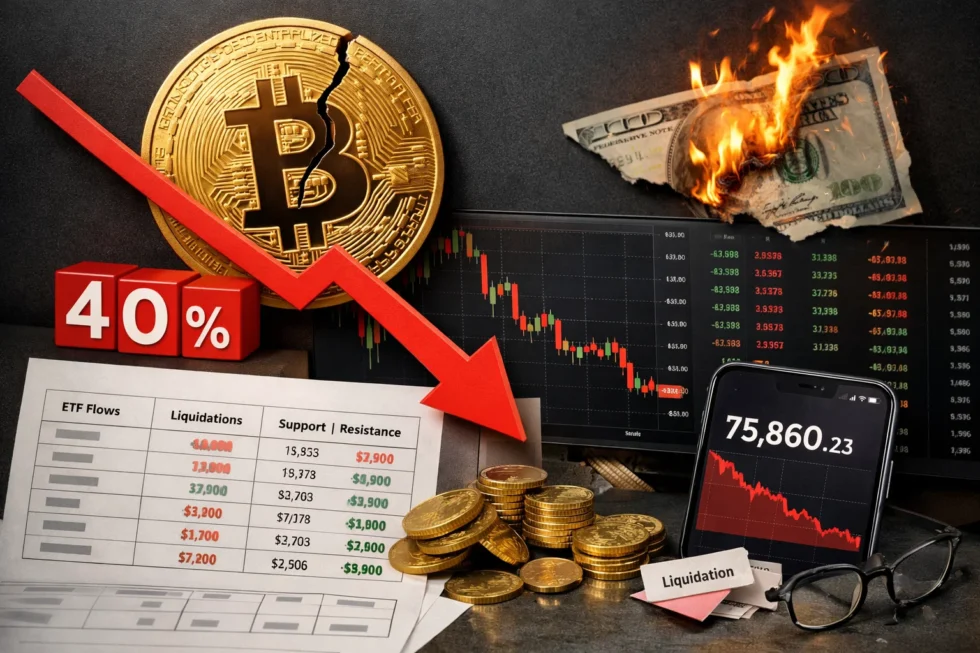
Bitcoin has extended its decline, slipping below $76,000 and marking its lowest level since April 2025, as a combination of macroeconomic pressure, tightening liquidity and rising investor risk aversion weighs on the cryptocurrency market, the Renewz editorial team notes. The move has erased nearly 40% of Bitcoin’s value from its all-time high, reached in November 2025, and has triggered one of the largest waves of liquidations seen so far this year, according to market data reviewed by The WP Times.
According to market data, Bitcoin fell as low as $75,600 in early trading on Monday before stabilising slightly. At current levels, the world’s largest cryptocurrency is down approximately 10–12% year to date, underperforming several traditional asset classes amid renewed strength in the US dollar and shifting expectations around US monetary policy.
A sharp correction after record highs
Bitcoin entered 2026 following a strong rally in the second half of 2025, when prices surged to a record high of above $126,000 in November. That rally was driven by a combination of institutional inflows, optimism around spot Bitcoin exchange-traded funds (ETFs), and expectations of looser global monetary conditions.
The current correction has reversed much of that momentum. From its peak, Bitcoin has now lost roughly $47,000 per coin, equivalent to a decline of around 37–38%. Market capitalisation has fallen accordingly, with Bitcoin’s total value dropping to approximately $1.6 trillion, down from more than $2.1 trillion at the peak. Despite the scale of the move, analysts note that such drawdowns are not unprecedented in Bitcoin’s history. Since its launch in 2009, the cryptocurrency has experienced multiple corrections exceeding 30%, even during longer-term bull cycles.
Stronger dollar and Federal Reserve uncertainty
One of the most significant drivers behind the latest sell-off has been renewed strength in the US dollar. The dollar index (DXY) rose in late January and early February following growing speculation that Kevin Warsh, a former Federal Reserve governor, could become the next chair of the US central bank.
Warsh is widely regarded by markets as more hawkish than his predecessor, Jerome Powell, and has previously argued for tighter monetary conditions and a reduction in excess liquidity. His potential nomination has fuelled expectations that interest rates could remain higher for longer, or that financial conditions could tighten further. Historically, periods of dollar strength have tended to weigh on Bitcoin and other risk-sensitive assets. A stronger dollar raises the opportunity cost of holding non-yielding assets and often leads investors to reduce exposure to speculative markets. Market strategists note that even modest shifts in interest-rate expectations can have outsized effects on cryptocurrencies, which remain highly sensitive to global liquidity conditions.
Liquidations amplify market moves
Beyond macroeconomic factors, technical dynamics have played a critical role in accelerating Bitcoin’s decline. Data from derivatives markets shows that more than $2 billion in leveraged crypto positions were liquidated over a 48-hour period as prices fell through key technical levels.
These liquidations occur when traders using borrowed funds are forced to close positions after losses exceed margin requirements. The effect can be self-reinforcing: falling prices trigger liquidations, which in turn add further selling pressure to the market.
Bitcoin’s drop below the psychologically important $80,000 level appears to have triggered a large number of stop-loss orders and algorithmic trades. Analysts now identify the $75,000–$72,000 range as a critical near-term support zone. A sustained break below this area could open the way to deeper declines, potentially towards $70,000.
ETF flows turn negative
Another important signal has come from the ETF market. After strong inflows in late 2025, spot Bitcoin ETFs recorded net outflows in January 2026, with estimates ranging from $1.5 billion to $1.7 billion for the month. These outflows suggest that some institutional investors have chosen to reduce exposure amid rising volatility and uncertain macroeconomic conditions. While ETF holdings remain substantial overall, the shift in flows has contributed to a more cautious market tone.
Analysts point out that ETF-driven demand was a major source of support during Bitcoin’s rally in 2024 and 2025. A slowdown or reversal in that demand removes an important pillar from the market’s underlying structure.
Broader crypto market under pressure
The weakness in Bitcoin has spilled over into the wider cryptocurrency market. Ethereum, the second-largest digital asset, fell to around $2,200, its lowest level in several months, and is now down more than 45% from its own 2025 high. Smaller cryptocurrencies have seen even steeper declines, with some tokens losing 50–70% of their value since late 2025. According to CoinMarketCap data, the total market capitalisation of all cryptocurrencies has fallen to approximately $2.7 trillion, down from over $3.8 trillion at the peak. Bitcoin’s dominance of the crypto market has increased slightly during the sell-off, reflecting a typical “risk-off” pattern in which investors retreat from smaller, more volatile assets into relatively established ones.
What experts are saying
Market participants remain divided over Bitcoin’s near-term outlook. Some analysts warn that further downside is possible if macroeconomic conditions continue to tighten. Veteran trader Peter Brandt has suggested that a sustained loss of key support levels could expose Bitcoin to a deeper correction, potentially toward the mid-$60,000 range, though he emphasises that such moves would still be consistent with past cycles.
Others take a more measured view. Analysts at CryptoQuant note that while short-term momentum has turned negative, long-term on-chain indicators show no signs of widespread capitulation among long-term holders. Wallet data suggests that a large proportion of Bitcoin supply has not moved during the recent decline, indicating that many investors are holding through the volatility. Michael Saylor, executive chairman of Strategy, one of the largest corporate holders of Bitcoin, has publicly reiterated his long-term stance, describing Bitcoin as a multi-decade asset rather than a short-term trade. His company holds more than 200,000 bitcoins, acquired at an average price well above current levels.
Investor sentiment shifts to caution
Sentiment indicators underline the change in market psychology. The widely followed Crypto Fear & Greed Index has moved into the “extreme fear” zone, a level typically associated with heightened volatility and defensive positioning. Historically, such sentiment extremes have sometimes coincided with medium-term market bottoms, but analysts caution that timing remains difficult, particularly in an environment shaped by external macroeconomic forces. Retail trading volumes have declined, while derivatives markets continue to show elevated activity, suggesting that professional and institutional players are dominating price action.
Long-term perspective
Despite the current downturn, Bitcoin remains one of the strongest-performing assets of the past decade. From prices measured in cents in its early years, the cryptocurrency has risen by an estimated nearly 600,000% since 2012, far outperforming traditional markets over the long term.
Supporters argue that adoption, limited supply, and growing institutional infrastructure continue to underpin Bitcoin’s investment case. Critics counter that its volatility and sensitivity to liquidity conditions make it unsuitable as a store of value during periods of monetary tightening. For now, Bitcoin’s trajectory appears closely tied to broader financial conditions. As long as interest-rate expectations remain elevated and the dollar stays strong, analysts expect volatility to persist.
Bitcoin price timeline: November 2025 – 3 February 2026 (USD)
Weekly and key-date overview
| Date | Market context | BTC price (USD) | Change vs ATH | Notes |
|---|---|---|---|---|
| 10 Nov 2025 | All-time high amid ETF inflows and risk-on sentiment | 126,000 | 0% | Record driven by institutional demand and derivatives leverage |
| 20 Nov 2025 | ETF inflows peak, momentum slows | 122,500 | −2.8% | Early signs of profit-taking |
| 30 Nov 2025 | Month-end rebalancing | 118,000 | −6.3% | Volatility increases, volumes decline |
| 15 Dec 2025 | Liquidity thins before year-end | 112,000 | −11.1% | Leverage begins to unwind |
| 31 Dec 2025 | Year-end tax selling and book-closing | 105,000 | −16.7% | First sustained move below $110k |
| 10 Jan 2026 | First notable ETF outflows | 98,500 | −21.8% | Shift in institutional positioning |
| 20 Jan 2026 | US dollar strengthens, yields edge higher | 92,000 | −27.0% | Macro pressure builds |
| 27 Jan 2026 | Fed leadership speculation intensifies | 85,000 | −32.5% | Support at $90k breaks |
| 1 Feb 2026 | Large-scale derivatives liquidations | 78,500 | −37.7% | Over $1bn liquidated in 24 hours |
| 2 Feb 2026 | Psychological $80k level decisively breached | 76,200 | −39.5% | Algorithmic selling accelerates |
| 3 Feb 2026 | Lowest level since April 2025 | 75,600 | −40.0% | Market stabilises marginally |
Performance summary for the period
| Metric | Value |
|---|---|
| Peak price (Nov 2025) | 126,000 USD |
| Price on 3 Feb 2026 | 75,600 USD |
| Absolute decline | −50,400 USD |
| Percentage drawdown | ~40% |
| Trading range (Nov–Feb) | 75,600 – 126,000 USD |
| Bitcoin market capitalisation (ATH) | ~2.1 trillion USD |
| Bitcoin market capitalisation (3 Feb) | ~1.6 trillion USD |
| Year-to-date performance (2026) | −10% to −12% |
Liquidity and derivatives impact
| Indicator | Estimated value |
|---|---|
| Total crypto liquidations (Jan–early Feb) | >2.0 billion USD |
| Largest 24-hour liquidation event | ~1.1 billion USD |
| Share of liquidations in BTC pairs | ~45% |
| Leverage reduction vs Nov peak | −30% to −35% |
ETF and institutional flows
| Indicator | Data |
|---|---|
| Net spot Bitcoin ETF flows (Jan 2026) | −1.5 to −1.7 billion USD |
| ETF trend | Shift from inflows to net redemptions |
| Institutional positioning | Defensive, reduced leverage |
| Corporate BTC holders | Holdings largely unchanged |
Key technical levels (as of 3 February 2026)
| Level type | Price (USD) | Significance |
|---|---|---|
| Immediate resistance | 80,000 | Former support, now resistance |
| Short-term support | 75,000 | Tested multiple times |
| Secondary support | 72,000 | Volume-node from Q2 2025 |
| Major support zone | 68,000–70,000 | Long-term trend support |
| Downside risk level (bear case) | ~65,000 | Cycle retracement scenario |
Bitcoin’s downturn follows a classic post-peak pattern amid tighter liquidity
From a market-structure standpoint, Bitcoin’s decline between November and early February bears the hallmarks of a post-peak correction, rather than a single event-driven shock. After reaching record highs in late 2025, the market entered a phase in which momentum weakened and liquidity conditions tightened, exposing the extent of leveraged positioning built up during the rally.
Several factors converged over the period. A strengthening US dollar, driven by shifting expectations around US monetary policy, reduced demand for risk-sensitive assets. At the same time, liquidity expectations deteriorated as investors reassessed the Federal Reserve’s policy trajectory, increasing the cost of capital across financial markets. Spot Bitcoin ETFs, which had absorbed significant inflows during the rally, recorded net outflows as volatility rose, removing a key source of marginal demand. These pressures were compounded by the forced unwinding of leveraged positions, particularly in derivatives markets, which amplified price movements once key technical levels were breached.
Market analysts note that similar drawdowns have occurred in previous Bitcoin cycles, notably in 2017–2018 and 2021–2022, when sharp corrections followed periods of rapid appreciation. The difference in the current cycle lies in scale and structure: absolute price levels are significantly higher, institutional participation is deeper, and exposure via regulated products such as ETFs is far greater. As a result, price moves now tend to reflect not only retail sentiment but also broader shifts in global liquidity and risk appetite.
Read about the life of Westminster and Pimlico district, London and the world. 24/7 news with fresh and useful updates on culture, business, technology and city life: Silver Price Today Surges and Falls: Latest Updates on Gold, Platinum, and Market Trends