

Russia has unveiled a modernised air-delivered glide bomb designated UMPB-5, according to information that has emerged in recent days from open-source monitoring and defence analysts. The munition appears to represent an evolutionary upgrade of Russia’s existing UMPK glide-bomb kits, with a primary focus on extending strike range rather than introducing a fundamentally new guidance or payload architecture. The development was first reported by The WP Times, citing analysis published by Defence Blog.
What the UMPB-5 is
The UMPB-5 is assessed to be a modular glide-bomb conversion system intended to transform standard unguided, free-fall aerial bombs into guided, stand-off munitions. Systems of this type have become a core component of Russia’s air-strike doctrine, allowing tactical aircraft to conduct attacks from launch points positioned outside the effective engagement envelope of a portion of Ukraine’s air-defence assets, including short- and medium-range systems.
Unlike purpose-built cruise missiles, glide-bomb conversion kits such as the UMPB-5 rely on aerodynamic lift and satellite-assisted navigation rather than onboard propulsion, enabling relatively low-cost mass deployment while significantly extending strike distance compared with traditional gravity bombs.
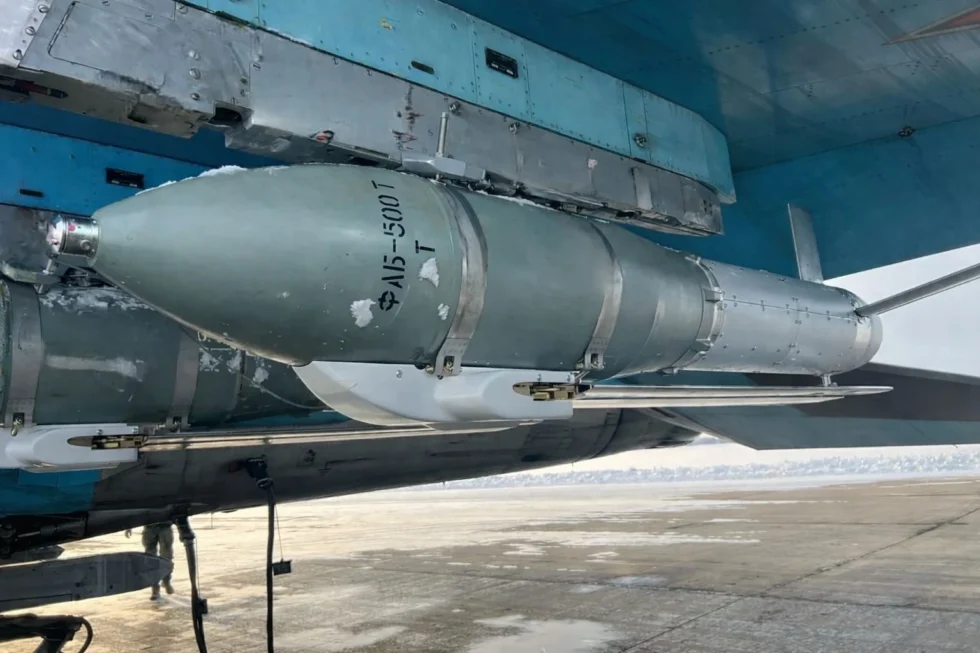
Open-source imagery and video material circulating since late January indicate that the UMPB-5 is structurally and conceptually derived from earlier UMPK-series designs, sharing a comparable modular layout, attachment points and guidance housing. This suggests that the UMPB-5 represents an incremental, evolutionary upgrade focused on range and glide efficiency, rather than the introduction of a new weapons class or a departure from Russia’s existing glide-bomb architecture. Such continuity indicates that the UMPB-5 is designed to be compatible with existing bomb stocks and aircraft integration procedures, minimising the need for changes to production lines, logistics chains or pilot training while improving stand-off performance.
Aerodynamic design changes and glide-range optimisation
The most significant updates to the UMPB-5 appear to be concentrated in its aerodynamic configuration, rather than in propulsion or guidance architecture. Analysis of available imagery suggests a revised airframe profile combined with an enlarged or reconfigured deployable wing assembly, designed to increase lift-to-drag ratio after release from the carrier aircraft.
These aerodynamic refinements are intended to extend horizontal glide distance by improving energy retention during unpowered flight. Rather than increasing speed, the design focuses on maintaining altitude and glide efficiency over longer distances. There is currently no open-source indication of changes to the warhead, internal bomb casing, or primary control surfaces, supporting the assessment that the upgrade prioritises range optimisation within an existing structural framework.
Guidance and navigation architecture
According to Ukrainian military assessments, the UMPB-5 retains the guidance and navigation architecture used in earlier UMPK-based glide-bomb systems. This architecture combines inertial navigation with satellite-assisted correction, allowing the munition to follow a pre-programmed flight path toward fixed coordinates after release.
The guidance package is commonly associated with modules referred to as SMART and Kometa-M12, which provide mid-course correction when satellite navigation signals are available. Such systems are optimised for strikes against stationary or pre-surveyed targets, rather than mobile assets, and are assessed to offer limited resistance to electronic warfare interference. Ukrainian sources describe the resulting accuracy as “acceptable” under conditions where satellite navigation remains uninterrupted.
Engine-assisted variant UMPB-5R and extended strike range
Open-source references also mention a potential engine-assisted modification, designated UMPB-5R. Ukrainian analysts suggest that this variant may incorporate a compact turbojet engine manufactured by SWIWIN. If such a configuration exists, the addition of a propulsion unit would allow the munition to sustain powered flight after release, reducing its dependence on initial altitude and glide efficiency alone. Open-source estimates indicate that this could increase maximum strike range to up to 200 kilometres, depending on launch parameters such as aircraft speed, release altitude and flight profile. At present, however, there is no independent confirmation that the UMPB-5R has entered serial production or operational deployment, and assessments of its capabilities remain provisional.
Range increase without propulsion
Even in its unpowered configuration, the UMPB-5 is assessed to offer a notable improvement in stand-off range. Russian-language monitoring channels, including the outlet Polkovnyk HSh, estimate that aerodynamic refinements alone add approximately 40–50 kilometres to effective range. Under favourable launch conditions, the unpowered version is therefore believed to be capable of striking targets at distances of up to 160 kilometres.
Expected operational use
The UMPB-5 is expected to be deployed from tactical aircraft such as the Su-34, operating either from within Russian airspace or over occupied territories. The extended stand-off distance allows launch platforms to remain farther from frontline air-defence systems while still engaging targets deeper inside Ukraine. Its modular design also simplifies logistics, enabling older stocks of unguided bombs to be converted into guided weapons without requiring entirely new production lines.
Related security developments
Separately, Russian authorities in the Belgorod region recently confirmed the discovery of a crater consistent with the impact of a FAB-500 aerial bomb. The incident became public on 21 January, when the regional governor acknowledged the find without providing further details on how the munition was released. In Ukraine, the Security Service of Ukraine (SBU) reported dismantling a Russian military intelligence network in Odesa. According to the agency, two individuals were detained on suspicion of preparing drone-based attacks using a civilian quadcopter adapted to carry an explosive payload.
Read about the life of Westminster and Pimlico district, London and the world. 24/7 news with fresh and useful updates on culture, business, technology and city life: Horizon Hunters Gathering: what PlayStation has confirmed so far — and why the reveal is dividing fans