
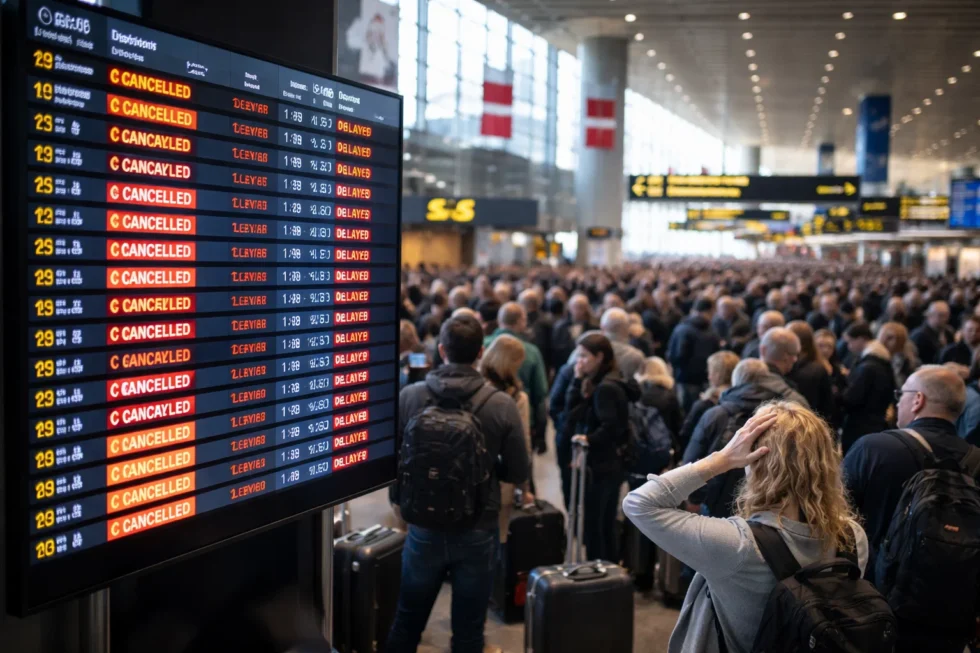
Copenhagen flight disruption became the focal point of a major Europe-wide aviation breakdown on Wednesday, 12 February 2026, as airlines delayed 1,362 flights and cancelled 56 services, leaving thousands of passengers stranded across Spain, France, Germany, the Netherlands, the United Kingdom, Denmark, Italy and Switzerland. This is reported by The WP Times, citing airport authorities, airline statements and aviation monitoring data.
According to industry tracking data and official airport updates published on 12 February 2026, sustained operational pressure built throughout the day at several of Europe’s busiest hubs — including Madrid, Amsterdam, Paris, London Heathrow, Frankfurt and Copenhagen Airport — triggering widespread missed connections, rolling delays and large-scale rebooking across international and domestic routes. Travellers reported missed connections, extended queues at transfer desks and repeated schedule changes as network carriers struggled to restore operational stability. Copenhagen Airport, a critical Northern European hub, recorded 117 delays and two cancellations, placing it among the ten most disrupted airports in Europe during the reporting period.
Scale of the disruption across Europe
By mid-morning, aviation monitors confirmed disruption across ten major airports, with Spain and the Netherlands bearing the heaviest volume impact, while Denmark and the UK faced significant knock-on effects through hub-and-spoke networks.
Most affected airports today
| Airport | Delays | Cancellations |
|---|---|---|
| Madrid Barajas | 249 | 14 |
| Amsterdam Schiphol | 236 | 12 |
| Paris Charles de Gaulle | 158 | 13 |
| Frankfurt am Main | 127 | 3 |
| Copenhagen Airport | 117 | 2 |
| Paris Orly | 109 | 2 |
| London Heathrow | 105 | 6 |
| Barcelona | 101 | 1 |
| Zurich | 82 | 1 |
| Rome Fiumicino | 78 | 2 |
Madrid and Amsterdam together accounted for 485 delays and 26 cancellations, highlighting how congestion at a small number of hubs can cascade across the European network.
WWhy Copenhagen flight disruption matters
Copenhagen Airport plays a disproportionately strategic role in Europe’s aviation network, acting as the main interchange between Scandinavia, continental Europe and long-haul transatlantic routes. Its tightly scheduled “wave” structure means that even short delays quickly multiply: missed feeder flights from Norway, Sweden and Finland cascade into lost onward connections to Germany, France, the UK and beyond. When Copenhagen slows, the effects are felt far outside Denmark within hours.
Today’s disruption was driven primarily by Scandinavian Airlines (SAS), which recorded 38 delayed departures at the hub. While cancellations remained limited, repeated rolling delays proved more damaging than outright cancellations. Aircraft arrived late, crews timed out, and departure slots were missed during peak transfer windows, creating congestion across security, passport control and gate rotations. For a hub optimised for fast connections, this type of delay profile is especially disruptive, as it undermines minimum connection times and forces widespread rebooking across partner airlines and alliance networks.
Crucially, Copenhagen also functions as a buffer hub for Northern Europe during wider continental disruption. When pressure builds simultaneously at Madrid, Amsterdam and Paris, Copenhagen’s reduced recovery margin leaves fewer rerouting options for airlines and passengers alike — amplifying today’s Europe-wide impact rather than absorbing it.
Airlines most affected by today’s disruption
Several of Europe’s largest carriers recorded high delay volumes across multiple hubs, reflecting network-wide strain rather than isolated airport failures.
Airlines with the highest operational impact
- Iberia – 57 delays, 13 cancellations
- Air France – 108 delays, 13 cancellations
- KLM – 100+ delays, 6 cancellations
- Lufthansa – 60+ delays, 4 cancellations
- British Airways – 37 delays, 1 cancellation
- Scandinavian Airlines – 43 delays
- Vueling Airlines – 67 delays
- ITA Airways – 28 delays
Additional carriers including Ryanair, easyJet, Swiss, Virgin Atlantic, Emirates and TAP Air Portugal also reported operational delays.
Pressure points: transatlantic exposure
London Heathrow recorded 11 US-linked delays, the highest transatlantic exposure in Europe today. Zurich followed with seven US-related delays, underlining how long-haul schedules amplify disruption when European hubs fall behind. By contrast, Barcelona reported no US-linked delays despite more than 100 total delays, showing how network composition shapes disruption patterns.
Country-by-country impact snapshot
- Spain: Madrid and Barcelona combined for 350 delays and 15 cancellations, led by Iberia and Vueling
- France: Paris CDG and Orly together recorded 267 delays and 15 cancellations, dominated by Air France
- Germany: Frankfurt logged 127 delays and three cancellations, mainly involving Lufthansa
- Netherlands: Amsterdam recorded 236 delays and 12 cancellations, with KLM responsible for the majority
- United Kingdom: Heathrow saw 105 delays and six cancellations, largely affecting British Airways
- Denmark: Copenhagen Airport logged 117 delays and two cancellations, driven by SAS
- Italy: Rome Fiumicino recorded 78 delays and two cancellations, mainly linked to ITA Airways
- Switzerland: Zurich logged 82 delays and one cancellation, with Swiss operating 26 delayed flights
Read about the life of Westminster and Pimlico district, London and the world. 24/7 news with fresh and useful updates on culture, business, technology and city life: How to vote in Westminster London local elections 2026: deadlines and voter ID rules – full guide UK