

On Thursday, 7 May 2026, voters across all 32 London boroughs will head to the polls to elect over 1,800 local councillors who will shape municipal policy on housing, transport, and social care for the next four years. This election cycle marks the first full-scale borough contest since the permanent implementation of the Elections Act 2022, requiring every voter at a polling station to present a valid form of photo identification. Following a brief period of legislative uncertainty in early 2026, the UK government confirmed that all scheduled London contests will proceed as planned, affecting approximately 6 million eligible residents. The outcome is expected to serve as a critical barometer for national political sentiment mid-way through the parliamentary term. This is reported by The WP Times.
Voter Eligibility: Who Can Participate in the May 2026 Elections
To vote in the London borough council elections on 7 May 2026, residents must meet specific criteria regarding age, residency, and nationality. Unlike General Elections, the franchise for local government elections includes a broader range of international residents living within the capital.
Nationality and Residency Requirements
Eligible voters must be registered at an address in a London borough and be at least 18 years old on polling day. The nationality requirements are as follows:
- British and Irish Citizens: All are eligible to vote.
- Qualifying Commonwealth Citizens: Citizens of Commonwealth countries (including those from nations like India, Nigeria, and Canada) who have leave to enter or remain in the UK, or do not require such leave, are eligible.
- European Union (EU) Citizens: Eligibility depends on the date of residency. Citizens from Denmark, Luxembourg, Poland, Portugal, and Spain are eligible regardless of their arrival date. Citizens from other EU nations are eligible only if they were legally resident in the UK on or before 31 December 2020 and have remained resident without a break.
Mandatory Photo ID: Valid Documents and the "Voter Authority Certificate"
For the 2026 local elections, the "Voter ID" requirement is strictly enforced. Voters who arrive at a polling station without an accepted form of physical photo identification will be turned away and unable to cast their ballot.
Accepted Forms of Identification
The Electoral Commission accepts a range of documents. The ID does not need to be "in date" as long as the photograph remains a true likeness of the voter.
- Passports: Issued by the UK, Channel Islands, Isle of Man, British Overseas Territories, EEA states, or Commonwealth countries.
- Driving Licences: Full or provisional licences issued by the UK, EU, Norway, Iceland, Liechtenstein, the Isle of Man, or any of the Channel Islands.
- Local Travel Passes: The 60+ London Oyster Photocard, Freedom Pass, and Older Person’s Bus Pass are all accepted.
- Other: Biometric Immigration Documents (BRP), Blue Badges, and National Identity Cards issued by EEA states.
What to do if you lack Photo ID
Residents who do not possess any of the accepted documents can apply for a Voter Authority Certificate (VAC). This is a free document issued specifically for the purpose of voting.
- Application Deadline: The deadline to apply for a VAC for the 7 May election is 5:00 PM on Tuesday, 28 April 2026.
- How to apply: Applications can be made online via the official government portal or by contacting the local borough's Electoral Services office. Applicants will need to provide their National Insurance number and a digital photograph.
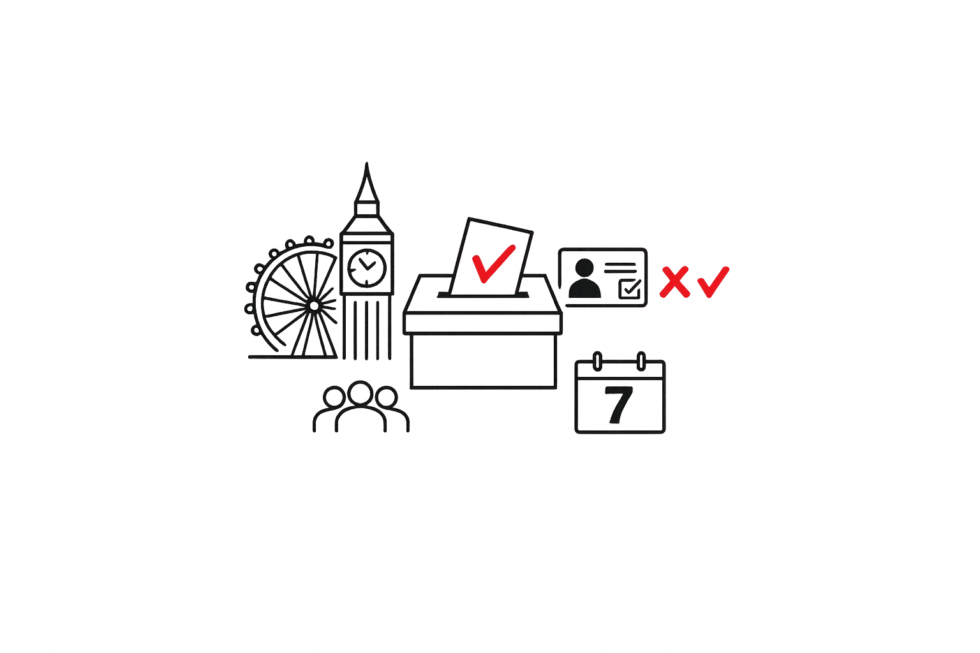
Key Deadlines and Action Plan for Londoners
To ensure participation, Londoners must adhere to a series of strict administrative deadlines throughout April and May 2026.
| Event / Deadline | Date and Time | Action Required |
| Voter Registration Deadline | 20 April 2026 (Midnight) | Register online at gov.uk |
| Postal Vote Application | 21 April 2026 (5:00 PM) | Apply if you cannot visit a polling station |
| Voter ID (VAC) Application | 28 April 2026 (5:00 PM) | Apply for free ID if you have no photo ID |
| Proxy Vote Application | 28 April 2026 (5:00 PM) | Appoint someone to vote on your behalf |
| Polling Day | 7 May 2026 (7:00 AM – 10:00 PM) | Vote in person with valid photo ID |
Alternative Voting Methods: Postal and Proxy Voting
For those unable to attend a polling station in person on 7 May 2026, two alternative methods are available. Notably, postal voters are not required to provide photo ID, as their identity is verified via a signature and date of birth match.
Postal Voting
The deadline to apply for a postal vote is 5:00 PM on Tuesday, 21 April 2026. Ballot papers are sent out approximately two weeks before the election. Under new rules introduced in 2024, postal vote arrangements must be renewed every three years. Voters are encouraged to return their ballots via Royal Mail as early as possible to avoid postal delays.
Proxy Voting
A proxy vote allows a designated person to vote on your behalf at your polling station. The deadline for new proxy applications is 5:00 PM on Tuesday, 28 April 2026. Your chosen proxy must also be registered to vote and must bring their own photo ID to the polling station. Emergency proxy votes may be available until 5:00 PM on polling day in cases of unforeseen medical emergencies or work-related travel.
The Candidate Nomination Process and Legal Thresholds
For those seeking to stand as a candidate in the 2026 London borough elections, the legal window for formal nominations is strictly limited. According to the statutory timetable issued by the Electoral Commission, the "Notice of Election" will be published on Monday, 23 March 2026, marking the start of the formal process.
Nomination Deadlines and Delivery
Prospective candidates must deliver their completed nomination papers by hand to the Returning Officer of their specific borough.
- Final Deadline: All papers must be submitted no later than 4:00 PM on Thursday, 9 April 2026.
- The Subscriber Rule: Each nomination must be "subscribed" (signed) by a Proposer and a Seconder who are registered electors within the specific ward where the candidate is running. It is critical that these subscribers' names and electoral numbers match the 2026 electoral register exactly, or the nomination will be declared invalid.
- Withdrawal: Candidates wishing to retract their application must also do so by the 4:00 PM deadline on 9 April.
Qualifications and Disqualifications
To qualify, a candidate must be a British, Irish, qualifying Commonwealth, or EU citizen (with retained rights) and be at least 18 years old. Crucially, they must meet at least one of four residency or work-based criteria, such as being registered to vote in the borough or having occupied land as an owner/tenant in the borough for the preceding 12 months. Disqualifications apply to those employed by the council they wish to serve or those subject to bankruptcy restrictions orders.
Ward Boundary Changes and "All-Up" Election Dynamics
A significant number of Londoners may find themselves voting in different wards or for a different number of councillors in 2026 due to recent reviews by the Local Government Boundary Commission for England (LGBCE).
New Political Maps
The 2026 elections follow a series of electoral reviews aimed at ensuring "voter parity"—meaning each councillor represents roughly the same number of residents.
- Redistricting: Boroughs such as Haringey, Newham, and Tower Hamlets have seen ward boundaries shifted to account for new high-density housing developments.
- Polling Cards: Residents are urged to check the "Ward" section of their poll card, arriving in late March 2026, as their traditional polling station or local representatives may have changed since the 2022 contest.
- The "All-Up" System: Unlike some parts of England that elect by "thirds," all 32 London boroughs hold "all-up" elections. This means every single one of the 1,800+ seats is contested on 7 May, leading to a complete potential turnover of council administrations in a single night.
Enhanced Accessibility and Hidden Disability Support
Under the provisions of the Elections Act 2022 and updated 2026 guidance from the Electoral Commission, Returning Officers are mandated to provide specific equipment to ensure "independent and secret" voting for all residents.
Physical and Sensory Aids
Every London polling station on 7 May 2026 will be equipped with:
- Tactile Voting Devices: These plastic templates fit over the ballot paper, allowing blind or partially sighted voters to identify where to mark their "X" using embossed numbers and braille.
- Audio Ballot Papers: Many stations now provide QR codes or telephone helplines that read out the candidate list in the order they appear on the paper.
- Support Aids: Large-print sample ballot papers, high-visibility signage, and pencil grips for voters with dexterity issues are standard requirements.
Support for Hidden Disabilities
New for 2026 is a "hidden disability" protocol. Polling staff have received specific training to assist voters with neurodivergence or anxiety. This includes the "see a mask, wear a mask" policy for clinically vulnerable voters and the provision of quiet spaces where possible. Voters are legally entitled to bring a companion (aged 18+) to assist them in the booth, provided the companion signs a simple declaration form on-site.
Polling Day Logistics and Support
On 7 May 2026, polling stations across London will be open from 7:00 AM to 10:00 PM. Voters can find their designated polling station on their poll card, which is typically mailed in late March, or by entering their postcode on the wheredoivote.co.uk website.
Local authorities have been instructed to ensure that polling stations are accessible. This includes the provision of tactile voting devices, large-print ballot papers, and ramps for wheelchair users. If a voter is in the queue at 10:00 PM, they are legally entitled to cast their vote. Following the close of polls, ballot boxes will be transported to central counting locations, with most borough results expected to be declared throughout the early hours of Friday, 8 May 2026.
This election represents a pivotal moment for local governance in London. For the individual citizen, the primary responsibility is the verification of their registration status and the acquisition of valid ID. For the first time in a major local cycle, "no ID" effectively means "no vote," making pre-election preparation essential for all eligible Londoners.
Read about the life of Westminster and Pimlico district, London and the world. 24/7 news with fresh and useful updates on culture, business, technology and city life: Reform UK on women, family and equality: what senior figures have said — and what UK law allows