
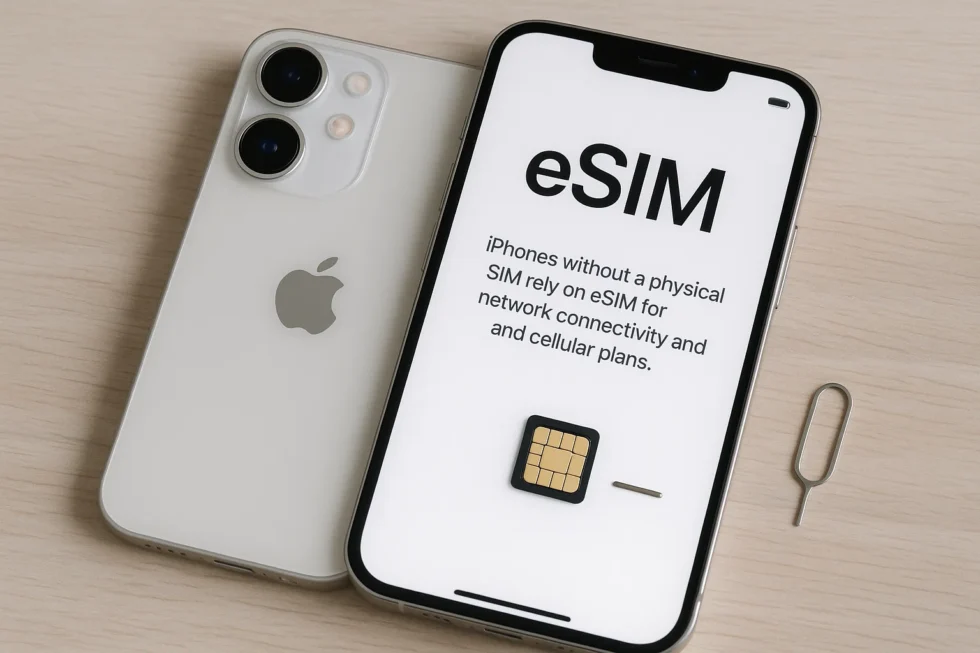
The familiar plastic SIM card is rapidly disappearing. With its newest iPhones and iPads, Apple has shifted entirely to eSIM technology – a built-in digital replacement that makes switching networks faster, safer and more convenient. For London users this brings real advantages, from easier travel to multiple numbers on one device, but also new questions: how is an eSIM set up, which UK networks already support it, and what pitfalls remain when moving abroad? As The WP Times reports, this FAQ highlights the essentials, gives practical tips and explains why the eSIM is set to become the new standard in mobile connectivity.
What exactly is an eSIM and how does it work
An eSIM (embedded SIM) is a small chip permanently installed in the device. Instead of inserting a physical card, users activate their mobile service digitally – usually by scanning a QR code, using an app, or adjusting settings directly on the iPhone.
Unlike the traditional SIM, an eSIM can store multiple profiles at once. This means you can have a UK number, a business number and even a European travel profile all on the same phone. Switching between them is almost instant.
Which Apple devices in London support eSIM
Apple introduced eSIM support with the iPhone XS and XR back in 2018. Since then, all new iPhones and iPads include the feature. The iPhone 17 Air (2025) takes the decisive step: it ships without a SIM slot at all. iPads such as the iPad Pro and iPad Air also rely on eSIM for mobile data, while the Apple Watch Cellular has always used it.
In London, adoption is widespread. Major networks – EE, O2, Vodafone UK and Three – offer eSIM as standard. Even smaller providers like Giffgaff and Lycamobile are trialling it, particularly for prepaid customers.
Advantages for Londoners
The key advantage is flexibility. New profiles can be downloaded within minutes without waiting for post delivery or visiting a shop. For commuters and frequent travellers this makes life easier, allowing smooth transitions between UK and EU tariffs.
Another benefit is durability: with no SIM tray, devices are more resistant to water and dust. On top of that, an iPhone can store up to eight profiles and run two simultaneously – ideal for separating work and personal use.
The common pitfalls
The transition isn’t without issues. Some prepaid tariffs are not yet eSIM-compatible, and when switching to a new iPhone, customers may need to request a fresh profile from their provider. The simple swap of a plastic card is no longer possible.
Global availability also varies. While the UK, EU and US are well covered, networks in parts of Asia and Africa still lag behind. Travellers from London should always check compatibility before flying.
Step-by-step set-up guide
Activating an eSIM is straightforward if you follow the process carefully:
- Ensure Wi-Fi is enabled and iOS is up to date.
- Scan the QR code provided by your operator or use their app (e.g. MyEE or Vodafone UK).
- Label each profile clearly, such as “Personal”, “Business” or “EU travel”.
- Choose which line should handle data and calls in the iPhone settings.
- Deactivate unused profiles instead of deleting them, so they remain available later.
Example: a Londoner could keep their O2 number active for everyday calls, while adding a temporary Paris data plan from Airalo before boarding the Eurostar – all within minutes.
Security and privacy concerns
On security grounds, the eSIM is more robust than its predecessor. Because the chip is fixed inside the device, it cannot be stolen or physically swapped. Profiles are encrypted and managed directly through the provider.
The real risk lies in phishing attacks. Fraudsters may send fake QR codes or links. The rule of thumb: only use codes or apps supplied directly by your operator. For professionals in London handling sensitive data, this precaution is crucial.
eSIM and international travel
For a city as globally connected as London, the eSIM is particularly useful. Services such as Holafly and Airalo allow travellers to purchase local data plans before they even take off.
That means no more queuing at airport kiosks or fiddling with tiny plastic cards. A three-day business trip to Berlin, for instance, can be covered with a €10 prepaid eSIM package downloaded straight to the iPhone.
Future outlook
With Apple now phasing out the SIM tray, analysts expect that by 2027 most major manufacturers will follow suit. London, with its mix of commuters, business travellers and tech-savvy consumers, is likely to be at the forefront of this digital shift.
For users the message is clear: mastering eSIM now means being prepared for the standard of tomorrow.
Table: UK network support for eSIM (2025)
| Provider | eSIM available | Special feature |
|---|---|---|
| EE | Yes | Multiple eSIMs, app management |
| O2 | Yes | Prepaid and business tariffs supported |
| Vodafone UK | Yes | Flexible EU roaming options |
| Three | Yes | Strong traveller packages |
| Giffgaff | Partial | Limited eSIM pilot on select plans |
Why London is ready for the eSIM era
The move from physical SIM cards to digital eSIMs is not a minor technical update – it is a structural shift in how people connect. Apple’s decision to remove the SIM tray from the iPhone 17 Air marks the point of no return, and London is already at the centre of this transformation. With networks such as EE, Vodafone, O2 and Three providing full eSIM support, Londoners enjoy a level of flexibility unmatched in many other cities. Travellers can switch seamlessly between UK and European plans, download a foreign profile before their plane even lands, and manage several numbers without ever handling plastic. The city’s role as a global hub for finance, tech and culture makes it the ideal testing ground for the digital-only future. Challenges remain – from phishing risks to gaps in coverage outside Europe – but the advantages clearly outweigh the drawbacks. In a world where mobility is everything, London’s early embrace of eSIM shows why the capital is ready to lead the next chapter of connectivity.
Read about the life of Westminster and Pimlico district, London and the world. 24/7 news with fresh and useful updates on culture, business, technology and city life: DeepSeek Prepares AI Agent to Compete With OpenAI by End of 2025.