
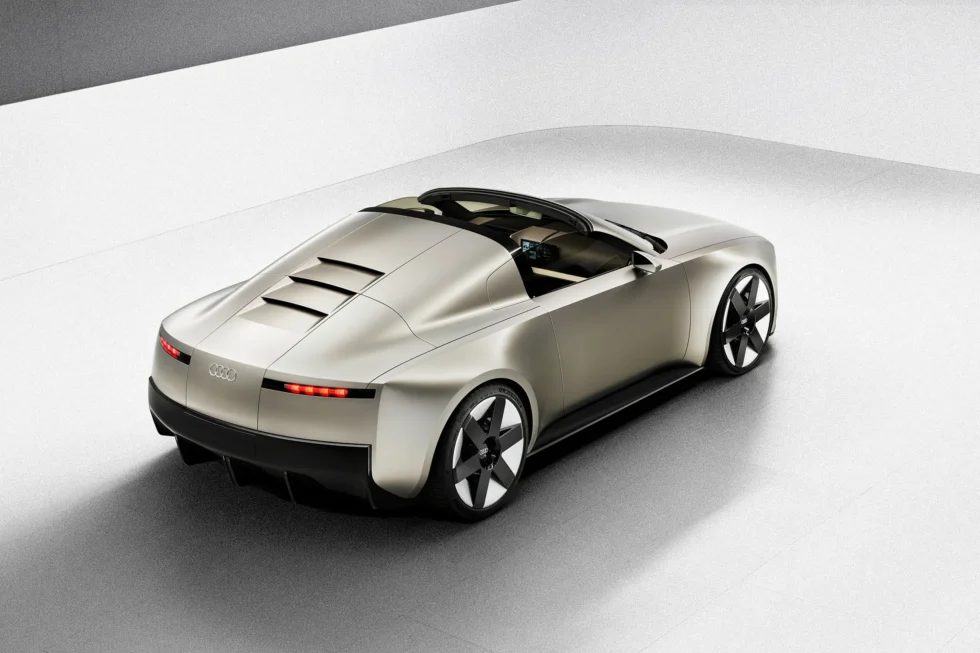
The TT has long symbolised accessible sportiness in Audi’s portfolio. Its retirement left a visible gap in the brand’s performance line-up, one that Audi now intends to fill with a bold electric alternative: the recently unveiled Concept C. Unlike many futuristic prototypes, this model is already close to production reality. Chief executive Gernot Döllner emphasised that the car is “precisely in the middle between TT and R8,” balancing the agility and affordability of the former with the refinement and power associated with the latter—yet without intruding into the rarefied supercar segment, as reported by The WP Times has, citing an interview with Top Gear.
In his interview with Top Gear, Döllner was clear about Audi’s strategic intent: “During my time at Audi, I will only present concept cars that have a decision to be produced.” That statement underlines that the Concept C is not a showpiece, but a decisive step in Audi’s transformation—designed to carry forward the emotional legacy of the TT while adapting it to the technological demands of an electric era.
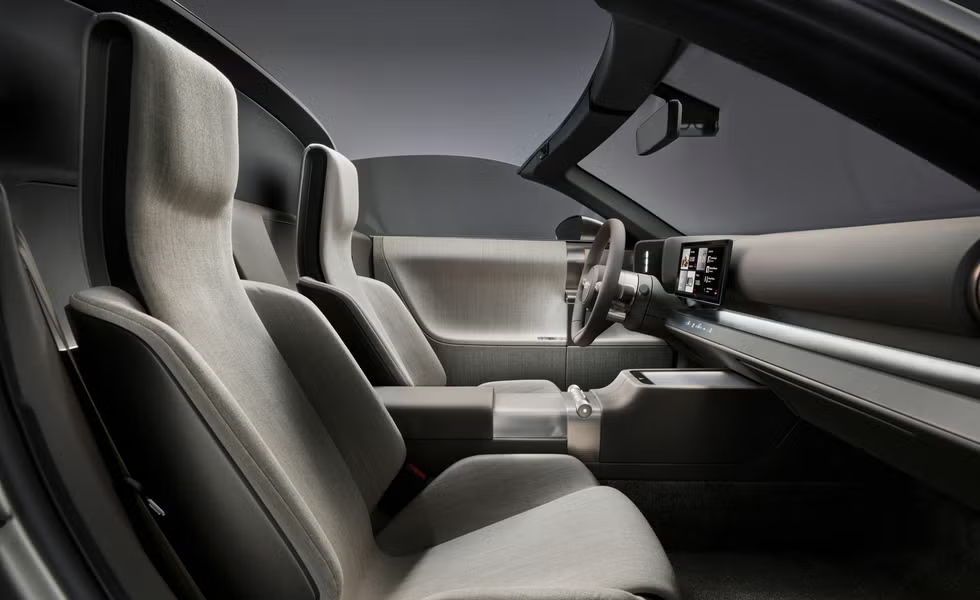
Concept C: near-production and functional
The Concept C is not a speculative design experiment, but a working prototype that already signals Audi’s next design and engineering phase. Unlike many show cars, which often remain little more than sculptural studies, the Concept C has been engineered as a fully functional, road-legal vehicle. This makes it a clear preview of what drivers can expect when the production version arrives in 2027.
Key characteristics highlighted by Audi:
- Design language – upright rectangular grille, slim vertical LED headlights and sharp body lines mark a departure from the softer forms of the TT.
- Functionality – the car unveiled in Munich is not static; it can be driven legally on public roads, underlining its seriousness.
- Production intent – around 90% of the concept’s architecture and styling will remain intact in the final model.
- Positioning – performance is set between the retired TT and the supercar R8, creating a new middle ground in Audi’s portfolio.
- Naming – the TT badge will not return. “Sometimes it’s easier to develop a car than to find a name for it,” CEO Gernot Döllner admitted.
In strategic terms, the Concept C shows Audi’s intent to avoid half measures in the EV transition. By putting a nearly production-ready prototype on the road, the brand signals to enthusiasts and investors alike that its electric sports car will not be a niche side project but a core element of its future identity.
Table: Positioning of Audi’s sports cars
| Model | Production Years | Powertrain | Market Position | Successor Role |
|---|---|---|---|---|
| Audi TT | 1998–2023 | Petrol, Diesel | Entry-level sports car | Discontinued |
| Audi Concept C | Prototype 2025 | Electric | Between TT and R8 | Future successor |
| Audi R8 | 2006–2024 | V8/V10 petrol | Supercar, halo model | Retired, no direct EV |
The EV sports car dilemma
So far, electric performance cars have failed to capture the imagination of purists. Vehicles such as Rimac Nevera achieve world-class acceleration, yet lack the visceral noise, vibration and mechanical feedback that enthusiasts associate with driving pleasure. No production EV currently offers a manual gearbox.
Audi aims to address this gap by adding virtual layers of engagement. The strategy includes:
- Simulated gearshifts controlled via paddles.
- Artificial engine sound integrated into the cabin.
- A “virtual redline” experience similar to petrol cars.
Hyundai’s precedent and Audi’s ambitions
Hyundai set an important benchmark with the Ioniq 5 N. The Korean manufacturer equipped its electric hot hatch with a digital transmission that mimics the behaviour of a combustion engine. Drivers use paddle shifters to “change gears”, encounter a simulated redline and hear synthetic engine sounds carefully tuned to match the car’s acceleration curve. For many, this system transformed the perception of an EV from a silent commuter into something resembling a performance car.
Audi is now watching closely. By applying a similar principle to the Concept C, the brand wants to close the emotional gap that has long separated electric cars from their petrol predecessors. Chief executive Gernot Döllner even argued that the effect is more than psychological: “Even on the racetrack, I’m faster with a car with a virtual gearbox.”
The reasoning is straightforward:
- Rhythm and orientation – simulated shifts give drivers a clearer sense of speed progression.
- Confidence – audible cues help anticipate vehicle response.
- Engagement – digital feedback creates the impression of mechanical interaction.
For Audi, adopting such technology is not about imitation but about refinement. While Hyundai proved the concept works, Audi aims to elevate it to a premium level—linking it to brand heritage and integrating it with a more sophisticated acoustic experience. If successful, it could mark a turning point where “virtual driving” becomes not a compromise, but a competitive advantage in the EV sports segment.
Looking forward: the sound of the future
The question of sound remains central to the identity of a sports car. Electric drivetrains are inherently quiet, reducing the visceral engagement that enthusiasts often consider essential. Audi is therefore exploring how sound can be reintroduced—not as an afterthought, but as an engineered element of driving dynamics.
Engineers are testing whether the unmistakable five-cylinder note, long associated with Audi’s RS models, could return in digital form. By embedding synthetic acoustics into the virtual gearbox system, the brand hopes to evoke an emotional link to its heritage while offering drivers tangible feedback during acceleration.
This approach highlights a broader dilemma in automotive design: should future sports cars create entirely new acoustic identities, or should they preserve echoes of their combustion past? Audi appears inclined toward a hybrid philosophy—combining modern electric performance with familiar auditory cues that remind drivers of what once defined the brand.
If successful, this strategy could set a precedent for the wider industry, where sound becomes as carefully designed and marketed as exterior styling or performance metrics. For Audi, the challenge is to ensure that digital soundscapes feel authentic, not artificial. Only then can the “sound of the future” carry the same cultural weight as the roar of combustion once did.
Key innovations of the upcoming sports car
- New design language – rectangular grille, slim LEDs.
- Performance positioning – between TT and R8.
- Virtual gearbox – paddle-operated, simulated shifts.
- Synthetic engine acoustics – potential revival of the five-cylinder sound.
- Road-ready concept – functional and 90% identical to the production version.
The Concept C is more than a study—it is Audi’s attempt to reconcile electric technology with the emotional appeal of sports cars. Its success will depend on whether virtual solutions convince drivers that digital sensations can be as thrilling as mechanical ones. For Audi, this project is not merely about replacing the TT; it is about redefining what driving pleasure means in the electric era.