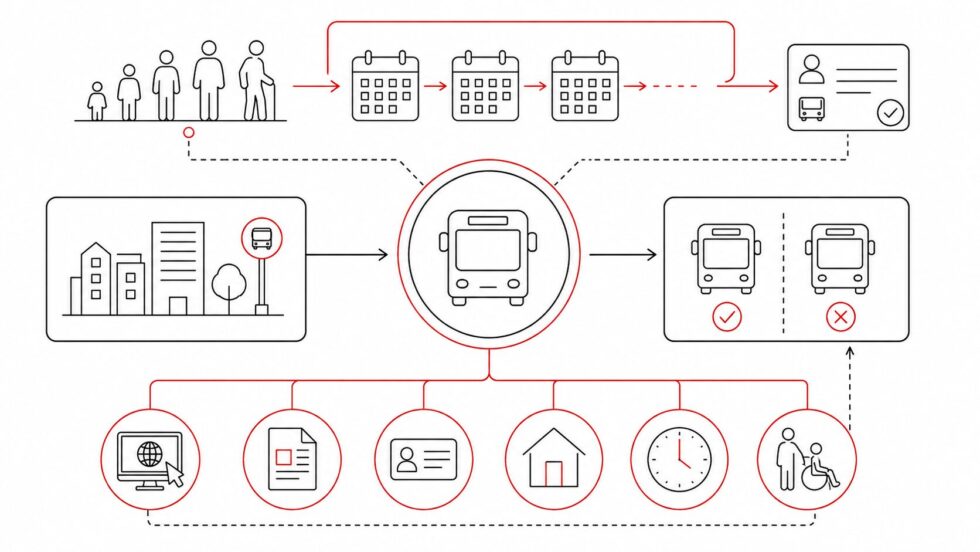
The August England bus pass change is not the abolition of free travel and it is not a new concession introduced by Andy Burnham’s government. It is the next practical stage of a timetable already written into pension law: because eligibility for an older person’s bus pass in England is normally tied to State Pension age, people born after 5 April 1960 must wait beyond their 66th birthday before qualifying. During August 2026, the immediate impact falls particularly on people born between 6 May and 5 June 1960, whose State Pension age is 66 years and two months, while later birth groups face progressively longer delays. The WP Times has examined the official Department for Work and Pensions timetable, the national concessionary travel rules and the separate temporary August scheme for children to establish exactly what is changing and what is not.
The distinction matters because several different transport policies are operating at the same time. England’s statutory older person’s bus pass remains in place, existing eligible passholders do not lose their cards merely because the pension age is rising, and disabled people continue to qualify under separate legal categories. However, people approaching 66 can no longer assume that their birthday automatically marks the date on which they become entitled to free national concessionary bus travel. Their precise eligibility date now depends on their date of birth, while London residents continue to have a separate route to free local travel from age 60 through the capital’s concessionary arrangements.
What the August England bus pass change actually means
The central rule is straightforward: in England, an older person normally becomes eligible for a free bus pass when they reach State Pension age. The same government calculator used to check pension age also tells applicants when they become eligible for free bus travel. That means a pension-age reform automatically affects the date on which many people can obtain an age-related concessionary pass, even though the transport scheme itself has not been withdrawn. The increase from 66 to 67 is being introduced gradually between 2026 and 2028. Under the statutory timetable, people born between 6 April 1960 and 5 March 1961 reach State Pension age at 66 plus a specified number of months. Those born from 6 March 1961 onwards generally reach it at 67 under the current timetable.
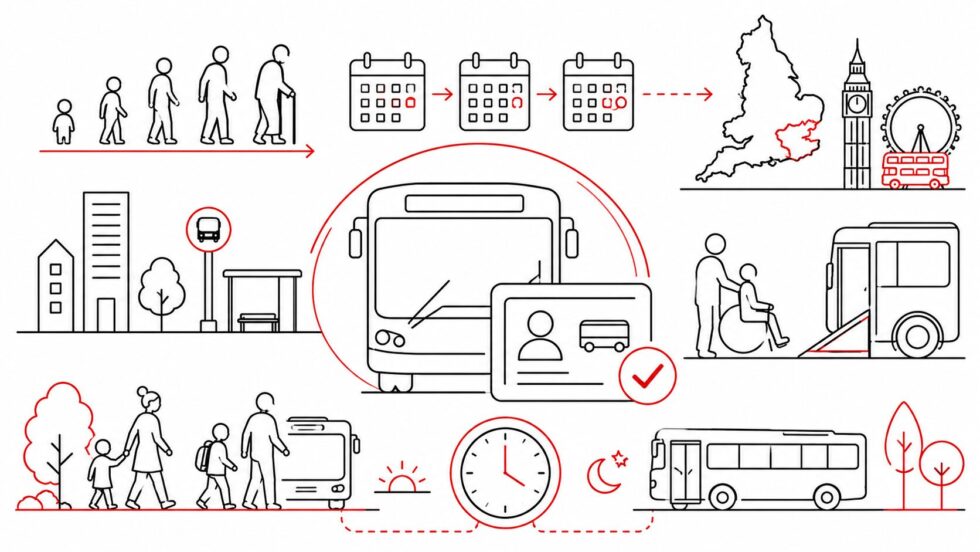
This creates a rolling series of eligibility dates rather than one single national changeover day. A person born in April 1960 waits one additional month after turning 66. Someone born in May 1960 waits two months. A person born in July 1960 waits four months, while someone born in February 1961 waits 11 months. The practical consequence is that two neighbours who both describe themselves as 66 may become eligible for an older person’s bus pass on different dates.
The official timetable is:
| Date of birth | State Pension age and usual English bus-pass age |
|---|---|
| 6 April 1960 to 5 May 1960 | 66 years and 1 month |
| 6 May 1960 to 5 June 1960 | 66 years and 2 months |
| 6 June 1960 to 5 July 1960 | 66 years and 3 months |
| 6 July 1960 to 5 August 1960 | 66 years and 4 months |
| 6 August 1960 to 5 September 1960 | 66 years and 5 months |
| 6 September 1960 to 5 October 1960 | 66 years and 6 months |
| 6 October 1960 to 5 November 1960 | 66 years and 7 months |
| 6 November 1960 to 5 December 1960 | 66 years and 8 months |
| 6 December 1960 to 5 January 1961 | 66 years and 9 months |
| 6 January 1961 to 5 February 1961 | 66 years and 10 months |
| 6 February 1961 to 5 March 1961 | 66 years and 11 months |
| 6 March 1961 to 5 April 1977 | 67 |
The Department for Work and Pensions explains that the Pensions Act 2014 brought the rise to 67 forward by eight years and altered the phasing method. Instead of all affected people reaching pension age on a common date, each birth-date band is assigned a pension age of 66 years plus a fixed number of months.
This is why describing the development simply as an “August law change” can be misleading. The legal timetable did not suddenly begin in August. The phased rise began in 2026, and August is one point in an implementation process that continues until 2028.
Who is affected in August 2026 and when can they apply
The most relevant group during summer 2026 consists of people born from 6 May to 5 June 1960. Their State Pension age is 66 years and two months, meaning they become eligible two months after their 66th birthday rather than on the birthday itself. Depending on the exact date of birth, their qualifying date falls between July and August 2026. For example, a person born on 20 May 1960 turns 66 on 20 May 2026 but reaches State Pension age at 66 years and two months, on 20 July 2026. Someone born on 5 June 1960 reaches the same age threshold on 5 August 2026. Their eligibility for an English older person’s bus pass would normally be linked to that later date rather than to their 66th birthday.
The next groups face longer waits:
- People born from 6 June to 5 July 1960 qualify at 66 years and three months.
- Those born from 6 July to 5 August 1960 qualify at 66 years and four months.
- People born from 6 August to 5 September 1960 qualify at 66 years and five months.
- Each subsequent monthly birth band adds another month until the final transitional group reaches 66 years and 11 months.
The official table includes special handling for dates that do not exist in every month. It states, for example, that a person born on 31 July 1960 is treated as reaching 66 years and four months on 30 November 2026. Similar provisions apply to people born on 31 December 1960 and 31 January 1961.
Applicants should therefore avoid estimating their date by counting roughly from their birthday. The government’s State Pension age checker is the safer route because it calculates the statutory date and also shows when free bus travel becomes available. The application itself is handled by the relevant local council. GOV.UK asks users to enter their postcode to find the correct authority and to check whether any local rule allows them to qualify sooner. Councils may set their own application windows, so some permit applications shortly before the qualifying date even though the pass cannot be used until eligibility begins.
Does an existing older person’s bus pass stop working?
No general rule has been announced cancelling valid passes held by people who have already qualified. The change affects the point at which new age-based applicants become eligible. It does not reset the age of existing holders or remove the statutory concession from people who already reached the required age.
Under Department for Transport guidance, the English National Concessionary Travel Scheme provides free local bus travel to eligible older and disabled residents. Passes are issued by travel concession authorities, and the maximum expiry period that may be printed on a card is five years. A holder may still need to renew an expiring card under their council’s normal procedure, but that is separate from the pension-age transition.
Are disabled bus passes affected by the pension-age increase?
The increase to State Pension age does not remove the separate entitlement for eligible disabled people. National guidance identifies two broad statutory groups: older people who have reached State Pension age and people who qualify under one of the recognised disability categories.
The categories include people who are blind or partially sighted, profoundly or severely deaf, without speech, unable to walk because of a substantial long-term condition, without arms or without long-term use of both arms, or who meet specified learning-disability or driving-licence medical criteria. Applications and evidence requirements are administered locally.
What free travel an English older person’s bus pass provides
The statutory English concession generally allows eligible residents to travel free on qualifying local bus services anywhere in England. It is not normally limited to the council area that issued the card, although discretionary extras offered by a particular council may only apply locally.
The national minimum hours are:
- from 9.30am until 11pm on weekdays;
- all day at weekends;
- all day on bank holidays.
Local authorities may provide more generous terms, such as free journeys before 9.30am, companion travel or reduced early-morning fares. Those extras are discretionary and vary by area, so a passholder should not assume that a local benefit available at home will apply elsewhere.
The national concession covers eligible local bus services. It does not automatically include long-distance coaches, tourist services, services on which most seats can be reserved, temporary routes operating for fewer than six consecutive weeks, rail-replacement buses or services carrying a special amenity charge.
Passes are issued to eligible people whose sole or principal residence is within the issuing authority’s area. Nationality is not the deciding factor: a foreign national who is genuinely resident in England may qualify, while a visitor in the country for a short stay does not.
Why London, Wales, Scotland and Northern Ireland have different rules
The phrase “UK free bus pass” often conceals four different systems. Concessionary travel is devolved, and the rules governing Wales, Scotland and Northern Ireland are determined separately from the English scheme.
In England outside London, age-based eligibility is generally linked to State Pension age. In Wales, Scotland and Northern Ireland, older residents can normally obtain the relevant concession from age 60. London also has its own arrangements: GOV.UK states that people living in the capital can travel free on buses, Tube services and other participating transport from age 60, but that concession is restricted to London.
Londoners should distinguish between the 60+ London Oyster photocard and the older person’s Freedom Pass. The former provides free travel within the capital from 60, subject to its rules and residence requirements. Eligibility for the older person’s Freedom Pass is linked to State Pension age. The pension-age rise can therefore still matter to a London resident even though another local concession may already provide travel from 60.
This regional variation also explains why advice circulated under a general UK headline may not apply to every reader. A person living in Cardiff, Edinburgh or Belfast should follow the relevant devolved scheme rather than the English State Pension age timetable.
Is the change a new policy introduced by Andy Burnham
Andy Burnham became Prime Minister on 20 July 2026, but the rise from 66 to 67 and its phased birth-date timetable pre-date his premiership. The schedule derives from pension legislation enacted years earlier. It is therefore more accurate to say that the transition is continuing under his government than to present it as a new Burnham policy.
The distinction is important in a personal-finance article because it separates a change in political leadership from the legal basis of an individual’s entitlement. The government could propose amendments in future, but the current eligibility dates are determined by the existing statutory timetable unless Parliament changes the law. The Department for Work and Pensions describes the position in its guidance: “The State Pension age for men and women will now increase to 67 between 2026 and 2028” (Department for Work and Pensions, State Pension age timetables). It adds that people born between 6 April 1960 and 5 March 1961 reach pension age at 66 plus the specified number of months.
No evidence in the official guidance indicates that older person’s bus passes are being abolished in August. The change is a delay in the qualifying date for certain new applicants, not the termination of the concession.
A separate August scheme gives children free bus travel
There is another significant England-wide bus policy in August 2026, but it concerns children rather than pensioners. The Department for Transport announced free travel on participating local buses for children aged five to 15 from 1 to 31 August. The measure forms part of the government’s Great British Summer Savings programme. The government said typical child fares cost between £1 and £2 and presented the temporary scheme as cost-of-living support for families during the school holidays. It applies during August only and should not be confused with the permanent English National Concessionary Travel Scheme for older and disabled people.
“Great British Summer Savings means more people can be excited about getting out and about this summer,” Transport Secretary Heidi Alexander said when the measure was announced on 10 July 2026, referring to family trips to museums, attractions and other destinations (Heidi Alexander, Department for Transport press release, 10 July 2026). She said the package combined children’s free bus travel with the continuing £3 fare cap. The overlap between these two developments may create confusion. August brings a temporary expansion of free bus travel for children, while the pension-age transition delays the point at which some people in their mid-60s qualify for the older person’s pass.
What people approaching 66 should do now
Anyone born after 5 April 1960 should check their exact State Pension age before planning around a free bus pass. A birthday alone is no longer a reliable indicator during the 2026–2028 transition.
The practical steps are:
- Use the official State Pension age checker and record the exact qualifying date.
- Enter your postcode on the GOV.UK bus-pass page to identify the issuing council.
- Check how early that council accepts applications.
- Prepare the requested photograph, proof of address and identification.
- Confirm the hours and any additional local concessions before travelling.
- Do not assume that coach, tourist or cross-border services are covered.
- Check separate disability eligibility where relevant.
The government checker warns that State Pension age is regularly reviewed and that future results may change. Any later proposal to move the pension age again would require a further political and legislative process; reported discussions are not the same as an enacted entitlement change.
For now, the confirmed position is narrower. The free bus pass remains part of England’s statutory concessionary system. What has changed is the age at which a growing number of applicants enter that system. In August 2026, some people who expected to qualify at 66 will instead have to wait until the date produced by the State Pension timetable.
Materials used: GOV.UK, Department for Work and Pensions, Department for Transport, English National Concessionary Travel Scheme guidance, London Councils.
Read about the life of Westminster and Pimlico district, London and the world. 24/7 news with fresh and useful updates on culture, business, technology and city life: Will Elon Musk’s Tesla Tiny House Really Reach the UK – or Is It Just Another Vision