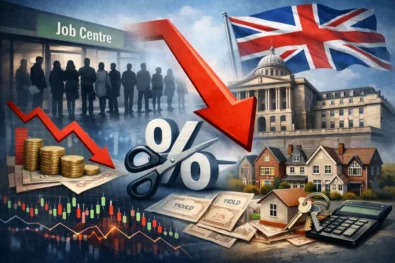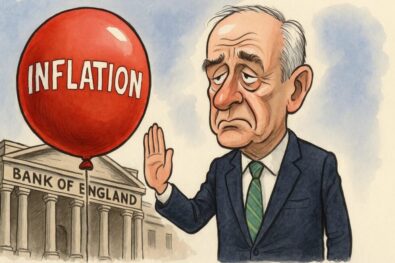
The Bank of England is set to announce its latest interest rate decision on Thursday, 18 December 2025, a move that markets see as pivotal amid diverging global monetary paths. Global markets are navigating a narrow corridor between cautious optimism in the technology sector and persistent uncertainty over monetary policy, as investors simultaneously assess the US consumer price inflation release and Micron Technology’s updated earnings outlook. US equity futures traded modestly higher in early European hours, supported by renewed strength in semiconductor stocks, although overall sentiment remains fragile after several consecutive declines on Wall Street. Inflation trajectories and central bank policy signals continue to define risk appetite across regions. This is reported by The WP Times, citing Investing.com and Reuters.
At the centre of market attention is the upcoming release of US consumer price inflation, widely seen as a critical input into the Federal Reserve’s policy calculus for 2026. The data follows a series of labour market indicators pointing to cooling employment conditions, including an unemployment rate of 4.6% — the highest level in more than four years. While policymakers have increasingly prioritised labour market stability, inflation remains stubbornly above the Fed’s 2% target, complicating the outlook for rate cuts.
US inflation: stalled disinflation tests Fed patience
Economists expect both headline and core US CPI to come in at around 3.0% year on year, unchanged from previous readings. Such an outcome would reinforce concerns that the disinflation process has stalled, with consumer prices locked in a narrow band between 2.3% and 3.0% for over a year. For investors, the implication is clear: expectations of aggressive monetary easing may be premature.
“The CPI report cannot be ignored, even as labour market weakness grows,” one senior market strategist noted, adding that persistent inflation could force the Fed to keep rates higher for longer than markets currently anticipate. Equity markets, particularly growth and technology stocks, remain highly sensitive to any shift in rate expectations.
Micron restores confidence in the chip sector
Against this uncertain macro backdrop, Micron Technology provided a rare source of optimism. The US chipmaker forecast significantly stronger second-quarter earnings, signalling robust demand from data centres and cloud service providers. The update helped stabilise sentiment in a sector that had been rattled by disappointing results from peers such as Oracle and Broadcom.
Micron’s chief executive, Sanjay Mehrotra, told investors that the company expects to meet only “half to two-thirds of demand” from several major customers through 2026, underlining the intensity of demand for memory chips. High-bandwidth memory, a critical component in training and deploying generative AI models, remains a key growth driver. “We are in the early stages of a multi-year investment cycle tied to AI infrastructure,” Mehrotra said during the earnings call.

Bank of England set to diverge from peers
In Europe, attention is firmly fixed on London. While the European Central Bank and Nordic central banks are expected to hold rates steady, the Bank of England is widely anticipated to cut interest rates to 3.75% from 4.0%. UK inflation fell sharply in November, strengthening the case for easing, although at 3.2% it remains the highest among G7 economies.
“The UK is entering a phase where growth risks outweigh inflation risks,” said one London-based economist, warning that prolonged tight policy could further weaken domestic demand. Markets are currently pricing in only one additional BoE rate cut in 2026, though expectations for a second cut have risen following the latest inflation data.
Oil prices rise despite weak annual performance
In commodity markets, oil prices moved higher after US President Donald Trump ordered a blockade of sanctioned oil tankers linked to Venezuela, raising concerns about supply disruptions from the OPEC member. Brent crude rose above $60 a barrel, while US WTI also gained. However, analysts caution that the broader outlook remains bearish.
“The key questions are how effective the blockade will be and how long it will last,” ING analysts said in a note, adding that a looming supply surplus and the prospect of a peace agreement in Ukraine continue to weigh on prices. Despite the latest uptick, both Brent and WTI are on track for their worst annual performance in years.
Read about the life of Westminster and Pimlico district, London and the world. 24/7 news with fresh and useful updates on culture, business, technology and city life: Why is the Bank of England poised to cut UK interest rates before Christmas — and who wins