
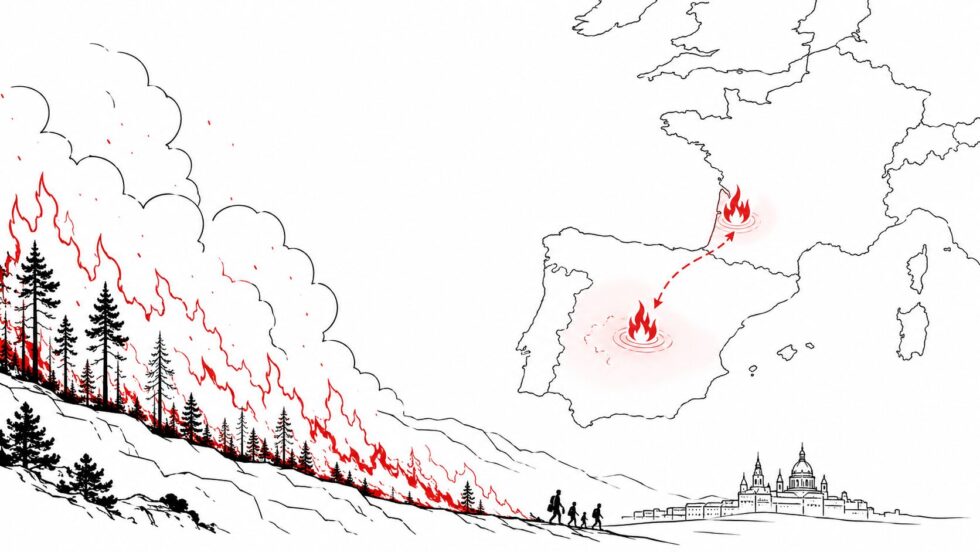
Saturday 26 July 2026 — More than 220,000 people have now been driven from their homes across France and Spain as some of the fiercest wildfires in living memory sweep both countries, forcing France to deploy the army and pushing Spain to declare its first-ever national wildfire emergency. A blaze near Bordeaux has burned close to 98,000 hectares — a "historic record", in the words of France's interior minister — while in Spain three fires west of Madrid merged into a single wall of flame that officials at one point admitted was beyond their power to extinguish, The WP Times reports.
The French toll is staggering in scale. Around 200,000 people have been evacuated across the Gironde and Landes regions, and by Saturday the fire had crept to within roughly 30km of Bordeaux, the country's sixth-largest city. Overnight, authorities ordered the evacuation of suburbs close to the centre — Le Haillan, Eysines and Mérignac among them — as the flames pushed east. Interior Minister Laurent Nunez warned the fight would be "long and very difficult", telling reporters that afternoon winds were expected to worsen the spread.
What has unsettled specialists is the nature of the blaze itself. Prime Minister Sébastien Lecornu described it as a "convective fire" — one that, he said, generates its own winds, accelerates its spread and can abruptly change direction. Civil security experts, he added, had never encountered such a phenomenon. President Emmanuel Macron ordered the armed forces to mobilise, with troop numbers set to pass 1,000 over the course of Saturday, backed by 18 aircraft including an Airbus A400M military cargo plane to dump retardant. On the Cap Ferret peninsula, a summer tourist magnet whose population multiplies tenfold in the holiday season, hundreds fled by boat as the flames reached the coast. Even so, French officials sought to steady nerves abroad. Speaking to BBC Radio 4's Today programme, international partnerships minister Éléonore Caroit urged tourists not to abandon their plans. "It's more than an incident, it really is a tragedy," she said, insisting that most of the country was untouched — while calling the fires a wake-up call on climate change.
Across the Pyrenees, Spain is grappling with a disaster that has already proved deadlier. In the Sierra Oeste west of Madrid, three major fronts — around Almorox, in the province of Toledo, and the towns of Villa del Prado and San Martín de Valdeiglesias — fused into a single blaze that authorities feared could join a fourth fire burning in Burgohondo, across the provincial line in Ávila. The interior minister, Fernando Grande-Marlaska, declared the emergency of national interest in the early hours, handing operational command to the Military Emergency Unit (UME).
The human cost is climbing. According to the government's delegate in Madrid, Francisco Martín, evacuations across Madrid and Ávila had risen to between 70,000 and 75,000 by Saturday — some 35,000 evacuated and 20,000 confined to their homes in the Madrid region, and roughly 30,000 in Ávila. Fires in the Madrid, Toledo and Ávila area have now charred close to 15,000 hectares. Among the buildings under threat is the NASA deep-space tracking station at Robledo de Chavela — one of just three such installations worldwide — which was evacuated as flames approached, alongside the historic monastery town of El Escorial.
Madrid's regional president, Isabel Díaz Ayuso, called it the "worst fire in the history of the region", warning of a "perfect storm" of high temperatures, relentless wind and merging fronts. On Friday, the Madrid regional government's emergency chief, Carlos Novillo, was blunt: the fire was at its peak and beyond the capacity of firefighters to contain.
The wider Spanish picture is grim. Nearly 126,000 hectares have burned nationwide in 2026 — against roughly 24,000 over the same period last year — with 32 major forest fires recorded compared with a typical nine, according to the Ministry of Environment. That makes Spain the EU country with the most scorched land this year, per the European Forest Fire Information System (EFFIS). The season has already taken lives: at least a dozen people died in the Los Gallardos fire in Almería earlier in July, the deadliest single blaze of the summer, while a firefighter was killed battling flames in Sicily. There were, however, tentative grounds for hope by Saturday morning. Cooler temperatures, higher humidity and lighter winds allowed the Madrid fires to advance little and ease in intensity, the regional government said — what Martín called a "real window of opportunity" before conditions were forecast to deteriorate again. Prime Minister Pedro Sánchez, visiting a coordination centre near the capital, struck a cautious note: "We don't know how the wind will develop, even though temperatures have dropped." Health Minister Mónica García, meanwhile, urged residents near the fires to stay indoors and wear FFP2 masks, warning that airborne PM2.5 pollution was running well above World Health Organization limits.
Europe has rallied round. Both governments activated the EU Civil Protection Mechanism, and Brussels confirmed the deployment of four Canadair CL-415 amphibious water-bombers — two from Greece and two from Italy — plus support from the Copernicus satellite system. France, for its part, is receiving reinforcements including Black Hawk helicopters from the Czech Republic and Slovakia, with crews from Croatia, Sweden, Portugal and beyond also joining the effort. For those on the ground, the ordeal has been raw. In a village west of Madrid, 86-year-old Ecologio Cabrera, sheltering in a sports hall crowded with evacuees, told AFP: "If you don't run from it and you try to face it, it devours you." His family had tried to save their home with garden hoses until firefighters arrived and ordered everyone out.
Scientists say the twin catastrophes are no coincidence. Europe is warming faster than any other continent — more than twice the global average since the 1980s, according to the EU's Copernicus Climate Change Service — and hotter, drier conditions are turning vegetation into ready fuel. Meteorologist Chloe Brimicombe warned that such conditions are growing more likely because of climate change, telling Sky News that summers like this are set to become the norm. More land has already burned across Europe this year than the annual average of the past two decades.
Read about the life of Westminster and Pimlico district, London and the world. 24/7 news with fresh and useful updates on culture, business, technology and city life: Will Elon Musk’s Tesla Tiny House Really Reach the UK – or Is It Just Another Vision