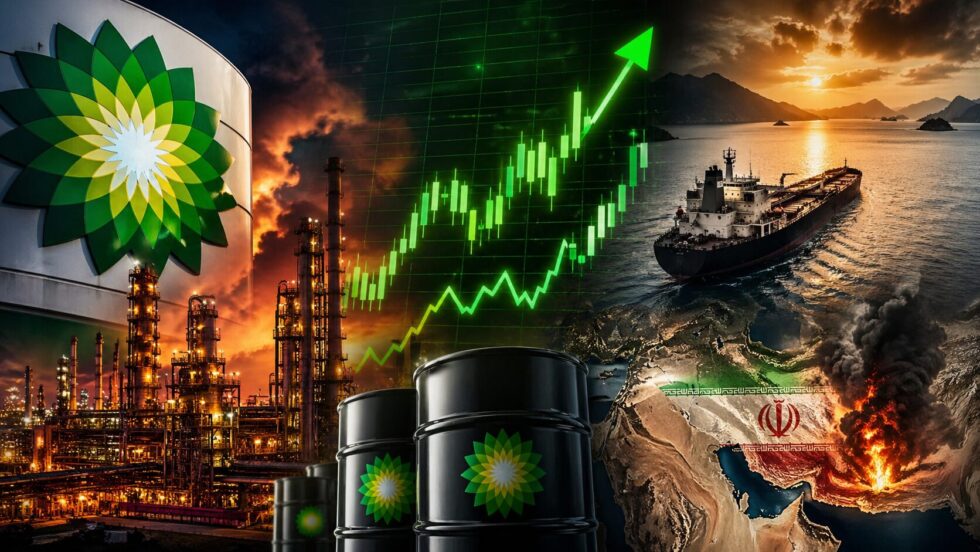
BP share price moved higher in early trading on Tuesday after the British energy major reported first-quarter profits of $3.2bn, more than double the level seen a year earlier, driven by a sharp rise in global oil prices following the Iran conflict and disruption to key supply routes. Brent crude has climbed to around $110 per barrel — up from roughly $73 before the escalation began — boosting earnings across the sector and lifting investor expectations for oil majors, The WP Times reports.
The results, covering January to March 2026, significantly beat analyst forecasts and highlight the scale of gains generated by BP’s trading operations during a period of geopolitical instability, The WP Times reports, citing BBC News. The earnings mark the company’s first quarterly update since the conflict intensified around the Strait of Hormuz, a critical energy corridor responsible for around 20% of global oil and liquefied natural gas flows.
Why is BP share price rising now
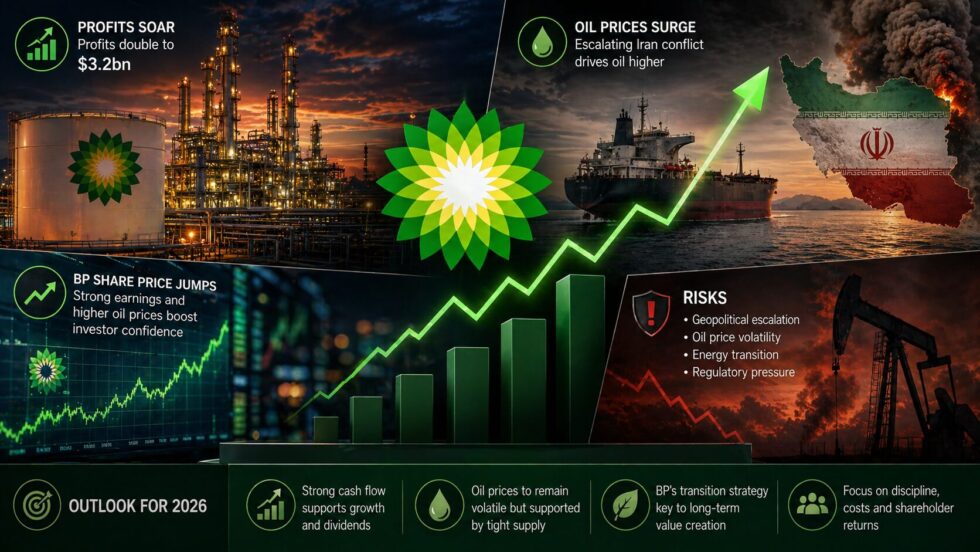
The movement in BP share price reflects a direct response to higher commodity prices and stronger-than-expected financial performance. The company’s underlying replacement cost profit — a key industry metric — reached $3.2bn, comfortably ahead of market expectations of approximately $2.6bn. The primary driver was the “exceptional” performance of BP’s oil trading division, which benefited from heightened volatility and price swings in global markets. In parallel, investor sentiment has shifted towards energy stocks as a hedge against geopolitical risk and inflationary pressure. Key factors supporting BP share price:
- Rising oil prices due to Middle East conflict
- Strong trading and midstream performance
- Earnings beating analyst expectations
- Increased demand for energy equities
- Supply disruption through key global routes
Earnings breakdown shows trading strength
BP’s financial results show a clear divergence between operational stability and trading-driven growth. While upstream production — the extraction of oil and gas — remained broadly flat during the quarter, downstream and trading segments delivered a substantial increase in profitability. The company’s customers and products division, which includes trading, reported profits of $2.5bn compared with just $103m in the same period last year. This shift highlights how volatility in global markets can significantly enhance margins for integrated energy companies.
Financial overview
| Metric | Q1 2026 | Q1 2025 |
|---|---|---|
| Profit | $3.2bn | $1.38bn |
| Trading division | $2.5bn | $103m |
| Brent crude | ~$110 | ~$73 |
| Net debt | $25.3bn | $22.18bn |
Despite strong earnings, BP’s net debt increased to $25.3bn, reflecting ongoing capital requirements and investment commitments. The company has reiterated its target to reduce debt levels to between $14bn and $18bn by the end of next year.
Executive response and market reaction: leadership shift meets oil shock
The results land at a critical inflection point for BP, arriving just weeks after Meg O’Neill formally assumed the role of chief executive in early April 2026. The timing is significant: her first earnings cycle coincides directly with one of the most volatile energy market environments in recent years, triggered by the Iran conflict from 28 February and the disruption to flows through the Strait of Hormuz.
Her initial response has been tightly calibrated around continuity and operational control rather than strategic reset. Management signalled that BP is prioritising supply reliability, trading optimisation and coordination with governments during the current disruption phase — a message aimed at both markets and policymakers.
Statements and context
(“I joined at a time when our industry is operating in an environment of conflict and complexity,” said Meg O’Neill in a company statement, London, April 2026)
(“We are working with customers and governments to get fuel where it is needed, helping minimise disruption and the impact on people’s lives,” she added in the same statement)
The market response was immediate. BP shares rose in early London trading on 28 April, extending a rally that has already pushed the stock more than 30% higher year-to-date. The move reflects both the earnings surprise and a broader re-rating of energy equities across the FTSE 100, where oil majors are acting as direct beneficiaries of elevated crude prices and supply-side risk. Notably, the scale of the share price reaction was reinforced by the composition of earnings. Investors are placing higher value on BP’s trading arm — which delivered “exceptional” performance — as it provides flexibility and upside during volatile market conditions, unlike pure upstream exposure.
What risks could affect BP share price in the coming quarters
Despite the strong first-quarter performance, BP has already outlined near-term operational headwinds that could influence the trajectory of the share price through the second half of 2026.
The company expects reported upstream production to decline in the second quarter, driven by a combination of scheduled maintenance and ongoing disruption linked to the Middle East. This introduces a structural constraint: while high prices support margins, lower volumes can limit total revenue expansion. At the same time, macro risk remains elevated. Oil markets are currently pricing in geopolitical disruption — meaning any de-escalation could trigger a rapid correction in crude prices, directly impacting BP’s earnings outlook.
Investor sentiment is also not uniformly positive. The recent annual general meeting exposed tensions between management and shareholders over governance and climate transparency, highlighting a secondary layer of pressure beyond pure financial performance.
Risks to monitor
- Expected decline in upstream production in Q2 2026
- Potential correction in Brent crude prices from current elevated levels
- Net debt position at approximately $25bn and deleveraging targets
- Ongoing shareholder pressure on governance and climate disclosure
- Continued instability in Middle East supply routes
- Dependence on trading performance for earnings upside
Outlook: what happens next for BP share price in 2026
The forward trajectory of BP share price remains tightly linked to three variables: oil price levels, geopolitical stability and execution under new leadership. In the near term, elevated crude prices and constrained supply continue to support strong margins, particularly for integrated players with significant trading exposure.
However, the durability of this rally depends on whether current market conditions represent a temporary shock or a sustained structural shift in global energy supply. If disruption in the Strait of Hormuz persists and prices remain above $100 per barrel, BP is likely to maintain elevated earnings momentum. Conversely, a stabilisation in geopolitical conditions or a decline in demand could quickly reset expectations. Investors are therefore increasingly focused on capital discipline, debt reduction and how Meg O’Neill positions the company beyond the immediate windfall. In the short term, BP share price is expected to remain highly sensitive to oil market signals — functioning not just as a company-specific indicator, but as a real-time proxy for global energy risk and pricing dynamics.
Read about the life of Westminster and Pimlico district, London and the world. 24/7 news with fresh and useful updates on culture, business, technology and city life: Why is Giant from Gladiators leaving BBC after three seasons and what triggered his departure