
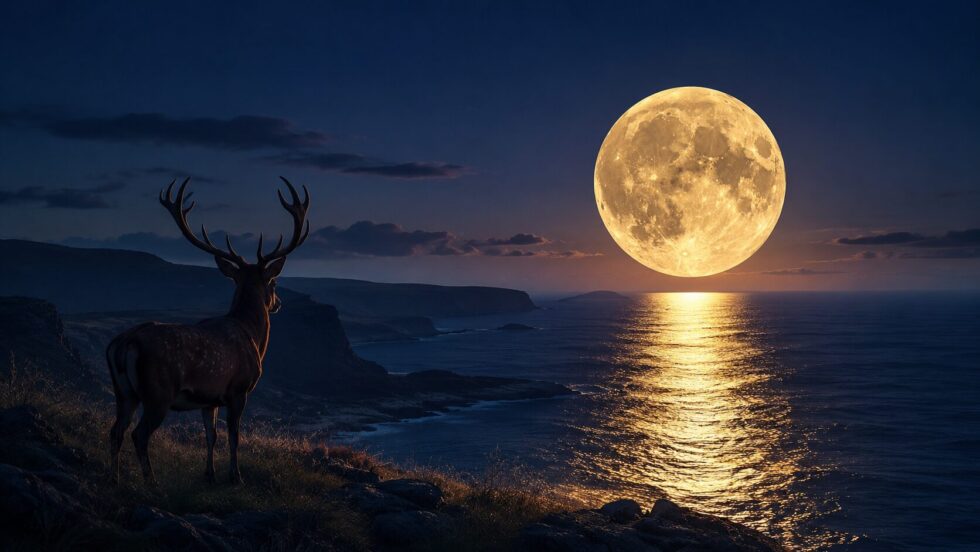
The Buck Moon, the full moon July skywatchers have been waiting for, will reach its precise peak at approximately 15:36 BST on Wednesday 29 July, bringing the second full Moon of Britain’s astronomical summer low across the southern sky. Although the exact instant of the July full moon occurs during daylight, people across the UK should still see an almost perfectly illuminated lunar disc after sunset on Tuesday and Wednesday, provided cloud does not obscure the horizon, The WP Times reports.
The full moon July 2026 display will be particularly striking because the Moon follows a shallow summer path and remains relatively low above Britain’s southern horizon. That low position can make the disc appear unusually large beside buildings, church towers, trees or coastal landmarks, although the effect is an optical illusion rather than a true increase in size. This is not a supermoon: Royal Observatory Greenwich identifies the only supermoon of 2026 as the full Moon on 24 December.
When Is the Buck Moon in the UK in July 2026
The Buck Moon becomes astronomically full at approximately 15:36 BST on Wednesday 29 July 2026, when the Moon and Sun are positioned on opposite sides of the Earth. Royal Observatory Greenwich gives the UK time as 3.36pm, while astronomical tables for London place the phase at approximately 3.35pm; the one-minute difference reflects rounding between calculation systems. The precise moment will not provide the best public viewing opportunity because it takes place in the afternoon, while the sky is still bright. The Moon will already have risen in parts of Britain, but its pale disc may be difficult to distinguish against daylight, especially where haze or cloud sits close to the horizon.
The more useful viewing period begins after sunset on Wednesday evening. By then, the July full moon will remain more than 99 per cent illuminated and should look completely round to the unaided eye. It will also appear essentially full on Tuesday night, 28 July, and during the first part of Thursday night, 30 July.
| Key Buck Moon detail | UK information |
|---|---|
| Full Moon date | Wednesday 29 July 2026 |
| Exact peak | Approximately 15:36 BST |
| Best practical viewing | After sunset on 29 July |
| Main direction | Southern to south-western sky |
| Appearance | Very low, bright and almost perfectly round |
| Equipment needed | None |
| Supermoon? | No |
| Next full Moon | Friday 28 August 2026 |
The Moon does not become “full” for an entire night in the strict astronomical sense. Full Moon is an exact alignment that occurs at a specific moment. However, the change in illumination is so gradual that human eyesight cannot normally detect the difference during the surrounding evenings.
What Time Should You Look for the July Full Moon
Skywatchers should begin looking as evening twilight develops rather than waiting until the middle of the night. The Moon’s unusually low summer track means it will not remain visible until dawn in the way many winter full Moons do.
For London, astronomical data indicates that the Moon rises in the south-east during the afternoon and sets before midnight. Its position after sunset will therefore be low across the southern part of the sky before moving towards the south-west. Local timings will vary across the country, and hills, buildings or trees can delay the moment when the disc becomes visible from a particular location. A practical UK viewing plan is:
- Arrive before sunset. This allows time to find an open view and avoid searching for a location in darkness.
- Face south or south-east initially. The Moon will follow a low arc across the southern sky.
- Check the horizon carefully. It may sit much lower than observers expect.
- Continue looking towards the south-west later in the evening.
- Do not wait until after midnight. In several UK locations, the Moon may already have set.
The full Buck Moon will be conspicuous once the sky darkens, but its low altitude means a clear horizon matters more than access to a formally designated dark-sky site.
Why Will the Full Moon July 2026 Appear So Low
The July full moon takes a low route because the full Moon lies approximately opposite the Sun in the sky. During the British summer, the Sun travels high across the daytime sky; the full Moon on the opposite side of the celestial sphere consequently follows a much lower night-time path. Royal Observatory Greenwich says the Buck Moon will sit no more than around 15 degrees above the southern horizon when viewed from London. For comparison, an outstretched fist held at arm’s length covers roughly ten degrees of sky, meaning the Moon will remain only about one-and-a-half fist widths above the horizon at its highest. This geometry explains why the best places to watch are not necessarily remote fields. A city bridge, riverside path, coastal promenade or open park can provide an excellent view if the southern horizon is unobstructed.
The low altitude also increases the chance that atmospheric haze, thin cloud or pollution will soften the Moon’s appearance. At the same time, those conditions can produce deep yellow, orange or reddish colours as moonlight travels through a greater thickness of the Earth’s atmosphere.
Is the July Buck Moon a Supermoon
No. The Buck Moon of 29 July 2026 is not a supermoon, despite the term frequently appearing beside photographs of previous July full Moons. A supermoon occurs when a full Moon takes place close to perigee, the nearest part of the Moon’s elliptical orbit around Earth. The exact definition varies because “supermoon” is a popular rather than formally standardised astronomical term, but the July event does not meet the usual criteria. Royal Observatory Greenwich lists one supermoon in 2026, on 24 December. At close lunar approaches, a full Moon can appear up to around 14 per cent wider and 30 per cent brighter than a full Moon near the most distant part of its orbit, although the difference is difficult to judge without photographs or direct comparisons.
The 2026 Buck Moon may nevertheless look enormous near the horizon. That appearance comes from the Moon illusion, a visual effect in which the human brain interprets the lunar disc as larger when it is seen beside familiar objects such as rooftops, trees or hills. The Moon itself does not suddenly expand, and a photograph taken with the same lens settings will show that its angular diameter changes little as it climbs.
Why Is July’s Full Moon Called the Buck Moon
The name Buck Moon is traditionally associated with the period when male deer, known as bucks, are growing new antlers. Deer shed and regrow their antlers in a recurring annual cycle, and by July the new growth is often clearly visible. Full Moon names developed as seasonal markers used by different communities to connect parts of the lunar calendar with farming, wildlife, weather and food gathering. The names now used in British media draw from several traditions and should not be treated as one universal historical naming system.
Royal Observatory Greenwich also records Thunder Moon as a July name, referring to the thunderstorms often associated with high summer. Another traditional term is Hay Moon, connected with the cutting and gathering of hay. These names do not describe a change in the Moon’s physical properties. A Buck Moon is astronomically the same type of full Moon as any other: the name identifies the month and seasonal context rather than a separate lunar event. Common Names for the July Full Moon
- Buck Moon: associated with the growth of new antlers on male deer.
- Thunder Moon: linked to summer storms.
- Hay Moon: connected with the traditional hay harvest.
- July full Moon: the straightforward astronomical calendar description.
The Buck Moon title has become the most widely recognised in current English-language coverage, particularly in North America and Britain.
Will the Buck Moon Be Visible Across the UK
The Moon itself will be visible from every part of the United Kingdom where the southern horizon is sufficiently clear. The decisive factor will be local weather rather than geography.
Current Met Office guidance indicates a broadly dry and settled start to the period in southern Britain, with sunny spells and very warm conditions. Northern and north-western areas face a greater chance of cloud or scattered showers, while forecasts become more changeable towards the end of July and early August. Because cloud forecasts can shift considerably over two days, viewers should check an hourly local forecast on Wednesday afternoon rather than relying on a single national outlook. The most favourable conditions are likely to occur where there are:
- breaks in low cloud;
- limited haze near the southern horizon;
- no prolonged rain;
- an open view away from tall buildings;
- moderate or low local light glare.
Thin high cloud will not necessarily prevent a sighting. The full Moon is bright enough to shine through some broken layers, although sharp crater detail and photographs may suffer.Heavy cloud close to the horizon is more disruptive because the Moon’s low path gives it less opportunity to rise above the obstruction.
Where Are the Best Places to See the Buck Moon
The best viewing location is a safe, open place with a clear southern or south-eastern horizon. Darkness helps, but horizon access is the priority.Suitable locations include:
| Location type | Why it works |
|---|---|
| East- or south-facing coast | Long, unobstructed horizon |
| Hilltop or elevated park | Reduces blockage from buildings and trees |
| Riverside promenade | Often provides open views through urban areas |
| Reservoir or lakeside path | Clear horizon and reflections on water |
| Open farmland | Limited artificial obstruction |
| City bridge | Useful alignment with landmarks and skyline |
| Large public park | Accessible and usually less enclosed |
Coastal sites can produce particularly dramatic views because the low Moon may appear above the sea or beside a lighthouse. However, viewers should avoid unstable cliffs, isolated tidal areas and unlit paths.In cities, photographers can use the low altitude to frame the Moon beside towers, domes, cranes or historic buildings. The apparent size becomes especially striking when a long lens compresses the distance between the foreground and the Moon.
How to Photograph the July Full Moon
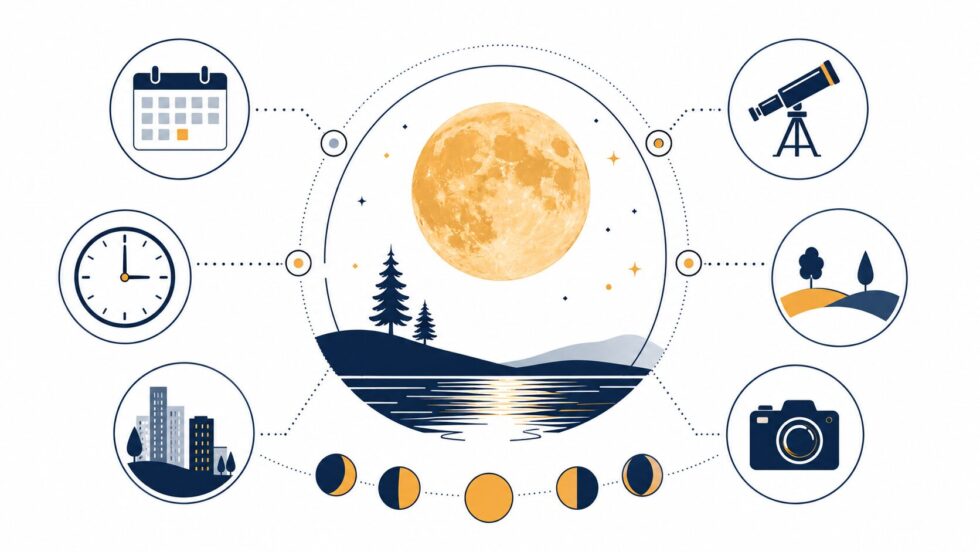
A smartphone can record the Buck Moon, but automatic exposure often turns the disc into a featureless white circle. The Moon is a sunlit object and requires a much shorter exposure than the surrounding night landscape.For a clearer image:
- Clean the camera lens. Fingerprints produce haze around bright objects.
- Turn off the flash. It cannot illuminate the Moon.
- Tap the Moon on the screen. This tells the camera where to focus.
- Reduce exposure manually. Drag the brightness control down until surface markings appear.
- Stabilise the phone. Use a wall, railing, tripod or firm support.
- Avoid excessive digital zoom. It enlarges pixels rather than adding real detail.
- Include a foreground subject. Buildings, trees or water give the picture scale and context.
- Take several exposures. Atmospheric conditions change quickly near the horizon.
For interchangeable-lens cameras, a telephoto lens between approximately 200mm and 600mm can make the Moon prominent in the frame. A tripod is helpful for composition, but extremely long exposures are unnecessary and can blur the lunar surface because the Moon moves across the sky.A useful starting point is a low ISO, a moderately narrow aperture and a shutter speed fast enough to preserve detail. Exact settings depend on the lens, cloud, atmospheric haze and whether the photographer is exposing for the Moon alone or combining it with a darker landscape.
Do You Need a Telescope to See the Buck Moon
No equipment is required. The Buck Moon will be easily visible to the naked eye whenever cloud permits.Binoculars can reveal the broad dark plains known as lunar maria and some of the bright ray systems extending from impact craters. A small telescope provides greater detail, but a full Moon is not always the best phase for studying crater relief because sunlight strikes the central lunar surface almost directly.The most dramatic crater shadows appear near the terminator, the boundary between lunar day and night. During a full Moon, that boundary lies around the far edge of the visible disc, so mountains and craters can appear flatter than they do during quarter phases.
Observers using binoculars should never attempt to find the Moon by sweeping close to the Sun during daylight. Wait until the Sun has set before using optical equipment unless an experienced observer is following appropriate solar-separation procedures.
What Else Can Be Seen in the Summer Sky
The Buck Moon arrives during an active period for summer astronomy, although its brightness will wash out many faint stars and meteors. The Perseid meteor shower is active through the second half of July and into August, with its main peak expected during the night of 12–13 August. The shower is produced when Earth passes through debris associated with Comet 109P/Swift–Tuttle. Observing conditions improve away from urban light, particularly after the Moon has moved out of the evening sky. The next major event is the 12 August 2026 total solar eclipse. Totality will cross parts of Greenland, Iceland, northern Spain and a small area of Portugal. The UK will experience a substantial partial eclipse rather than totality, meaning the Moon will cover part—but not all—of the Sun. NASA confirms that the partial phase will reach Britain and Ireland during the evening.
Certified eclipse glasses will be essential. Ordinary sunglasses, smoked glass, camera filters and improvised materials do not provide safe solar protection. A partial lunar eclipse follows on 28 August 2026. Unlike a solar eclipse, a lunar eclipse is safe to view without eye protection. During the event, part of the full Moon will move into Earth’s dark central shadow.
Buck Moon Questions Answered
What date is the Buck Moon in 2026?
The Buck Moon falls on Wednesday 29 July 2026, when the Moon reaches full illumination during the British afternoon before appearing almost perfectly round in the evening sky.
What time is the July full moon in the UK?
The full moon July 2026 reaches its exact astronomical peak at approximately 15:36 BST. At that moment, the Moon will be positioned opposite the Sun from Earth’s perspective, although daylight will prevent most observers from seeing the full effect.
Can I see the Buck Moon at 15:36 BST?
The Moon may already be above the horizon in parts of the UK, but the bright afternoon sky will make it pale and difficult to identify. The most reliable viewing period begins after sunset, when the lunar disc becomes brighter against the darkening sky while remaining more than 99 per cent illuminated.
Which direction should I face?
Begin by looking towards the south-east or southern horizon shortly after sunset. As the evening progresses, the Buck Moon will follow a low arc across the southern sky and move towards the south-west before setting. Buildings, hills and trees can easily block the view because the Moon will remain relatively close to the horizon.
Is the Buck Moon a supermoon?
No. The July full Moon is not a supermoon. Although it may appear unusually large when seen beside rooftops, trees or landmarks, this is mainly caused by the Moon illusion and its low position in the sky. The only full Moon generally classified as a supermoon in 2026 is expected on 24 December.
Will the Buck Moon look orange?
It may appear golden, orange or reddish when it is low above the horizon. At that angle, moonlight travels through a thicker layer of the Earth’s atmosphere, which scatters more blue light and allows warmer colours to dominate. Haze, dust, humidity, smoke and thin cloud can intensify the effect.
Can the July full Moon be seen from a city?
Yes. The Buck Moon is bright enough to remain visible through substantial urban light pollution, including from central London and other major cities. A clear southern horizon is more important than complete darkness, although parks, riverbanks, bridges and elevated viewpoints will usually provide a cleaner and more dramatic view.
Is Tuesday or Wednesday better for viewing?
Both Tuesday 28 July and Wednesday 29 July should show an apparently full lunar disc. Wednesday is the official Buck Moon date, but the Moon will already look almost completely illuminated on Tuesday evening. Viewers should therefore choose the night with the clearer local forecast rather than relying solely on the official astronomical date.
The Essential Buck Moon Viewing Guide for the UK
UK observers should not expect the Buck Moon to rise high overhead or remain visible throughout the night. The July full moon follows a low summer path, moving across the southern sky and towards the south-west before setting. The best strategy is to choose an open location with an unobstructed southern or south-eastern horizon, arrive before sunset and check the latest hourly cloud forecast shortly before travelling. No telescope, specialist equipment or dark-sky reserve is required. The Buck Moon can be seen with the naked eye, and even a brief opening in the clouds may reveal a bright, sharply defined lunar disc above the summer landscape. Binoculars can improve surface detail, while photographers will obtain the strongest compositions by framing the Moon beside buildings, trees, hills, water or coastal landmarks.
Claims that the Buck Moon is exceptionally large or a supermoon should be treated with caution. Its dramatic appearance will come mainly from its low altitude, warm atmospheric colour and the visual comparison with familiar objects near the horizon. Astronomically, it remains a normal full Moon; visually, however, the combination of timing, landscape and clear weather could make it one of the most striking lunar displays of the British summer.
Read about the life of Westminster and Pimlico district, London and the world. 24/7 news with fresh and useful updates on culture, business, technology and city life: How old is Madonna? Her age as she opens the 2026 World Cup halftime show
Materials used: Royal Observatory Greenwich, Met Office, NASA Eclipse Science, NASA Scientific Visualization Studio, Time and Date.