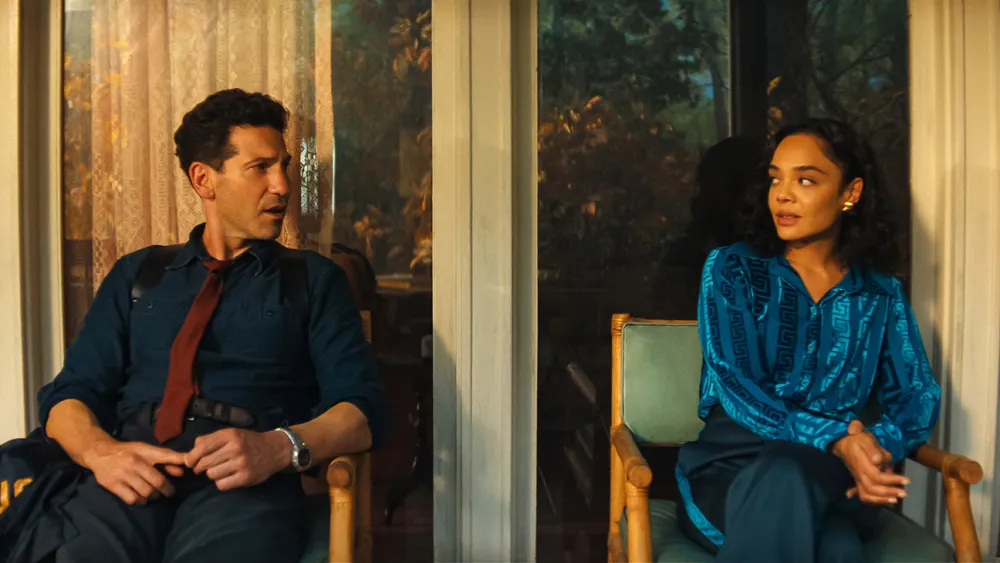
Netflix’s His & Hers arrives with the kind of pedigree that usually signals a prestige drama: a bestselling novel by Alice Feeney, a respected British film-maker in William Oldroyd and two global stars, Tessa Thompson and Jon Bernthal, placed at the centre of a small-town murder mystery. Set in rural Georgia, the six-part series follows a disgraced television reporter and a local detective whose past relationship becomes entangled in a brutal killing that links them both to the victim. On paper, the show promises a layered psychological thriller built around conflicting truths and unreliable perspectives. As The WP Times reports, Netflix is once again testing whether star power and glossy production can carry a mystery that depends on subtlety, structure and emotional tension.
The story begins in the quiet town of Dahlonega, where a woman is found stabbed and staged with a taunting message — a crime so rare that it immediately draws national attention. Jack Harper, played by Bernthal, is the local detective tasked with handling a case that quickly becomes personal. At the same time, Anna Andrews, portrayed by Thompson, a former Atlanta news anchor who disappeared from the public eye after a family tragedy, returns to the town to cover the murder. What initially looks like a professional collision soon reveals a deeper connection: Jack and Anna were once married, and both have their own complicated history with the victim.
This overlapping of personal and professional lives should give His & Hers a powerful emotional engine. The central idea — that the same story can look radically different depending on who is telling it — is one of the most fertile themes in modern crime drama. Yet from the opening episodes, the series struggles to turn that concept into real suspense. Instead of forcing viewers to weigh competing truths, it offers a largely neutral, omniscient perspective that flattens what should be a morally and psychologically ambiguous story.
What is Netflix’s His & Hers and why did it attract so much attention
His & Hers was launched by Netflix on 8 January 2026 as a six-episode limited series, adapting Alice Feeney’s popular novel for a global audience. The project was widely seen as a major step for William Oldroyd, whose films Lady Macbethand Eileen established him as a director interested in power, repression and moral ambiguity. Moving into television gave him a chance to explore those themes over a longer narrative arc, something that, in theory, suits a mystery built on secrets and shifting perspectives.
Netflix reinforced those expectations by casting Tessa Thompson and Jon Bernthal in the lead roles. Thompson brings emotional intelligence and restraint to Anna, a journalist trying to reclaim both her career and her identity after personal loss. Bernthal, known for playing damaged, volatile men, gives Jack a rough, defensive edge that fits a detective haunted by his past. The supporting cast — including Sunita Mani, Pablo Schreiber and Marin Ireland — adds further weight, creating the impression of a carefully assembled ensemble drama rather than a disposable streaming thriller.
The series was also marketed as a story about truth in the age of media. With Anna returning to television to cover a murder that involves her own history, His & Hers Netflix touches on the uneasy relationship between journalism, personal trauma and public storytelling. That combination of crime, media and intimate relationships is one of the reasons the show generated strong interest ahead of its release.
Why is His & Hers on Netflix struggling to deliver a convincing mystery
The main problem with His & Hers Netflix is not a lack of ambition, but a failure to commit to its own narrative idea. The novel is built around the concept of two unreliable narrators — “his” and “hers” — each offering a version of events that forces the reader to question what is real. The television series largely abandons that device. Instead of immersing viewers in competing subjective worlds, it presents most scenes from a detached, all-seeing perspective. The audience is told that characters are lying, but rarely given enough contradictory evidence to actively doubt them.
That choice drains much of the tension from the story. The investigation unfolds in a straightforward way, even though the script insists that nothing and no one should be trusted. The result is a mismatch between what the series claims to be about and how it actually behaves. Viewers are encouraged to watch rather than to participate in the mystery.
The emotional core of the show also suffers. Thompson and Bernthal are meant to play two people with a long, painful shared history, yet their scenes together feel oddly muted. There is little sense of unresolved love, anger or betrayal between them, making it harder to believe that the murder threatens to expose something deeply personal. Without that emotional pressure, the crime becomes just another plot mechanism rather than a catalyst for genuine drama.
Visually, His & Hers is sleek but distant. The Georgia setting never feels fully alive, and the stylised lighting creates a glossy, almost artificial mood. Heavy use of voiceover — filled with vague, philosophical statements about lies and truth — further distances the viewer from the characters. Instead of deepening the story, it often underlines how thin the drama is.
In the end, His & Hers looks like prestige television but behaves like a routine streaming thriller. It has the cast, the budget and the pedigree of a major Netflix drama, yet it never quite finds the psychological depth or narrative sharpness that its premise promises.
Read about the life of Westminster and Pimlico district, London and the world. 24/7 news with fresh and useful updates on culture, business, technology and city life: Netflix Stranger Things conformity rumour: is there really a secret episode nine coming on 7 January
Photo: Netflix