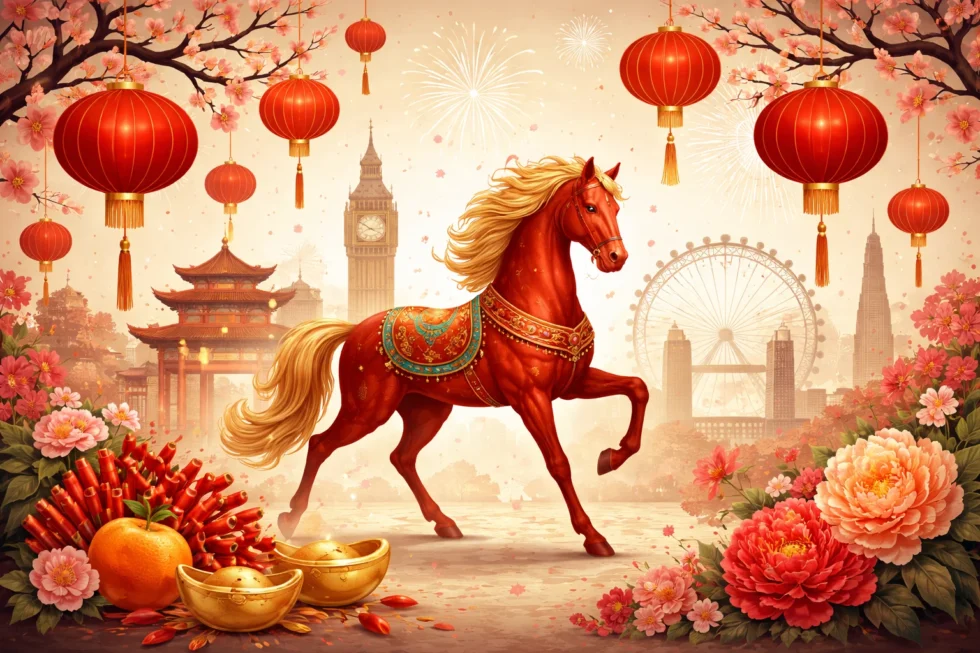
Chinese New Year, also known globally as Lunar New Year, enters a new cycle on 17 February 2026, opening the Year of the Horse and the annual Spring Festival period. Rooted in the lunar calendar rather than fixed dates, the festival combines astronomy, symbolism and social ritual in a way that continues to shape both private family life and public urban culture, according to The WP Times editorial team.
In 2026, Lunar New Year falls later than in some recent years, aligning with the first new moon of the lunar calendar. The date matters not only culturally but practically: it determines when millions of people travel, gather, close businesses temporarily and mark a clear psychological transition from one year to the next. While the festival is most closely associated with China, it has long since become a global event — and in cities such as London, it now forms part of the civic calendar.
When is Chinese New Year 2026 and how long does it last
For readers asking when is Chinese New Year 2026, the answer is precise: Tuesday, 17 February 2026. This date marks the first day of the lunar year and the start of the Spring Festival.
Celebrations traditionally last 15 days, concluding with the Lantern Festival on 3 March 2026, which coincides with the first full moon of the new year. In mainland China, public holidays typically cover the first week, but cultural observance extends well beyond that period.
The shifting date explains why questions such as when is Chinese New Year and when is Lunar New Year recur annually. Unlike the Gregorian calendar, the lunar system follows moon phases, anchoring the festival to natural cycles rather than fixed numbering.
Chinese New Year and Lunar New Year: what is the difference
Chinese New Year is a form of Lunar New Year, but the two terms are not always interchangeable. Lunar New Year refers broadly to celebrations marking the lunar calendar’s new year across several cultures, including in Korea, Vietnam and parts of Southeast Asia. Chinese New Year specifically reflects traditions that developed within Chinese history and society. In practice, many global cities — including London — use the terms interchangeably, reflecting the influence of Chinese diaspora communities on how the festival is presented internationally.
Why 2026 is the Year of the Horse
Each Lunar New Year corresponds to one of twelve zodiac animals, repeating in a fixed cycle. The Year of the Horse is traditionally associated with movement, independence and outward energy. In contrast to more inward-looking zodiac years, Horse years are often interpreted as periods of acceleration, visibility and change. In 2026, the Horse is paired with the Fire element, creating a Fire Horse year, a combination that appears only once every 60 years. In cultural interpretation, this pairing amplifies themes of intensity and momentum. While these beliefs are not predictive in a scientific sense, they continue to influence how people frame decisions, timing and expectations for the year ahead.
The structure of the Spring Festival: key rituals explained
Chinese New Year is not a single day but a structured sequence of rituals, each tied to specific meanings.
| Ritual or symbol | What happens | Cultural meaning |
|---|---|---|
| House cleaning (before New Year) | Deep cleaning in the final days of the old year | Clearing away past misfortune |
| Reunion dinner | Family meal on New Year’s Eve (16 February 2026) | Continuity across generations |
| Red decorations | Lanterns, banners, envelopes | Protection, vitality, good fortune |
| Firecrackers | Loud noise at key moments | Marking a clear break from the past |
| Red envelopes (hongbao) | Money given to children and unmarried relatives | Blessing rather than payment |
| Temple visits | Prayers during early festival days | Alignment with cosmic order |
| Lantern Festival | Public lantern displays | Closure, clarity, renewal |
These rituals function less as superstition and more as social choreography — creating shared timing, shared meaning and collective pause.
Food as symbolism, not indulgence
In the context of Lunar New Year, food operates as a system of symbols rather than a display of excess. The reunion table is carefully curated, with dishes chosen for their linguistic associations, historical origins and perceived ability to carry intention into the coming year. Eating, in this setting, becomes an act of meaning-making.
Fish occupies a central position because its name is a homophone for “surplus”, embedding the idea that resources should extend beyond immediate consumption. Traditionally, the fish is served whole and often left partially uneaten, reinforcing the concept that prosperity should continue rather than be exhausted. The gesture reflects a broader cultural preference for continuity over completion.
Dumplings, common in northern traditions, derive their significance from shape rather than flavour. Modelled on ancient gold ingots, they represent stability, stored value and intergenerational security. Their preparation is frequently communal, turning the act of cooking itself into a ritual of collective investment in the future.
Rice cakes, prepared in advance of the new year, are associated with progress through linguistic association: the word for cake echoes the term for height or growth. Their dense, layered texture mirrors the belief that advancement should be gradual and cumulative rather than abrupt.
Long noodles, served intact and never cut, symbolise longevity and an unbroken life course. The emphasis on length reflects a cultural view of time as continuous, where wellbeing is measured not by intensity but by endurance.
The repetition of these foods year after year functions as cultural anchoring. For families dispersed by migration or economic necessity, shared culinary symbolism provides a stable reference point — a way of preserving identity and optimism across distance and generational change.
Chinese New Year in London: from community festival to civic event
In London, Chinese New Year has evolved from a neighbourhood-based celebration into one of the capital’s most visible and widely attended annual cultural events. What was once largely centred on Chinatown now extends across Chinatown, Leicester Square and Trafalgar Square, drawing crowds that regularly reach the hundreds of thousands. In both scale and prominence, it is recognised as the largest Lunar New Year celebration outside Asia.
This transformation reflects a broader shift in how London integrates cultural traditions into public life. Chinese New Year is no longer treated as a peripheral festival observed by a single community. Instead, it temporarily reshapes central London, turning streets into ceremonial routes and major squares into civic stages. The festival functions simultaneously as cultural expression, public gathering and urban ritual.
Crucially, this expansion has not diluted the festival’s cultural core. Community organisations continue to shape the programme, ensuring that traditional forms—lion and dragon dances, symbolic rituals, calligraphy and music—remain central. What has changed is the audience. Chinese New Year in London now addresses the city as a whole.
Chinese New Year 2026 in London: dates, times and locations
Chinese New Year 2026 begins on Tuesday, 17 February, marking the start of the Year of the Horse. While the festival period spans 15 days in the lunar calendar, London’s main public celebrations are concentrated over the following weekend, in line with long-established practice.
Key dates
- 17 February 2026 (Tuesday) — Lunar New Year Day, ceremonial opening
- 21–22 February 2026 (Saturday–Sunday) — main public celebrations in central London
Main public events at a glance
| Date | Time | Location | What happens |
|---|---|---|---|
| 17 Feb 2026 (Tue) | Morning–afternoon | Chinatown (Soho) | Ceremonial opening of the Lunar New Year, traditional lion dances visiting businesses, symbolic rituals marking the arrival of the Year of the Horse |
| 21 Feb 2026 (Sat) | approx. 12:00–17:30 | Chinatown & West End | Pre-festival activities, lion dances, community performances and cultural atmosphere throughout Chinatown |
| 22 Feb 2026 (Sun) | approx. 10:00–12:00 | West End parade route | Main Chinese New Year parade featuring lion and dragon teams, percussion groups and community organisations |
| 22 Feb 2026 (Sun) | approx. 12:00–18:00 | Trafalgar Square | Main stage programme with music, dance, ceremonial performances and cultural showcases |
| 22 Feb 2026 (Sun) | approx. 12:00–18:00 | Leicester Square | Cultural demonstrations including calligraphy, martial arts and family-focused activities |
| 21–22 Feb 2026 | All day | Chinatown restaurants | Extended opening hours and special Lunar New Year menus built around symbolic dishes |
Times reflect established London Chinese New Year schedules and may be subject to minor adjustments once the final programme is confirmed.
What to expect on the ground
Chinatown: ritual and continuity
Chinatown remains the ceremonial heart of Chinese New Year in London. Lion dances move from business to business, accompanied by drums and cymbals, performing rituals intended to bring prosperity and protection for the year ahead. For long-established businesses, these visits are not performative but customary—an annual act of continuity.
Trafalgar Square: the civic stage
The main stage in Trafalgar Square represents the festival’s civic dimension. Performances here are curated for a broad audience and position Chinese New Year as part of London’s official cultural calendar rather than a niche event. The location itself signals inclusion: this is a festival staged at the symbolic centre of the city.
Leicester Square: participation and explanation
Leicester Square typically hosts interactive and educational elements. Calligraphy, martial arts and craft demonstrations allow visitors to engage with traditions directly, providing context rather than spectacle alone. This space plays a key role in translating Lunar New Year symbolism for a wider public.
Food, commerce and the Lunar New Year economy
Chinese New Year in London also has a significant economic dimension. Across Chinatown, restaurants extend opening hours and introduce menus focused on symbolic dishes—fish, dumplings, rice cakes and longevity noodles. These choices are deliberate, reflecting meanings associated with surplus, continuity, progress and long life. For many businesses, the Lunar New Year period rivals Christmas in importance. Yet the atmosphere differs. Commerce is intertwined with ritual, and dining becomes a form of participation rather than consumption alone.
Why Chinese New Year matters in Britain
The prominence of Chinese New Year in the UK reflects deeper changes in how British cities understand cultural time. Unlike fixed national holidays, Lunar New Year introduces a rhythm shaped by celestial cycles, emphasising renewal, family obligation and continuity.
For many people in Britain, February is typically seen as a quiet or transitional month. Chinese New Year disrupts that perception. It reframes the period as a moment of beginning rather than recovery, offering a collective pause early in the year. Even for those without personal cultural ties to the festival, it has become a shared civic marker—public, visible and meaningful. In this sense, Chinese New Year in London functions as more than a celebration. It is an annual reminder that the city operates across multiple calendars, traditions and cultural frameworks at once.
Key questions answered clearly
When is Lunar New Year 2026?
Lunar New Year begins on 17 February 2026, with the first new moon of the lunar calendar.
How long do celebrations last?
Traditionally 15 days, ending with the Lantern Festival on 3 March 2026, although London’s public events are concentrated over one weekend.
What animal year is 2026?
2026 is the Year of the Horse, associated with movement, independence and outward momentum.
Is Chinese New Year celebrated widely in the UK?
Yes. London hosts one of the largest and most visible Chinese New Year celebrations outside Asia.
Why does the date change every year?
Because the festival follows lunar moon cycles rather than the Gregorian calendar, causing the date to shift annually.
Read about the life of Westminster and Pimlico district, London and the world. 24/7 news with fresh and useful updates on culture, business, technology and city life - When is Ramadan 2026 in the UK and London and how 30 days of fasting affect your body