
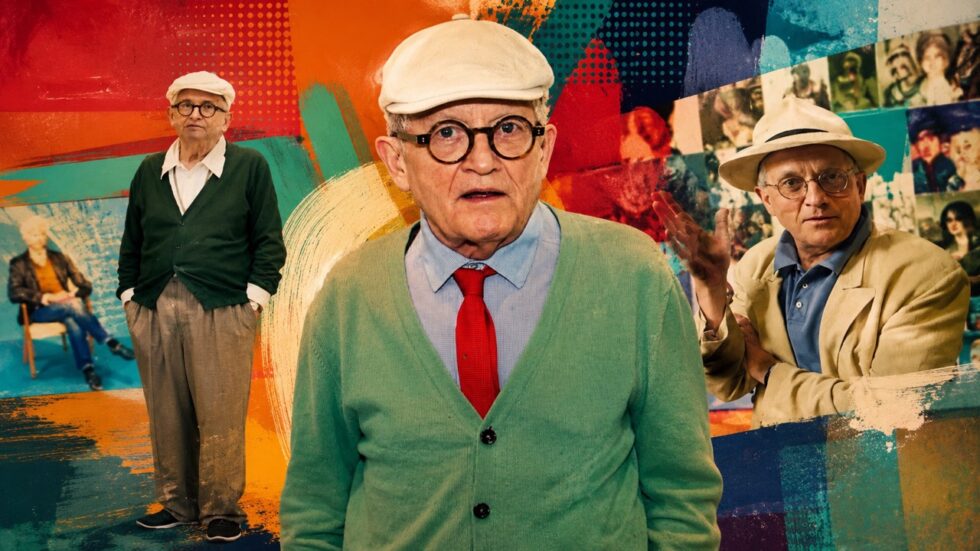
David Hockney died aged 88 after a career that carried British art from post-war Bradford to Los Angeles swimming pools, Yorkshire landscapes, Normandy digital drawings and record-breaking auction rooms. The Bradford-born painter, draughtsman, stage designer and restless experimenter died on 11 June 2026, leaving behind one of the most recognisable visual languages in modern culture: hard light, open colour, intimate portraits, fractured perspective and a belief that looking itself could be remade, The WP Times reports.
Hockney’s death closes a life that was never contained by one school, one country or one technique. He was often described through the bright surface of California — turquoise pools, glass houses, sun, youth and desire — but the deeper story was more complicated. His work joined pleasure with discipline, sensuality with structure, and public fame with a severe daily practice. From the Royal College of Art in London to the studios of Los Angeles, Bridlington and Normandy, he kept returning to the same central question: how does a person really see the world?
David Hockney death: what is known about the British artist’s final days
David Hockney died aged 88, just weeks before what would have been his 89th birthday on 9 July. Reports from major news organisations said he died at home, while no detailed public cause of death was immediately disclosed. The announcement was followed by a rapid wave of reaction because Hockney was not only a museum figure, but one of the few living artists whose name was familiar far beyond the art world. His paintings were reproduced on posters, studied in schools, debated by critics, bought for extraordinary sums and loved by people who did not necessarily follow contemporary art.
The public response was shaped by the unusual span of his career. Hockney was already a major figure in the 1960s, yet he remained active in the age of the iPad, immersive exhibitions and digital screens. His late work was not a footnote to an old career; it was part of the same argument about perception, technology and time. That is why his death is being treated not only as the loss of a famous painter, but as the end of a rare artistic life that stayed current for more than six decades.
Key facts now being reported include:
| Detail | What is known |
|---|---|
| Name | David Hockney |
| Age | 88 |
| Born | 9 July 1937, Bradford, West Yorkshire |
| Died | 11 June 2026 |
| Known for | British Pop Art, California pool paintings, portraits, landscapes, photo-collage, iPad drawings |
| Major works | A Bigger Splash, Portrait of an Artist (Pool With Two Figures), A Year in Normandie |
| Auction milestone | Portrait of an Artist sold for $90.3m in 2018 |
| Legacy | One of the most influential British artists of the 20th and 21st centuries |
Hockney’s importance cannot be reduced to a single canvas or record price. He helped make British art feel modern without making it cold. He showed that colour could be serious, pleasure could be intellectual, and personal life could become public art without losing complexity.
David Hockney and Bradford: how a Yorkshire childhood shaped a global artist
David Hockney was born in Bradford in 1937 into a working-class family marked by discipline, politics and independence of mind. His father, Kenneth, was a conscientious objector and a strong moral presence; his mother, Laura, came from a Methodist background and gave the family structure. Hockney grew up during wartime Britain, in a world of rationing, air raids and limited resources. The lack of easy materials did not stop his early drawing; it pushed him towards invention.
Bradford mattered because it gave Hockney more than a birthplace. It gave him a way of seeing social class, stubbornness, humour and work. He studied at Bradford College of Art before moving to London’s Royal College of Art, where his talent was quickly obvious but his obedience was not. He resisted academic rules, rejected some required conventions and insisted that art should be judged by the work itself rather than by institutional performance. That tension — between formal training and personal freedom — remained visible throughout his life.
Why the Royal College of Art years became decisive for Hockney
At the Royal College of Art, Hockney became known as a gifted but difficult student. He did not simply want to paint what he was told to paint; he wanted to paint what mattered to him. That included literature, politics, male desire, urban life and the charged atmosphere of a society changing faster than its laws. His early works openly addressed gay life at a time when homosexuality was still criminalised in Britain. This was not a decorative rebellion. It was a serious artistic and social act.
The Royal College years also placed him within a wider generation of artists who were dismantling old hierarchies between high art, popular culture, advertising, photography and private experience. Hockney belonged to the Pop Art moment, but he was never only a Pop artist. His work had graphic clarity and cultural immediacy, yet it also had tenderness, melancholy and an old-fashioned devotion to drawing. He looked modern because he refused to stop looking carefully.
David Hockney California paintings: why the swimming pools became modern icons
David Hockney’s move to Los Angeles in the 1960s transformed both his career and the public image of modern British art. California gave him a new architecture of light: flat roofs, glass walls, blue pools, open roads, bodies in motion and a visual culture shaped by cinema and photography. Paintings such as A Bigger Splash and Portrait of an Artist (Pool With Two Figures) became central to how later audiences imagined Los Angeles. They were not simply pictures of luxury. They were studies of distance, desire, silence and surface.
The pools were powerful because they allowed Hockney to paint what cannot easily be fixed: water, reflection, heat, movement and tension. A splash is an event that disappears almost immediately, yet Hockney turned it into a permanent image. A man standing by a pool can look relaxed, isolated, erotic or grieving depending on the viewer’s attention. That ambiguity helped his California paintings outlive the style of the 1960s. They became visual symbols of freedom, but also of emotional distance.
The most famous market confirmation came in 2018, when Portrait of an Artist (Pool With Two Figures) sold for $90.3m at Christie’s. At the time, it was a record for a living artist at auction. The price mattered because it showed how far Hockney had travelled from Bradford art school to the centre of the global art market. Yet the painting’s importance did not depend only on money. Its lasting power came from the strange calm of the scene: a swimmer underwater, a clothed man looking down, a relationship suspended between beauty and loss.
David Hockney legacy: why he mattered beyond painting
Hockney’s legacy is not only that he made famous pictures. It is that he kept changing the terms of how pictures could be made. He used painting, drawing, printmaking, photography, photocollage, fax machines, photocopiers, stage design, digital tablets and large-scale immersive formats. He did not treat technology as a replacement for art. He treated it as another tool for seeing.
His “joiners”, made from multiple photographs assembled into larger compositions, challenged the single-point perspective inherited from Renaissance painting and modern photography. Instead of pretending that vision was fixed, Hockney showed that looking happens over time. A face, a room or a street could be understood through fragments. The method was playful, but the idea was serious: human vision is active, mobile and selective.
Hockney also brought this curiosity into theatre and opera design. His stage work showed that scale, colour and illusion could change how audiences experience music and drama. Later, his iPad drawings surprised viewers who expected digital work to feel cold or mechanical. Hockney used the tablet as a sketchbook of immediacy. Blossom, trees, seasons and changing light became portable, repeatable and shareable, but still visibly touched by the hand and eye of an artist.
His range can be understood through several linked phases:
| Period | Main direction | Why it mattered |
|---|---|---|
| 1950s–early 1960s | Bradford and London training | Formed his discipline, drawing skill and resistance to convention |
| 1960s | Pop Art and early gay subject matter | Brought personal life and contemporary culture into British painting |
| Mid-1960s–1970s | Los Angeles paintings | Created a new visual language of light, water, desire and modern living |
| 1980s | Photo-collage and perspective experiments | Challenged the fixed viewpoint of conventional images |
| 1990s–2000s | Landscapes, theatre, optical theory | Expanded his work into scale, history and perception |
| 2010s–2020s | iPad drawings and Normandy work | Proved late-career innovation could be central, not secondary |
David Hockney quotes: what his own words reveal about art and looking
Hockney’s public statements often sounded simple, but they carried a strong theory of art. He repeatedly returned to the idea that drawing teaches people to look. This mattered because for him looking was not passive. It was a discipline, a pleasure and a form of resistance against distraction. His career can be read as a long defence of attention.
When he spoke about technology, he did not present himself as a futurist in the corporate sense. He was interested in tools only when they served images. A fax machine, a photocopier or an iPad mattered because it could make a picture possible in a new way. That position kept him from becoming nostalgic. He did not defend painting by rejecting technology; he defended pictures by using every available tool.
His best-known attitude may be summarised in the idea that an artist should paint what he loves. In Hockney’s case, that did not mean avoiding difficulty. Love in his work could mean erotic longing, family memory, grief, landscape, friendship, sunlight, architecture or the stubborn act of continuing to draw after illness and personal loss. The emotional directness was part of the intelligence of the work.
David Hockney and the art market: why the auction record did not define him
The 2018 Christie’s sale of Portrait of an Artist (Pool With Two Figures) made Hockney a global financial headline. For many readers outside the art world, the $90.3m price became the easiest fact to remember. But the auction record should be treated as evidence of demand, not as the measure of his achievement. Hockney had already changed the visual culture before the market confirmed it.
The art market often rewards scarcity, status and recognisability. Hockney’s work had all three, but it also had something rarer: immediate public readability without artistic simplification. A viewer could enjoy the blue of a pool or the freshness of a spring tree before knowing anything about perspective theory, sexuality, Pop Art or the history of photography. That accessibility sometimes made critics underestimate him. Over time, it became one of the reasons he mattered.
His popularity was not a weakness. It was part of the achievement. He built a serious career without making seriousness depend on darkness, obscurity or distance from ordinary viewers. His images could be reproduced widely and still hold their force in museums. That is a difficult balance, and few post-war British artists managed it with comparable consistency.
David Hockney in later life: Yorkshire, Normandy and the refusal to stop working
In later life, Hockney returned repeatedly to landscapes, especially in Yorkshire and Normandy. These works were sometimes read as a retreat from the charged modernity of Los Angeles, but that reading is too simple. The landscapes were another form of experiment. Trees, roads, fields and seasonal change allowed him to examine time, repetition and perception in a different register.
After a stroke in 2012, Hockney continued to work. After the death of his young assistant Dominic Elliott in 2013, he publicly acknowledged the shock and difficulty of continuing. Yet the larger pattern of his life remained one of persistence. He kept producing, exhibiting and arguing for the value of images. His late works, including large digital and panoramic projects, showed an artist still interested in scale and new forms of presentation.
Normandy became particularly important because it gave Hockney a stage for observing seasonal transformation. During the pandemic period, he made images of trees, blossom and the passage of time that reached audiences living through isolation and uncertainty. The subject was not spectacular in a conventional news sense. Its power came from attention: the world was still changing, and the artist was still looking.
What David Hockney leaves behind for British art
David Hockney leaves behind more than a catalogue of famous works. He leaves a model of artistic independence rooted in craft, curiosity and refusal. He refused to be only a Yorkshire artist, only a London artist, only a California painter, only a Pop artist, only a gay pioneer, only a landscape painter or only a digital experimenter. Each label explains something; none explains enough.
His influence will continue because younger artists inherit not just his colours or motifs, but his permission to move across media. He showed that drawing could survive photography, painting could survive television, and the hand could survive the screen. He also showed that pleasure in art does not have to be shallow. A bright surface can carry memory, loneliness, politics and desire.
For Britain, Hockney’s death removes one of the country’s most internationally recognised cultural figures. For the wider art world, it marks the end of a career that made modern life look sharper, brighter and stranger. His work asked viewers to slow down and look again — at a swimming pool, a face, a road, a tree, a room, a season. That lesson remains.
Prepared using materials from The Guardian, BBC News, Reuters, Associated Press, Financial Times, Christie’s, the Royal College of Art, and the David Hockney Foundation.