
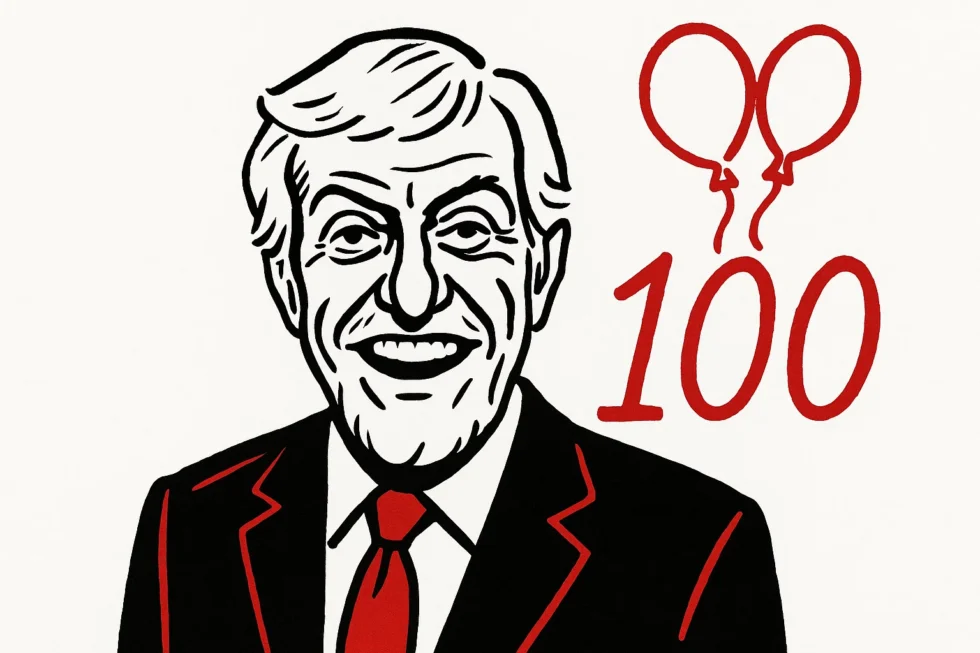
Dick Van Dyke turned 100 this week, reaching a milestone few performers in modern entertainment history have lived to see. Actor, dancer and comedian, he remains one of the last living links to the formative years of American television and post-war Hollywood cinema. His centenary has been marked by nationwide screenings, renewed media attention and a documentary celebrating a career that spans nearly eight decades. According to team at The WP Times , the London-based online magazine, Van Dyke’s 100th birthday is being viewed not merely as a personal celebration, but as a cultural landmark.
From Midwestern beginnings to television stardom
Born in 1925 in West Plains, Missouri, Dick Van Dyke grew up in Danville, Illinois, where he developed an early interest in performance and physical comedy. He has repeatedly credited silent film comedians — including Buster Keaton and Charlie Chaplin — as key influences on his timing, movement and visual humour.
His breakthrough came with The Dick Van Dyke Show, which aired on CBS from 1961 to 1966. The sitcom, centred on a television comedy writer and his family, became one of the most influential programmes of its era. It combined sharp dialogue with physical humour and helped redefine how middle-class American life was portrayed on screen. Van Dyke won multiple Emmy Awards for the role, establishing himself as one of television’s most recognisable faces.
Hollywood films and Disney classics
Van Dyke successfully transitioned from television to cinema during the 1960s. His role as Bert in Disney’s Mary Poppins (1964) remains his most internationally recognised performance. While his Cockney accent has often been the subject of affectionate criticism, the film itself became a cornerstone of family cinema and remains in continuous circulation six decades later.
He later appeared in Chitty Chitty Bang Bang (1968), further cementing his association with musical family films. Van Dyke once explained that he deliberately sought projects his children could watch — a decision that shaped both his public image and his enduring appeal.
Awards and professional longevity
Over the course of his career, Van Dyke has received four Primetime Emmy Awards, a Tony Award and a Grammy Award, placing him among the most decorated performers of his generation. He was inducted into the Television Hall of Fame in 1995.
In 2024, at the age of 98, he became the oldest recipient of a Daytime Emmy Award, winning for Outstanding Guest Performance in a Daytime Drama Series for his appearance in Days of Our Lives. Speaking ahead of the ceremony, he told Entertainment Tonight:
“I think I’m the last of my generation. I have almost all my marbles — I just can’t remember what I had for breakfast.”
Van Dyke is one Academy Award short of achieving EGOT status. He has openly joked about the possibility, telling interviewers he hopes such recognition would not come after his death.
Personal struggles and sobriety
Despite professional success, Van Dyke has spoken candidly about his battle with alcoholism in the 1970s. He later described achieving sobriety as a turning point that allowed him to rebuild his personal life and regain professional stability. Rather than damaging his reputation, this openness strengthened his public credibility, particularly as attitudes toward mental health and addiction evolved.
In later interviews, Van Dyke has noted that he now receives more letters from children than he did during the height of his fame, many of whom repeatedly watch his films on modern platforms. “I’m on my third generation,” he told CBS Sunday Morning in 2023.
Turning 100: how the milestone was marked
To mark his 100th birthday, cinemas across the United States screened a new documentary, Dick Van Dyke: 100th Celebration, which chronicles his life through archival footage and recent interviews. The film focuses not only on his professional achievements but also on his continued engagement with physical movement and performance.
Van Dyke has acknowledged that ageing has limited his mobility. He has spoken openly about joint problems and a weakened leg, yet remains committed to regular exercise. He credits his wife, Arlene Silver, a makeup artist and producer 54 years his junior, with encouraging him to maintain a gym routine several times a week.
“As I’ve said, if I’d known I was going to live this long, I would have taken better care of myself,” he told CBS Sunday Morning.
“I still try to dance”
Ahead of his centenary, Van Dyke reflected on how he once portrayed older characters as irritable or angry. “It’s not really that way,” he told ABC News, adding that emotional outlook matters as much as physical condition. Asked what he misses most about youth, he replied simply: movement.
“I still try to dance,” he said, laughing — a remark that has since been widely quoted as a concise summary of his approach to ageing.
A lasting cultural presence
Dick Van Dyke’s 100th birthday highlights more than personal longevity. It underscores the durability of a style of entertainment rooted in craft, discipline and physical performance. In an era dominated by rapid content cycles, his work continues to circulate across generations, serving as a bridge between early television, classic cinema and modern audiences.
At 100, Van Dyke remains less a monument than a participant — a living reminder that cultural impact can extend far beyond the era in which it began.
Read about the life of Westminster and Pimlico district, London and the world. 24/7 news with fresh and useful updates on culture, business, technology and city life: Zootopia 2 Box Office: How the Disney sequel set a massive new global record
Sources: CBS News, Associated Press, ABC News, Entertainment Tonight, The Times (London)