
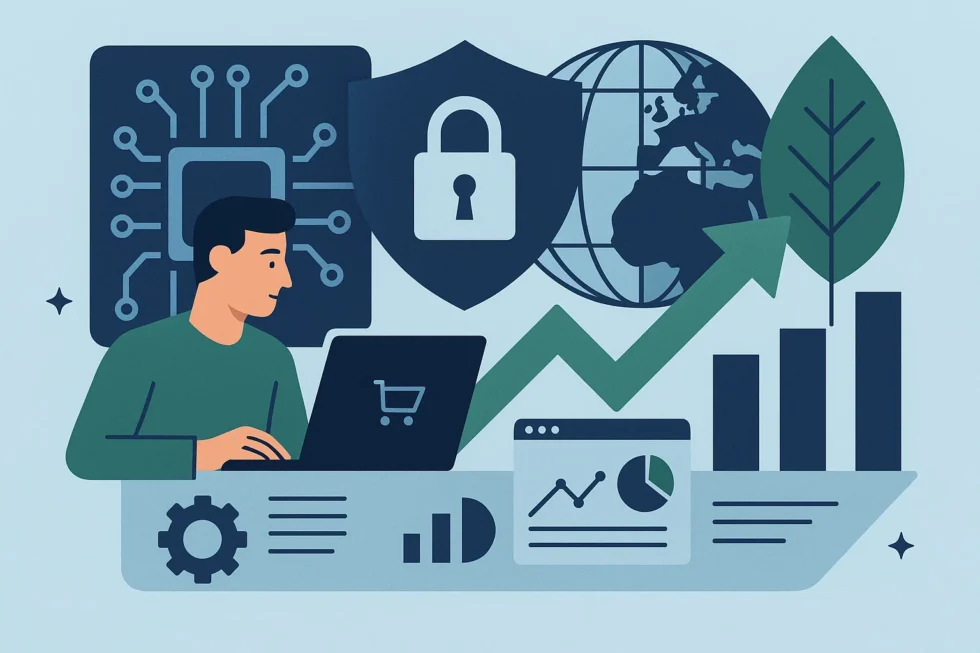
London, 2 November 2025. Artificial intelligence and cybersecurity are redefining the backbone of British e-commerce. As the sector surpasses £155 billion in annual online sales, the UK is turning into a testing ground for Europe’s digital transformation — where automation, data ethics and consumer trust determine who leads the market. The WP Times reports that Britain’s e-commerce firms face a dual challenge: rapid technological expansion alongside a growing need for data protection and environmental accountability.
Citing recent analyses from Ecommerce Europe, the European Union Agency for Cybersecurity (ENISA) and Mordor Intelligence 2025, The Times notes that the European online market now exceeds USD 680 billion with annual growth above 8 percent, while the UK must balance innovation with post-GDPR compliance, increasing cyber-threats and public pressure for greener, more transparent technology.
AI turns data into competitive intelligence
British retailers now treat artificial intelligence as a profit driver, not a marketing trend. Predictive analytics forecast stock levels; dynamic pricing engines adjust to market demand; and AI-based recommendations already account for 35 percentof online revenue. Machine-learning tools also combat waste and fraud — cutting operational costs by double digits. For example, fashion platforms using AI sizing algorithms have reduced returns by 20 percent, according to Ecommerce Europe 2025.
Cybersecurity becomes a brand issue
With 77 percent of cyber incidents in Europe involving DDoS or ransomware (ENISA 2025), data protection is now a selling point.
UK companies deploy continuous code audits, tokenisation, and AI-driven anomaly detection to protect payment systems. Consumer perception reflects this shift: YouGov found that 68 percent of Britons abandon a purchase if a site seems insecure. Security transparency has become a competitive advantage — and a new metric of brand integrity.
Ethics and sustainability in digital retail
Beyond algorithms, shoppers increasingly ask how ethical their technology is. Major UK data centres now operate on 90 percent renewable energy, while remote-first logistics models have cut emissions by 30 percent since 2023.
“Sustainability and trust are the twin currencies of digital retail,” says Tom Harris, sustainability director at Retail Economics UK. “AI is powerful, but without ethical design, it risks eroding confidence instead of creating value.”
The outlook for 2026: from speed to substance
Emerging trends point to a smarter, more transparent industry:
- AR/VR shopping to simulate in-store experiences;
- Voice commerce through Alexa and Google Home;
- Blockchain traceability in supply chains;
- BNPL regulation under the Financial Conduct Authority;
- Warehouse robotics filling skilled-labour gaps.
How to Stay Cyber-Safe in 2025: Everyday Security Tips for UK Businesses
Cyberattacks in the UK are rising faster than ever — and not just for big corporations. The National Cyber Security Centre (NCSC) warns that most breaches now target small retailers, freelancers and digital agencies that neglect basic online hygiene. In 2025, protecting your e-commerce platform, payments and customer data doesn’t require expensive software — it starts with daily discipline and awareness.
Five simple rules to protect your business
- Activate multi-factor authentication on every account — banking, email, hosting — to block over 90 % of unauthorised logins.
- Install updates weekly. Outdated plugins and systems are the main door for hackers — patch before you publish.
- Encrypt and back up your data. Use GDPR-compliant cloud storage and keep an offline copy in case of ransomware.
- Educate your staff. Most cyber incidents begin with phishing — train employees to check sender addresses and links.
- Monitor your logins and traffic daily. Tools like NCSC Early Warning or Google Security Checkup alert you before damage spreads.
Cybersecurity is now part of business culture in Britain: not a cost, but an act of trust. Companies that practise these five steps earn what money can’t buy — credibility and customer confidence.
E-commerce in 2025 is no longer just digital shopping — it is the operating system of Britain’s consumer economy. AI, cybersecurity and ethics will define who leads this market and who fades into digital noise.
Read about the life of Westminster and Pimlico district, London and the world. 24/7 news with fresh and useful updates on culture, business, technology and city life: Will Elon Musk’s Tesla Tiny House Really Reach the UK – or Is It Just Another Vision