
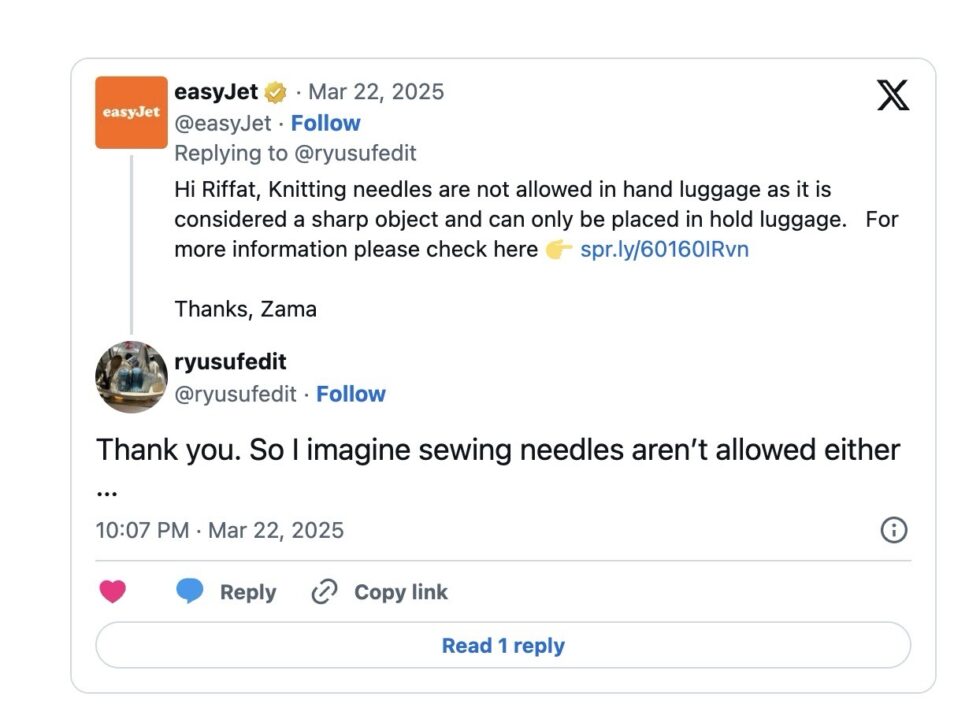
easyJet has clarified its cabin baggage rules after a passenger enquiry, confirming that knitting and sewing needles are not permitted in hand luggage and must be placed in hold baggage. The clarification followed a public exchange on X ahead of a planned flight from Liverpool to Faro, where a traveller asked whether circular knitting needles could be carried onboard for charitable use. The airline responded directly, reinforcing that any sharp or pointed items capable of causing injury are prohibited in the cabin under existing safety policy, reports The WP Times, citing UK media coverage and airline statements.
The clarification, reported by Daily Mirror and Liverpool Echo on 10 April 2026, directly affects passengers travelling on cabin-only fares — a key part of easyJet’s low-cost pricing structure. In practical terms, travellers carrying knitting or sewing items can no longer rely on hand luggage alone and may be forced to purchase hold baggage, often at an additional cost that exceeds the base fare. This turns a routine safety clarification into a clear pricing factor, particularly for budget-conscious passengers who deliberately avoid checked luggage.
What easyJet actually confirmed and why it matters
easyJet confirmed that knitting and sewing needles are classified as sharp objects and are not permitted in cabin baggage under its existing safety rules. The clarification followed a direct passenger enquiry and was issued publicly on 10 April 2026, removing uncertainty around whether smaller or circular needles might be allowed. The airline’s wording makes clear that the restriction is based on potential risk, not size or intended use. This aligns with standard aviation security frameworks applied across UK and EU airports. For passengers, this means such items must be planned into hold luggage before travel.
“Sharp objects or items with pointed edges that could cause injury are not allowed in cabin baggage. These items must be packed in hold luggage.” (easyJet, 10 April 2026)
“Yes, both sewing and knitting needles are not allowed onboard.” (easyJet confirmation)
Key allowed vs restricted items (cabin rules)
| Item | Cabin allowed | Condition |
|---|---|---|
| Tweezers | Yes | No restriction |
| Scissors | Yes | Rounded ends, blade <6cm |
| Razor blades | Yes | Must be in plastic cartridge |
| Small knives | Yes | Blade ≤6cm |
| Knitting needles | No | Must go in hold luggage |
| Sewing needles | No | Must go in hold luggage |
The distinction is based on measurable safety thresholds, particularly blade length and whether an item is enclosed or exposed.
Which items are still allowed in cabin bags
easyJet permits a limited group of personal items in cabin baggage where the physical characteristics fall below defined risk limits. The most important parameter is the 6cm blade threshold, which is widely used in European aviation screening. Items that are enclosed (such as cartridge razors) or structurally blunt are generally permitted. However, open pointed tools — even if small — are excluded from cabin transport. This creates a clear but strict boundary for passengers packing personal or hobby items.
Allowed items in cabin baggage (summary)
- Tweezers
- Scissors (rounded, under 6cm)
- Cartridge razors
- Small knives under 6cm blade
Anything outside this list — including knitting equipment — must be placed in checked baggage. This rule is applied consistently at airport security rather than onboard.
How much hold luggage costs and what passengers can buy
The rule has direct cost implications because easyJet operates a tiered pricing model where hold luggage is not included in basic fares. Passengers needing to carry restricted items must purchase checked baggage in advance or pay higher fees at the airport. The airline allows flexible weight and bag combinations, including pooling across passengers on the same booking. Standard allowances and upgrade options are clearly defined and apply across most routes. Prices vary by route and timing but follow a predictable structure.
Hold luggage options and limits
| Option | Details |
|---|---|
| Bags per passenger | Up to 3 |
| Standard weight | 23kg |
| Maximum per bag | 32kg |
| Extra weight | +3kg increments |
| Weight pooling | Yes |
Typical pricing ranges from £20 to £40+ per bag when booked in advance, with higher charges applied at the airport. As a result, passengers travelling with restricted items face a clear planning decision before departure.
What happens at the airport if you bring restricted items
At the airport, enforcement takes place at the security screening stage, not at the gate, which means passengers carrying restricted items such as knitting needles face immediate decisions. Under easyJet policy, such items cannot proceed through cabin baggage screening and are treated as non-compliant. Options are operationally limited and depend on timing before departure. In most cases, passengers must either surrender the item or incur additional costs to comply with baggage rules. This makes pre-travel packing decisions critical, especially on cabin-only fares.
What typically happens at security
- Item is confiscated during screening
- Passenger returns to check-in (if time permits)
- Last-minute hold baggage is purchased at airport rates
| Scenario | Outcome | Cost impact |
|---|---|---|
| Confiscation | Item permanently lost | None (item lost) |
| Return to check-in | Item placed in hold bag | Standard fee (if pre-booked possible) |
| Airport hold baggage purchase | Item accepted after payment | Highest cost (airport rate) |
Airport charges are consistently higher than online pre-booked prices, often making this the most expensive outcome. The process leaves little flexibility once a passenger reaches security.
Why this rule exists and how strictly it is enforced
The restriction is grounded in international aviation security standards, where items are assessed based on potential risk rather than intended use. Even objects associated with everyday activities — such as knitting — are classified as restricted if they have pointed or sharp characteristics. Airlines, including easyJet, apply these rules in line with UK and EU screening frameworks. This ensures consistency across airports, regardless of departure location. The approach prioritises uniform enforcement over individual interpretation.
Core enforcement logic
- Risk-based classification (not purpose-based)
- Focus on physical characteristics (sharp, pointed)
- Alignment with UK/EU airport security standards
- Limited discretion at screening level
In practice, enforcement is strict at security checkpoints, with only minor variation in interpretation. easyJet’s clarification removes uncertainty for passengers: knitting and sewing needles are not permitted in cabin baggage under its rules. For frequent travellers, the implication is practical — routine personal items may still trigger additional costs and require advance planning.
Read about the life of Westminster and Pimlico district, London and the world. 24/7 news with fresh and useful updates on culture, business, technology and city life: EasyJet passenger alert new: why travellers risk missing flights under Europe’s EES border system