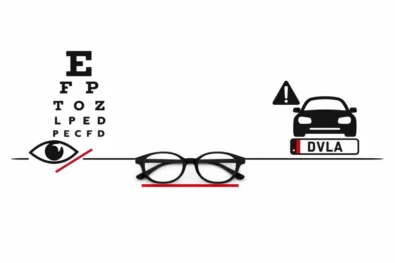
Britain is preparing to introduce the most significant change to eye tests over 70 driving in more than a generation, as ministers move to make vision checks mandatory for older motorists in a bid to cut deaths without taking away independence, The WP Times reports, citing the Department for Transport and the Driver and Vehicle Licensing Agency (DVLA).
Under proposals to be published this week as part of the government’s new road safety strategy, drivers aged 70 and over would be required to pass a formal eyesight test every three years in order to keep their driving licence. The move follows years of warnings from coroners, doctors and road safety bodies that Britain’s current system – which relies almost entirely on self-reporting – is no longer fit for purpose in an ageing society.
Why the government is acting now
Britain’s population is getting older, and so is its driving workforce. More than five million people in the UK now hold a driving licence past the age of 70, a figure that has risen sharply over the last decade as people live longer, healthier lives and remain active for longer.
However, the safety data has been moving in the opposite direction. Government figures show that around 24% of drivers killed in collisions in 2024 were aged 70 or older, despite this age group making up a far smaller share of total licence holders. Older drivers also accounted for roughly 12% of all car crash casualties.

Ministers say the new rules are designed to respond to those trends without unfairly penalising people simply because of their age. Lilian Greenwood, the local transport minister, said the strategy aims to “balance personal freedoms with measures to save lives” as Britain’s older population continues to grow.
What the new eye test rule would require
At present, UK drivers only need to prove their eyesight when they first take their driving test. After that, the system relies on honesty. Motorists are legally required to tell the DVLA if their eyesight deteriorates to the point where they can no longer meet the legal standard, but there is no routine checking and no enforcement mechanism unless someone is caught after a collision.
The legal eyesight standard in the UK is simple but strict: drivers must be able to read a standard number plate from 20 metres away, with glasses or contact lenses if needed.
Under the new proposals, drivers over 70 would need to demonstrate that they still meet this standard through a formal eye test every three years. Failure to do so would mean losing the licence until eyesight is corrected.
Why self-reporting has been criticised
The push for reform has been driven by a series of inquests and safety investigations. Last year, HM Senior Coroner for Lancashire, Dr James Adeley, said Britain’s reliance on self-reporting of eyesight problems was “ineffective and unsafe” after several fatal crashes involving drivers with serious vision impairment.
In a report sent to Transport Secretary Heidi Alexander, he warned that the current system allows drivers to ignore medical advice, lie about their condition or continue driving despite being told not to.
The UK is now one of only three countries in Europe that still relies almost entirely on self-reporting for visual fitness to drive.
What older drivers themselves are saying
Many older motorists already get their eyes tested far more frequently than the law requires. Eye tests are free in the UK from the age of 60, and opticians recommend having them at least every two years because they can detect conditions such as glaucoma, cataracts and macular degeneration.
Edmund King, president of the AA, said regular testing is already good practice. “Eye tests are free for people over 60 and healthcare professionals advise them every two years,” he said. “In fact, the AA advises everyone to have an eye test every two years.”
For many older drivers, the issue is not whether testing is sensible – but why it has taken so long to become mandatory.
Moira Hutchings, 71, from Farnborough, said she would never drive without the glasses she needs, even though she is technically allowed to. “How anyone cannot, at my age, be checked out is beyond me,” she said.
Why some experts want the rules to go further
While the new eye tests over 70 driving rule is widely welcomed, some campaigners argue it does not go far enough. Road safety groups point out that serious eyesight problems are not limited to older drivers, and that conditions such as diabetes and neurological disorders can affect vision at any age.
Robert Owens, 71, from Wrexham, believes all drivers should face regular health checks. “Cars are lethal weapons,” he said. “If the optician ever told me I wasn’t fit to drive, I would stop immediately.”
The risk of isolation if licences are lost
One of the government’s biggest concerns is the social impact of restricting older people’s mobility. For many pensioners, driving is not a luxury but a lifeline – allowing them to shop, see family, attend medical appointments and stay socially connected.
Professor Andrew Steptoe, director of the English Longitudinal Study of Ageing, warned that losing a licence can quickly lead to isolation. “Older people are at great risk of becoming socially isolated as friends pass away and families move,” he said. “If more people are unable to drive, support systems must be in place to keep them connected.”
Ministers say the new strategy will include measures to improve local transport and community support for people who give up driving for health reasons.
What happens next for eye tests over 70 driving in the UK
After the government publishes its full road safety strategy this week, the DVLA will begin issuing official notices to drivers aged 70 and over, explaining how and when they must book their eyesight test to keep their licence. The system will work through NHS-approved opticians and hospital eye clinics, with results sent directly to the DVLA.
Where older drivers book their eye test
Drivers can use any NHS-approved optician. These are the main nationwide providers used by the DVLA:
England & London
- Specsavers – www.specsavers.co.uk
- Boots Opticians – www.boots.com/opticians
- Vision Express – www.visionexpress.com
- NHS Optician Search – www.nhs.uk/opticians
Example London clinics:
- Specsavers Westminster, 5 Wilton Road, SW1V 1AN
- Boots Opticians Oxford Street, 393 Oxford St, W1C 2NB
- Vision Express Canary Wharf, Canada Place, E14 5AH
Scotland
- NHS Scotland Optometry – www.nhsinform.scot
- Specsavers Scotland – www.specsavers.co.uk
Example clinics:
- Specsavers Glasgow City, 100 Buchanan Street, G1 3HA
- Vision Express Edinburgh, 36 Princes Street, EH2 2BY
Eye tests are free for everyone aged 60+ in both England and Scotland.
Who to contact
DVLA (driving licence & test records)
0300 790 6801
www.gov.uk/dvla
NHS eye test booking
- England & London: www.nhs.uk/opticians
- Scotland: www.nhsinform.scot
How the new system works
Once the law takes effect:
- Drivers aged 70+ must take an eye test every 3 years
- The optician uploads the result directly to the DVLA
- If eyesight meets the legal standard, the licence stays valid
- If eyesight fails, the licence is paused until vision is corrected
Drivers will receive letters, emails or texts from the DVLA reminding them when their test is due.
Read about the life of Westminster and Pimlico district, London and the world. 24/7 news with fresh and useful updates on culture, business, technology and city life: Why Is London Zipcar free parking being offered in 200 bays as Southwark tries to stop Zipcar leaving