
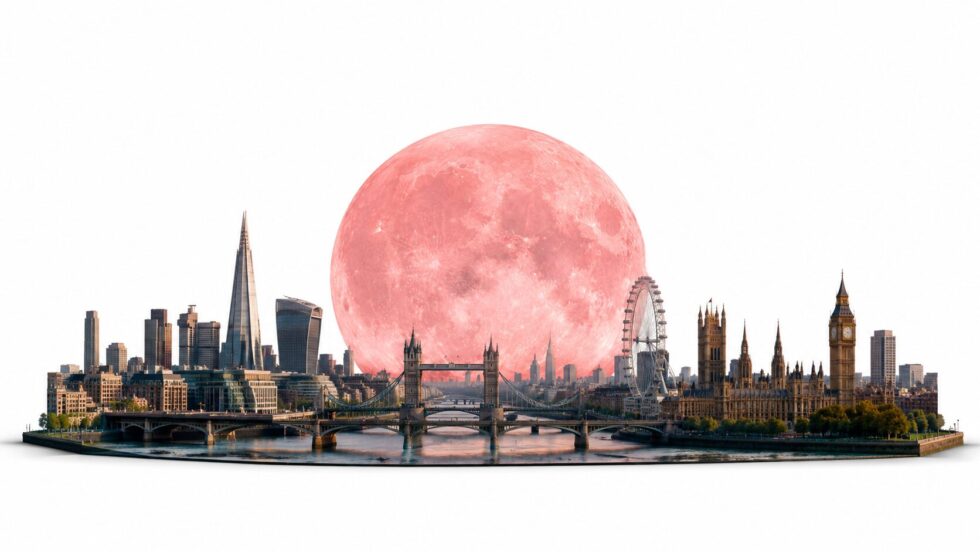
Full Moon Strawberry Moon 2026 peaks at 12.57am BST on Tuesday, 30 June, hanging unusually low over London after rising above the south-eastern horizon late on Monday evening. The June full Moon will not turn red despite its popular name; instead, it is expected to appear warm gold or honey-coloured near the skyline because moonlight passes through more of Earth’s atmosphere when the Moon sits close to the horizon, reports The WP Times editorial team.
Royal Museums Greenwich gives the UK full Moon time as 12.57am on 30 June 2026, while Timeanddate lists the Greater London full Moon at 00.56, so the one-minute difference is just source rounding, not a factual conflict.
When is the Strawberry Moon over London? Exact times in BST
The Moon reaches its full phase at a single global instant, but the clock time depends on where you are standing. For the capital, the Royal Observatory's home turf, the headline figure is the early hours of 30 June. All times show the time of the full Moon at the Royal Observatory's home in London, either in GMT or BST depending on the time of year.
Practical viewing, however, begins the evening before. According to astronomy specialists, the Moon will rise in the evening of the 29th at around 22:06 BST towards the South-East. From there it tracks a famously shallow arc. As the night progresses the Moon will climb in the sky travelling towards the South where the Moon will reach its highest point in the sky at an altitude of 7 degrees at roughly 01:07 BST on the morning of the 30th. That is strikingly low — barely a hand's-width above the horizon at its peak. Following this, the Moon will begin to descend travelling towards the South-West where it will set in the morning skies at around 04:11 BST.
The reassuring part for casual observers is that precision is not essential. Remember that you don't really need to know the exact time of peak illumination to enjoy viewing the full Moon, as the Moon will appear full throughout the night and on the nights surrounding the peak. Expect a convincingly full disc across the nights of the 28th, 29th and into the 30th.
| Strawberry Moon over London | Time (BST) |
|---|---|
| Moonrise (evening of 29 June) | ~10.06pm, towards the south-east |
| Highest point in the sky | ~1.07am on 30 June (altitude just 7°) |
| Peak full illumination | 12.57am on 30 June |
| Moonset (morning of 30 June) | ~4.11am, towards the south-west |
| Best viewing direction | South-east at moonrise, then south |
Why it's called the Strawberry Moon — and why it isn't red
Despite the name, no one in London should expect a crimson Moon. The label has nothing to do with colour and everything to do with the calendar. The most widely cited origin traces it to Indigenous peoples of North America. It has been found that this name was attributed to the Algonquin, Ojibwe, Dakota and Lakota peoples among others. The reason for this name was that this time of year was often known to correspond with the ripening of the abundant late springtime fruit and was named so to celebrate the impending harvest.
Other cultures attached their own names tied to the same season of growth. Another name that took inspiration from the harvest of the well-known and sought after fruit was the Haida name 'Berries Ripen Moon'. Across Europe, the June full Moon collected a string of alternative titles. It is also known by several traditional European names:
- Honey Moon and Mead Moon — from the midsummer honey harvest and mead-brewing, and, some argue, the warm honeyed tint of a low Moon
- Rose Moon — for the flowering of roses at this time of year
- Hot Moon — marking the arrival of summer heat
- Green Corn Moon (Cherokee) and Hoer Moon (Western Abenaki) — references to tending young crops
Any colour you do see is down to physics rather than fruit. When the Moon sits low, its light travels through a thicker slice of atmosphere, which scatters the shorter blue wavelengths and lets warmer tones dominate — giving a yellow, amber or occasionally orange cast just after it clears the horizon.
A 'micromoon': smaller and dimmer than average
This Strawberry Moon carries a second distinction beyond its low arc — it is a micromoon, the opposite of a supermoon. The full moon of June 2026 will also be what is known to some as a "Micro" Moon, appearing slightly smaller than usual too. The reason is orbital: the Moon travels an ellipse, and this full phase falls close to apogee, its furthest point from Earth. It is a micromoon: the full moon happens near apogee, the Moon's farthest point from Earth, so it looks about 7% smaller and roughly 10% dimmer than an average full moon.
It is emphatically not a supermoon. It is not a supermoon in 2026 (the next supermoon is in December). That said, the difference is subtle enough that the unaided eye will struggle to notice — and an entirely separate effect is about to make the Moon look enormous regardless.
The Moon illusion: why a 'micromoon' will still look huge over the rooftops
Here lies the paradox of June's full Moon. Technically smaller, yet to many Londoners it will appear strikingly large — and that is purely a trick of perception. Because this is the first full Moon after the 21 June solstice, it follows the shallowest path of the year. June's full moon tracks the lowest path of any full moon throughout the year, and that's thanks to its proximity to the summer solstice — when the sun is at its highest in the daytime.
A Moon clinging to the horizon hands the brain a set of reference points it cannot ignore. Earth's natural satellite will also appear particularly large to the unaided eye as it rests close to the horizon because of a phenomenon known as the moon illusion. Seen beside chimney pots, tower blocks, plane trees or the silhouette of a familiar London landmark, the disc reads as far bigger than when it floats alone high overhead with nothing to measure it against. The same low position also lends it that signature glow. You may also see the lunar disk adopt a yellow-orange glow in the period directly following moonrise, when its light will be scattered and filtered by the atmosphere.
Cameras, notably, refuse to play along — the illusion lives in the mind, not the lens — which is why photographs so often disappoint compared with the live view.
Where to watch the Strawberry Moon in London
The single most important factor is a clean, unobstructed view to the south-east at moonrise. Because the Moon stays so low this June, tall buildings and trees on that horizon will block it more readily than during a high-riding winter full Moon — so elevation and open sightlines matter more than usual. Good options across the capital include:
- Primrose Hill — a classic elevated vantage with a sweeping low horizon and the city skyline as foreground
- Greenwich Park and the Royal Observatory — fittingly, the very spot the official London timings are calculated for, with long views across the river
- Hampstead Heath (Parliament Hill) — high ground and a broad outlook back over central London
- Alexandra Palace — open terraces and one of the best panoramic horizons in north London
- Blackheath and Richmond Park — wide open expanses with minimal obstruction low down
- The Thames embankments and bridges — water and landmarks make ideal foreground for the moon-illusion effect
Wherever you settle, arrive a few minutes before moonrise and look towards the south-east. As the night wears on, the Moon drifts round to the south before sinking to the south-west.
Photographing June's full Moon in the capital
For anyone hoping to capture it, the low Moon is a gift — it sits naturally alongside ground-level landmarks. A few practical pointers from astronomers:
- Shoot at moonrise, during the warm "golden" window, for the richest colour
- Use a tripod and a timer to keep the shot sharp in low light
- A wide-angle lens frames the Moon within a London streetscape or skyline; a long telephoto (400mm+) isolates surface detail
- Include foreground objects — a bridge, a building, a tree-line — to convey scale and lean into the illusion
- A planetarium app such as Stellarium can pinpoint your exact local moonrise direction from your chosen spot
What else is in the sky on 29 June
The full Moon does not rise alone. It sits embedded in the stars of Sagittarius, and a few bright companions reward a wider look. Look 10 degrees to the upper right of the Strawberry Moon at sunset on June 29 to find the red light of Antares — derived from Greek for "rival of Ares" — glowing at the heart of the constellation Scorpius. Higher up, the season's signature star pattern hangs overhead. Find the Summer Triangle shining to the upper left of the Strawberry Moon on June 29. And as the sky darkens, glance the other way: look to the west to find Venus glowing brightly to its upper left in the golden glow of the setting sun.
When is the next full Moon after the Strawberry Moon
Once June's Moon wanes, the next is not far behind. The next Full Moon after the Strawberry Moon will occur on July 29, 2026 — traditionally known as the Buck Moon. Those hoping for a brighter, larger disc will have to wait until the year's end. The next supermoon falls in December 2026. As for the Strawberry Moon itself, the next Strawberry Moon after June 29, 2026, will occur on June 19, 2027.
Strawberry Moon 2026: London FAQ
What time is the Strawberry Moon in London?
Peak illumination is at 12.57am BST on 30 June 2026, with the Moon rising the evening before at around 10.06pm on the 29th.
Will the Strawberry Moon look red over London?
No — it typically appears gold, amber or orange when low, never strawberry-red. The name comes from the June strawberry harvest, not the colour.
Is the Strawberry Moon a supermoon?
No. It is a micromoon, appearing roughly 7% smaller and 10% dimmer than average, as it falls near the Moon's farthest point from Earth.
Why does it look so big if it's a micromoon?
The "moon illusion" — sitting low on the horizon next to buildings and trees, the brain reads it as much larger than it really is.
Where's the best place to see it in London?
Anywhere with a clear, low south-eastern horizon — Primrose Hill, Greenwich Park, Parliament Hill and Alexandra Palace are all strong choices.
Read about the life of Westminster and Pimlico district, London and the world. 24/7 news with fresh and useful updates on culture, business, technology and city life: What are tonight’s Lotto results and National Lottery numbers for Saturday 27 June 2026