

Bitcoin stands at a crossroads. Sixteen years after its mysterious birth, it has become both a technological revolution and a financial enigma. Its total market capitalization already exceeds $2.3 trillion, making it more valuable than most major corporations. Yet, the question remains: is Bitcoin destined to become a global currency, used seamlessly across borders, or will it remain the world’s digital gold — a modern store of value for turbulent economic times?
As global inflation pressures persist and traditional banking faces digital transformation, Bitcoin’s role is being reassessed by investors, policymakers, and central banks alike. The contrast between its promise as a borderless payment network and its reality as a speculative asset defines the modern crypto debate. In Poland, this dichotomy has already entered financial and political discourse — as notes the editorial board of The WP Times. The next decade may decide whether Bitcoin becomes money in motion or simply gold in the cloud.
Bitcoin’s Path Toward a Global Currency
Bitcoin was designed to serve as an independent, decentralized alternative to fiat systems. With its fixed supply of 21 million coins, it resists inflationary manipulation — a feature often hailed as its greatest strength. The blockchain ensures transparent settlement, peer-to-peer transactions, and censorship resistance, allowing users to move funds across borders without relying on intermediaries.
Technological upgrades like the Lightning Network now enable near-instant micropayments, making daily Bitcoin transactions increasingly feasible. El Salvador’s historic decision to adopt Bitcoin as legal tender in 2021 demonstrated its potential as a functioning currency. Some developing nations, struggling with unstable fiat systems, are exploring similar paths. Meanwhile, fintech firms integrate Bitcoin rails for remittances and cross-border commerce.
Still, major challenges persist. Bitcoin’s notorious volatility — with daily swings often exceeding 5 % — undermines its reliability as a payment medium. Its base network handles only around 7 transactions per second, a fraction of Visa’s capacity. Regulatory fragmentation, high transaction fees during congestion, and taxation uncertainties limit adoption. Moreover, the lack of consumer protection, custodial risks, and the environmental footprint of mining deter institutions from treating it as universal money.
Despite this, the vision of a borderless currency remains powerful. If technical scalability and legal clarity improve, Bitcoin could gradually evolve into a global monetary layer — not replacing fiat entirely, but complementing it in a new hybrid financial system.
Bitcoin as the Digital Gold of the 21st Century
For many economists and investors, Bitcoin’s most credible role lies not in replacing money, but in redefining store of value assets. Like gold, Bitcoin is scarce, durable, divisible, and independent of any government. But unlike gold, it’s portable, programmable, and verifiable at lightning speed.
Over the last decade, hedge funds, family offices, and corporations have begun treating Bitcoin as a strategic reserve asset. It functions as a hedge against inflation, currency devaluation, and geopolitical risk. Large institutional investors now hold billions in BTC, and financial giants like BlackRock and Fidelity offer Bitcoin ETFs, expanding mainstream access.
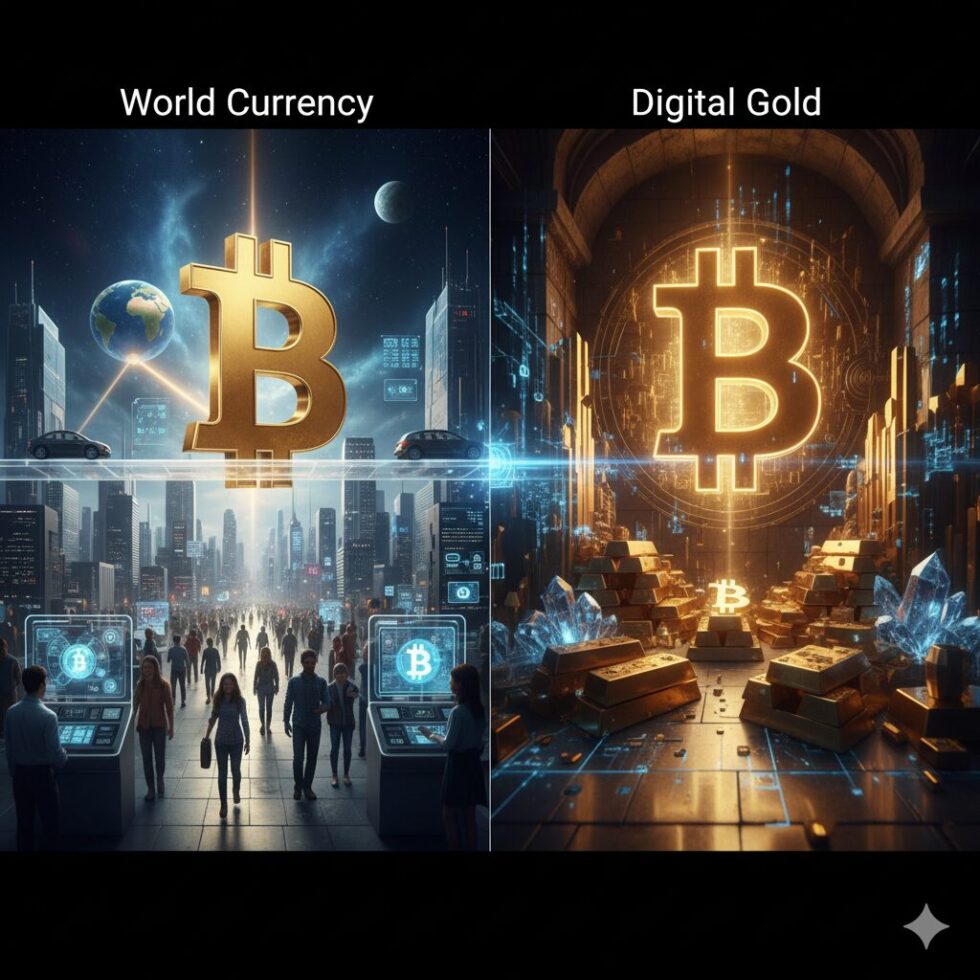
Here is a quick comparison of Bitcoin and gold on core metrics:
| Metric | Gold | Bitcoin |
|---|---|---|
| Market capitalization (2025 est.) | ~$26 trillion | ~$2.3 trillion |
| Annual volatility | 5–10 % | Often above 50 % |
| Divisibility | Difficult | Up to 1 satoshi (1/100,000,000 BTC) |
| Transferability | Physical transport | Instant digital transfer |
| Supply growth | 1–2 % per year | Fixed 21 million cap |
| Central bank adoption | High | Growing, experimental |
| Correlation with stocks | Low | Moderate, rising |
The “digital gold” narrative has already taken hold. In Q2 2025, Bitcoin’s dominance reached 62.1 % of the total crypto market, signaling investor preference for the asset’s perceived safety. Surveys indicate that four out of five market participants expect new all-time highs before 2026. Central banks, though cautious, are starting to explore limited exposure to Bitcoin alongside traditional reserves.
Institutional Moves and Sovereign Adoption
Institutional capital is transforming Bitcoin from a fringe asset into a financial mainstay. In 2025, global inflows into spot Bitcoin ETFs reached record highs, with billions entering weekly. Corporations such as MicroStrategy hold more than 640,000 BTC, worth tens of billions of dollars — the largest corporate treasury position in Bitcoin history.
Governmental interest is also rising. The U.S. Strategic Bitcoin Reserve, established in 2025 and holding nearly 200,000 BTC, marked a symbolic moment: for the first time, a major economy officially treated Bitcoin as a strategic financial resource. Some smaller economies, particularly those suffering from hyperinflation, are exploring similar reserves to stabilize national wealth.
In regions with limited access to banking, Bitcoin’s decentralized infrastructure allows citizens to store value and send remittances without intermediaries. The trend is particularly visible across Latin America, Africa, and Southeast Asia, where crypto wallets are increasingly replacing traditional accounts.
However, for sovereign-level adoption, custody, regulation, and taxation remain critical hurdles. Without international standards, Bitcoin may stay a parallel asset — powerful, but not yet universally recognized as legal tender.
The Technological and Security Frontiers
Bitcoin’s resilience lies in its simplicity, yet scalability remains its Achilles’ heel. The base layer can handle roughly 7 transactions per second, a limitation that becomes acute during network congestion. The Lightning Network offers a partial solution, allowing off-chain transactions that are cheaper and faster, but adoption remains gradual and technically complex.
Cybersecurity is another pressing concern. Despite the blockchain’s robust encryption, exchange hacks, phishing attacks, and lost private keys continue to cause billions in losses annually. Institutional investors now rely on multi-signature wallets, cold storage, and regulated custodians to minimize risk.
Energy consumption also draws criticism. Bitcoin mining’s estimated annual usage rivals that of small nations. Yet, industry data show a growing pivot toward renewable energy, with over 60 % of mining now powered by clean sources. As sustainability pressures mount, miners and policymakers are finding middle ground — emphasizing transparency and energy efficiency.
Ultimately, Bitcoin’s scalability, security, and sustainability will determine whether it can support a truly global monetary system.
Future Scenarios: Currency, Gold, or Hybrid Asset
Economists and analysts outline several plausible futures for Bitcoin over the next decade:
- Digital Gold Scenario (Most Likely):
Bitcoin becomes a global store of value akin to gold. It coexists with fiat and is held by individuals, corporations, and states as a hedge. - Hybrid Role:
Bitcoin functions both as store of value and as infrastructure for specific cross-border payments or settlements between financial institutions. - Global Currency Revolution:
Bitcoin achieves massive adoption, volatility stabilizes, and it becomes a daily medium of exchange. - Niche Asset Scenario:
Bitcoin remains a speculative instrument, never achieving full integration into the world’s financial system.
Most experts see the first two outcomes as the most realistic — a gradual institutional integration, not a sudden monetary revolution.
Practical Guidance for Investors and Users
If you are considering using or investing in Bitcoin, treat it as both a financial innovation and a speculative asset. Experts advise:
- Diversify: Limit exposure to 1–5 % of total portfolio value.
- Think Long-Term: Bitcoin rewards patience — short-term traders often lose to volatility.
- Use Reliable Custody: Opt for regulated custodians or hardware wallets.
- Stay Compliant: Track tax and legal developments in your jurisdiction.
- Leverage Technology: Use Layer-2 networks for faster, cheaper payments.
- Follow Institutional Trends: ETF inflows and treasury purchases often signal market direction.
- Prepare for Volatility: Price drops of 30 %–50 % are normal in crypto cycles.
In countries with unstable currencies, Bitcoin can provide access to global markets and act as a financial safety net — but it should never replace responsible fiscal policy or sound regulation.
Trends to Watch in 2025–2030
The next five years will test whether Bitcoin matures into a parallel monetary system or remains primarily a speculative commodity. Key factors to monitor include:
- Global ETF inflows and institutional holdings
- Integration between Bitcoin and CBDCs
- Regulatory harmonization across the EU, U.S., and Asia
- Technological upgrades improving scalability and privacy
- Adoption in crisis economies and high-inflation regions
The outcome will define not only Bitcoin’s identity but also the future architecture of global finance.
The Decade That Decides Bitcoin’s Identity
Bitcoin may never replace fiat money for everyday use, but it has already reshaped our concept of value. Its decentralized design challenges traditional banking, while its scarcity anchors it as digital wealth. Whether it evolves into a universal currency, remains digital gold, or becomes both, depends on how societies handle regulation, innovation, and trust.
From Wall Street to Warsaw, from miners to policymakers, one truth is clear: Bitcoin is no longer a fringe experiment. It’s a mirror reflecting humanity’s struggle for financial sovereignty in the digital age.
Read about the life of Westminster and Pimlico district, London and the world. 24/7 news with fresh and useful updates on culture, business, technology and city life: Why Is Crypto Becoming Part of Pension Funds and ETFs — and What Does It Mean for Investors