
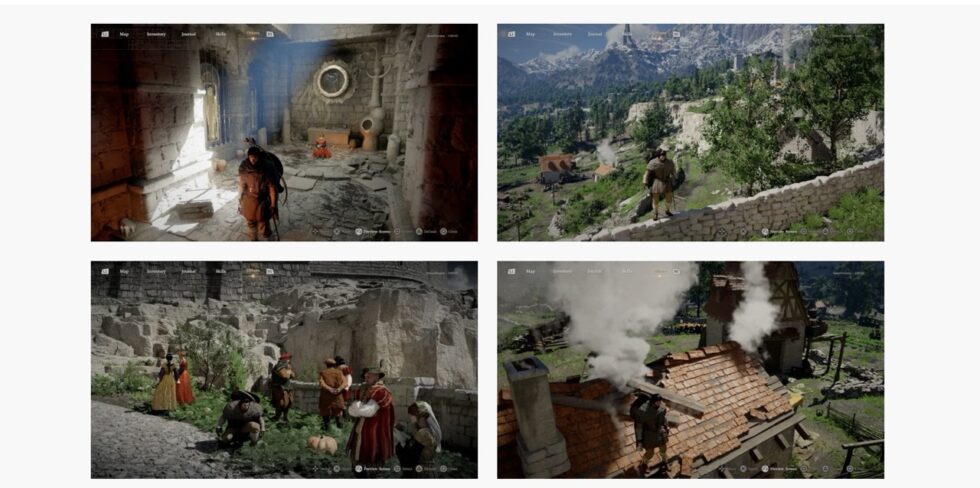
On 22 March 2026, early editorial analysis positions game crimson desert as one of the most ambitious — and distinctly divisive — open-world releases of the year. From its opening hours, game crimson desert communicates its design philosophy with striking clarity: scale over restraint, density over elegance, and spectacle over precision. Developed by Pearl Abyss, the project does not simply build on established RPG conventions but actively pushes beyond them, testing the limits of modern open-world design under the combined pressure of player expectations, technical ambition and systemic complexity, as reported by The WP Times.
The Core Vision Behind Crimson Desert Game
At its foundation, crimson desert game is built not around restraint, but around accumulation. Where many modern titles streamline their mechanics to create clarity and focus, game crimson desert moves in the opposite direction, deliberately layering systems until the experience becomes dense, almost overwhelming in scope. Open-world exploration, large-scale combat encounters, dynamic NPC routines, survival mechanics such as hunting and cooking, environmental puzzles, traversal tools and side systems are not introduced selectively — they are all present, often simultaneously competing for the player’s attention.
This design philosophy creates a world where inactivity is almost impossible. There is always something happening, something to engage with, something to interrupt the player’s current objective. Yet density does not guarantee cohesion. What emerges instead is a structure that feels expansive but not always controlled. The game rarely pauses to refine its strongest ideas, choosing instead to continue expanding outward. The result is a project that impresses through volume, but often struggles to maintain internal balance.
World Design: Scale That Almost Convinces
Travel reinforces this illusion. Movement across the map carries weight, distance feels earned, and the transition between locations contributes to a broader sense of immersion. It is in these moments — riding through landscapes, entering settlements, observing systems at work — that crimson desert gameplay feels closest to its intended vision. However, the illusion is not consistently sustained. While the world appears active, it does not always respond with meaningful depth. Player actions often fail to generate lasting consequences, and systems that initially seem reactive reveal their limitations over time. The result is a world that looks alive, behaves convincingly at a surface level, but does not always deliver the systemic depth it promises.
The most compelling argument in favour of game crimson desert is its world — not just in terms of size, but in how convincingly it attempts to simulate life beyond the player’s direct involvement. This is not a static backdrop. NPCs move through daily routines, environments shift subtly over time, and activities unfold across regions with a sense of continuity that suggests an independent existence.
Crimson Desert Gameplay: Ambitious But Fragmented
The defining characteristic of crimson desert gameplay is its relentless variety. The game shifts constantly between mechanics, often without warning and without clear structural transitions. One moment may involve exploration or traversal, the next combat, followed by puzzles, resource management or side activities. This constant movement creates energy, but also instability. Two parallel experiences emerge. On one hand, there is a strong sense of unpredictability — the feeling that anything could happen, that the game is not tightly scripted or restricted. On the other, there is a noticeable lack of design clarity. Systems do not always reinforce one another, and the player is frequently required to adapt to new rules without sufficient grounding. To understand this tension more clearly, the gameplay structure can be examined:
| Gameplay element | What works well | What breaks immersion |
|---|---|---|
| Exploration | open structure, freedom of movement | inconsistent rewards and pacing |
| Combat | visual intensity, large-scale encounters | repetition, excessive duration |
| Puzzles | multiple possible solutions | unclear logic, reliance on trial and error |
| Side activities | constant engagement, high volume | limited depth and weak long-term impact |
| Progression systems | diverse upgrades and abilities | imbalance between essential and redundant skills |
The pattern is consistent: functionality exists across all systems, but refinement is uneven. The game offers breadth, but rarely precision.
Combat And Pacing Problems
Combat is central to game crimson desert, yet it is also one of its most problematic systems. In its early stages, combat can feel dynamic and responsive. Enemy groups are manageable, movement flows naturally, and the player has enough control to engage creatively with encounters. As the game progresses, however, structural issues become more pronounced. Encounters extend well beyond their natural endpoint, with additional waves of enemies introduced not to deepen strategy, but to prolong duration. Reinforcements reduce clarity rather than enhance challenge, and repetition begins to replace meaningful variation.
Instead of building tension, the game often increases volume. Battles become tests of endurance rather than skill. The player is not consistently challenged to think differently, but simply to continue. Over time, this erodes engagement and disrupts pacing, particularly in situations that should feel routine rather than demanding.
Boss Fights: Intensity Without Integration
Boss encounters in crimson desert game represent a shift in design philosophy that is as noticeable as it is disruptive. These sequences introduce multi-phase structures, high damage thresholds and strict timing requirements, placing heavy demands on precision and resource management. In isolation, this approach can be effective. The problem lies in how these encounters relate to the rest of the game. Standard combat emphasises scale, movement and flexibility, while boss fights demand controlled, deliberate execution. The transition between these styles is abrupt, creating a disconnect within the overall gameplay loop.
Rather than acting as a natural escalation, boss fights often feel like interruptions. They impose a different rhythm, a different logic and a different set of expectations. As a result, they highlight inconsistencies in the design rather than reinforcing the experience.
Story And Narrative Limitations
Despite its cinematic ambitions, game crimson desert struggles to establish a compelling narrative foundation. The structure suggests importance — frequent cutscenes, extended dialogue sequences and attempts at emotional framing — but the execution lacks the necessary depth. Character development remains limited, with personalities that fail to leave a lasting impression. Dialogue often feels unnatural or overly functional, lacking the nuance required to support a story of this scale. Emotional stakes are introduced but rarely sustained, leading to moments that feel constructed rather than earned. As a result, the narrative does not drive the experience. Instead, the player’s engagement is anchored in exploration, progression and system interaction. This creates a disconnect between what the game presents as important and what the player actually values.
Systems That Add Complexity But Not Always Value
Beyond its core mechanics, crimson desert gameplay introduces a wide range of secondary systems designed to expand player choice. These include stealth mechanics, environmental puzzles and layered progression paths. In theory, these additions should enrich the experience. In practice, they often expose a lack of refinement. Stealth sections lack depth and flexibility, puzzles rely on unclear logic, and progression systems offer choices that are not always meaningful. This results in complexity without consistent value. Instead of strengthening the core gameplay loop, these systems sometimes dilute it, adding friction without delivering proportional reward.
Technical Performance Vs Technical Reliability
Technically, game crimson desert presents a clear contradiction. From a performance standpoint, it is impressive. Optimisation on PC is strong, frame rates remain stable across a range of hardware configurations, and visual fidelity — particularly lighting and environmental detail — is consistently high. However, reliability remains an issue. Bugs affecting progression, AI inconsistencies and occasional crashes disrupt the experience in ways that cannot be ignored. These issues are not merely cosmetic; they directly impact the player’s ability to engage with the game over extended periods. The contrast between visual polish and systemic instability reflects the broader pattern of the project: strong ambition supported by uneven execution.
Controls And Usability Issues
Control design introduces another layer of friction. The mapping of actions is often unintuitive, requiring players to memorise complex input combinations that do not align with standard expectations. This creates a barrier between intention and execution. Even after extended playtime, certain actions remain awkward. This is particularly problematic in a game that demands frequent transitions between combat, traversal and interaction systems. When controls fail to become intuitive, they reduce the effectiveness of otherwise strong mechanics.
Where Game Crimson Desert Succeeds
Despite its structural issues, game crimson desert delivers moments that clearly demonstrate its potential. Large-scale battles can be visually impressive, environmental design often achieves a strong sense of place, and the freedom to explore without strict constraints allows for genuinely memorable experiences.
It is in these moments — when systems align, when pacing stabilises, when the world feels cohesive — that the game reveals what it is capable of. These sequences do not fully define the experience, but they justify the ambition behind it.
Game crimson desert is defined by ambition, but also by imbalance. It offers scale, visual quality and an extraordinary range of mechanics, yet struggles with cohesion, pacing and refinement. Crimson desert gameplay alternates between immersion and frustration, often within the same session. This is not a failed project, but it is an uneven one. It pushes boundaries, experiments with structure and attempts to redefine expectations, but does not always maintain control over its own systems. The result is a game that is frequently impressive, occasionally exhausting and consistently interesting — a bold achievement that never fully resolves its own contradictions.
Read about the life of Westminster and Pimlico district, London and the world. 24/7 news with fresh and useful updates on culture, business, technology and city life: Apple Unveils AirPods Max 2: The New Benchmark for High-Fidelity Audio in 2026