

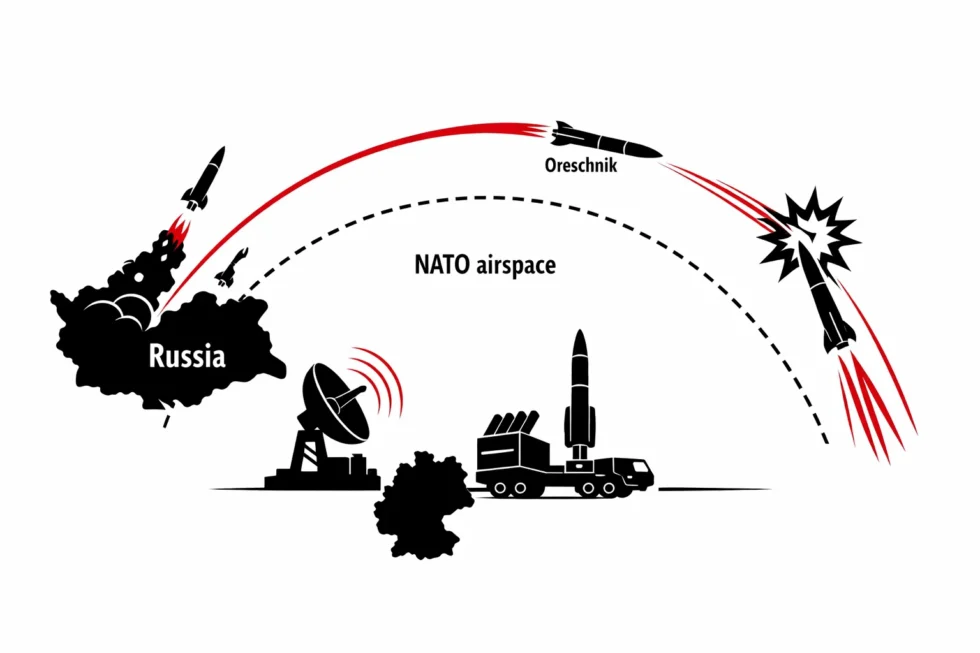
Arrow 3, Germany’s newly activated space-based missile-defence system, has undergone its first real-world operational exposure after Russia launched an Oreschnik intermediate-range ballistic missile towards western Ukraine, just 80 kilometres from Poland and NATO airspace. The launch, carried out late on 8 January from Russia’s Kapustin Yar missile range near the Caspian Sea, sent a Mach-10-class weapon across thousands of kilometres of European airspace before it struck close to Stryi, one of eastern Europe’s most strategically important gas-storage hubs. The flight was detected within seconds by US early-warning satellites and tracked through its mid-course phase in space by NATO-linked sensors, including Germany’s Arrow 3 radar system at Holzdorf, The WP Times reports, citing US and NATO defence releases.
With Arrow 3 only declared operational at Holzdorf in December, the launch marked the first time Germany’s €4bn missile shield had tracked a live Russian long-range ballistic missile in an operational setting — turning the strike into an unplanned but strategically significant test for European security, energy markets and defence investors.
What exactly is Russia’s Oreschnik missile
Oreschnik — Russian for “hazel tree” — is a new intermediate-range ballistic missile (IRBM) derived from the RS-26 Rubezh nuclear delivery platform. Ukrainian air-force tracking data shows it travels at Mach 10+ (around 12,000 km/h), placing it in the hypersonic velocity class.
With a range of 5,000–5,500 km, Oreschnik can strike any European capital from deep inside Russia. It is primarily designed to carry nuclear warheads, but can also be fitted with conventional payloads, as in the January strike. Western analysts note that, despite its speed, Oreschnik appears to follow a predictable ballistic trajectory rather than performing the aggressive mid-course manoeuvres associated with true hypersonic glide vehicles. That makes it a weapon of strategic deterrence and signalling, not precision warfare.
Why the strike mattered for Germany and NATO
The impact zone near Stryi lies at the heart of eastern Europe’s gas-storage and transit system, making the strike a combined military and energy-security signal. For Germany, the timing was critical. Arrow 3 became operational only weeks earlier, making this the first time Berlin’s new radar and sensor architecture was exposed to a live Russian long-range missile.
NATO confirmed that:
• US infrared satellites detected the launch within seconds
• NATO command calculated the trajectory within minutes
• Arrow 3 radar in Germany tracked the missile during its mid-course flight in space
That combination effectively turned Germany into a front-line missile-defence node for eastern Europe.
How Arrow 3 actually works
Arrow 3 is not a conventional air-defence system. It is designed to operate outside the Earth’s atmosphere, where long-range ballistic missiles travel during the most predictable phase of their flight.
Unlike systems such as Patriot, which intercept targets inside the atmosphere, Arrow 3 is an exo-atmospheric interceptor. It engages incoming warheads more than 100 kilometres above Earth, during their mid-course phase in space, before they can descend, separate, or release decoys.
The interceptor uses a hit-to-kill kinetic vehicle — it carries no explosive warhead. Instead, it destroys its target through a direct high-speed collision, using sheer kinetic energy to obliterate the incoming warhead at hypersonic velocity. From its deployment site at Holzdorf Air Base in Saxony-Anhalt, a single Arrow 3 battery provides coverage over:
- Germany
- Poland
- the Czech Republic
- the Baltic states
- and much of Central and Eastern Europe
The system was developed by Israel Aerospace Industries (IAI) in cooperation with Boeing and is fully integrated into NATO’s ballistic-missile defence and early-warning network, receiving real-time cueing from US and allied space-based sensors.
Did Arrow 3 attempt an interception
No. Once NATO calculated that the missile was heading for Ukraine, not NATO territory, interceptors were not authorisedunder alliance rules. However, Arrow 3 successfully performed its most important real-world task: tracking a Russian ballistic missile in space.
This provided invaluable live data on:
• Trajectory modelling
• Sensor fusion
• NATO response timing
Why Russia warned the United States
US defence officials have confirmed that Russia uses a formal ballistic-missile notification channel to warn Washington before launching long-range missiles toward Ukraine. The purpose is to prevent early-warning systems from misclassifying a regional strike as a strategic nuclear attack, which could trigger an automatic escalation response.
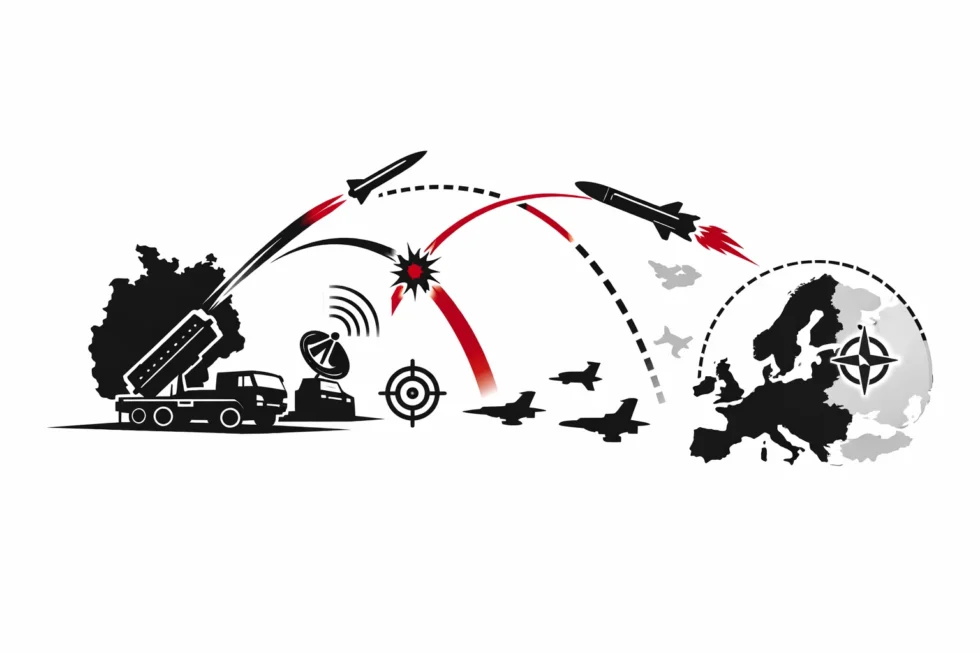
These notifications are passed through the US–Russia de-confliction and risk-reduction framework and are then fed into NATO’s integrated early-warning network, which combines US Space Force infrared satellites, allied radars and command systems.
As a result, Germany’s Arrow 3 command crews at Holzdorf received launch alerts before the missile left the launch rail, allowing the system’s radars and tracking algorithms to be activated in advance and the missile’s trajectory to be followed from its earliest phase of flight.
Arrow 3 vs Oreschnik — technical comparison
| Feature | Arrow 3 (Germany / Israel / US) | Oreschnik (Russia) |
|---|---|---|
| System type | Exo-atmospheric missile interceptor | Intermediate-range ballistic missile |
| Primary role | Destroy incoming ballistic missiles | Deliver nuclear or conventional warheads |
| Developer | Israel Aerospace Industries + Boeing | Russian Strategic Rocket Forces |
| Status | In service (IOC since Dec 2025) | Operational since 2024 |
| Deployment | Holzdorf Air Base, Germany | Launched from Kapustin Yar |
| Engagement altitude | >100 km (outer space) | Ballistic arc to several hundred km |
| Speed | Designed for hypersonic intercept | Mach 10+ |
| Range | Several thousand km | 5,000–5,500 km |
| Warhead | None (hit-to-kill) | Nuclear or conventional |
| Guidance | Radar + satellites | Inertial + satellite navigation |
| NATO integration | Fully integrated | Independent Russian system |
| Estimated cost | €2–3m per interceptor | €10–20m per missile |
How Germany’s Arrow 3 tracked Russia’s Oreschnik missile near NATO airspace
Russian forces launched an Oreschnik intermediate-range ballistic missile on 8 January from the Kapustin Yar test range, sending it across thousands of kilometres of European airspace before it struck near Stryi in western Ukraine, around 80 kilometres from Poland and NATO territory.
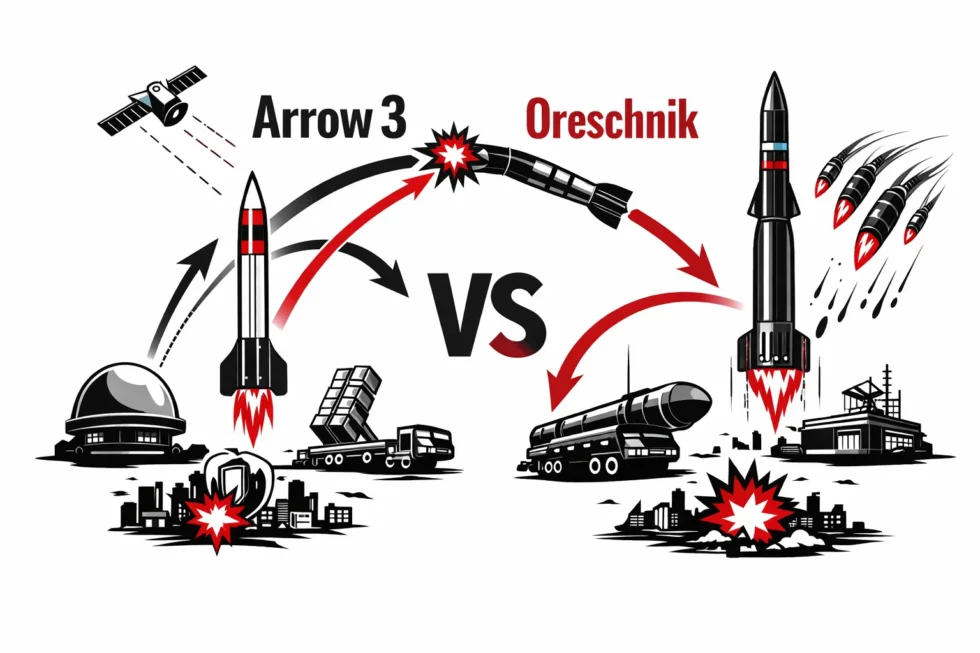
The launch was detected within seconds by US early-warning satellites, and tracking data were automatically fed into NATO’s integrated air-defence network, including Germany’s Arrow 3 radar system at Holzdorf. During its mid-course phase in space, the missile was continuously tracked by German sensors, marking the first time Berlin’s new missile-defence system had followed a live Russian long-range ballistic missile in an operational setting.
No interception was attempted because the missile’s calculated trajectory showed it was not heading towards NATO airspace. However, the strike occurred close to one of eastern Europe’s largest gas-storage facilities, placing critical energy infrastructure within the potential impact zone of a strategic-class weapon. From a technical standpoint, Arrow 3 performed its core task: detecting, tracking and modelling the flight of a Russian IRBM in real time.
What remains unknown
Despite the extensive tracking data, several critical aspects remain unclear. It is not publicly known whether the Oreschnik missile carried penetration aids, decoys or multiple warheads, all of which would affect how difficult it would be to intercept in a real combat scenario.
NATO has also not disclosed how close Germany’s Arrow 3 system is to full operational capability. The system is currently in initial operating status, meaning some engagement and command functions are still being phased in.
Most importantly, NATO has never had to make a live intercept decision for a missile that appeared to be heading toward a member state. In such a scenario, commanders would have only minutes to decide whether to fire — a test of both technology and alliance command structures.
What this means for European security and financial markets
Germany has effectively moved from being a rear-area logistics hub to becoming a front-line missile-defence gatekeeper for eastern Europe. That shift is already reshaping defence and energy economics across the continent.
| Sector | Strategic impact |
|---|---|
| Missile defence | Large-scale, multi-year expansion of NATO interceptor networks |
| Radar and sensors | Rapid growth in demand for space-tracking and early-warning systems |
| Defence stocks | Israel Aerospace Industries, Boeing, Raytheon and Thales positioned to benefit |
| Energy markets | Gas storage and pipelines increasingly priced for missile-strike risk |
| Insurance | Rising premiums for critical infrastructure across eastern Europe |
Europe is entering a long-term missile-defence investment cycle similar to that of the United States, driven directly by the emergence of weapons such as Oreschnik.
Despite claims from Moscow, western defence analysts do not believe so. Oreschnik travels at extreme speed, but it follows a largely predictable ballistic trajectory during its flight through space. That makes it precisely the type of weapon that systems like Arrow 3 were designed to defeat — by calculating its path early and destroying the warhead before it can descend, separate or deploy countermeasures. In strategic terms, Arrow 3 was built specifically to counter missiles of this class, turning speed and range into vulnerabilities rather than advantages.
Read about the life of Westminster and Pimlico district, London and the world. 24/7 news with fresh and useful updates on culture, business, technology and city life: What is happening in Iran as protests turn deadly and Trump threatens US military strikes