
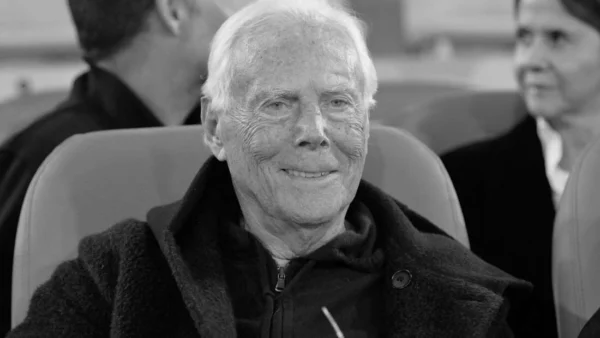
Milan, 4 September 2025 — Giorgio Armani, the Italian fashion legend long hailed as the “King of Fashion,” has died in Milan aged 91. For more than five decades, he shaped global taste with an aesthetic of quiet confidence: soft tailoring, clear lines and disciplined restraint. His name became shorthand for modern elegance, extending far beyond the runway into fragrance, interiors, restaurants and hotels. Industry figures credit him with redefining the suit and, by extension, a late-20th-century idea of power and ease. “Armani did not only design clothes; he taught the world to dress with calm authority,” wrote one leading critic. The WP Times reported that the fashion house confirmed his death on Instagram, and tributes have poured in from designers, editors and Hollywood.
Giorgio Armani early life
Armani was born on 11 July 1934 in Piacenza, northern Italy, and came of age amid wartime scarcity that forged discipline and thrift. He read medicine at the University of Milan before leaving after several years, concluding that he lacked a physician’s vocation. During military service in Verona he worked in a hospital, an experience that clarified his future lay in aesthetics rather than in clinics. Returning to Milan, he joined La Rinascente as a window dresser and buyer, learning fabrics, merchandising and the theatre of display. He later said the shop floor taught him more about proportion and desire than any classroom. “I did not seek fashion; fashion found me,” he recalled. Those early habits of rigour and observation became the grammar of his life’s work.
Quotes & facts
- Born 11 July 1934, Piacenza; died 4 September 2025, Milan.
- Studied medicine (not completed) at the University of Milan; army hospital in Verona.
- First fashion role: La Rinascente (visual merchandising, buying).
- “The shop window is a stage; the suit is its leading actor,” Armani once said.
Giorgio Armani designer beginnings
In the 1960s he joined menswear house Nino Cerruti, refining the soft, unarmoured jacket that became his signature. He prized movement over rigidity, letting cloth fall naturally rather than forcing silhouette with padding. Colleagues recall a designer who could discuss a single seam, lining or shoulder slope for an hour. In 1975 he co-founded Giorgio Armani S.p.A. with Sergio Galeotti, launching a new language of minimalism that read as both modern and Italian. The first collections were radical in their restraint, and critics took notice. Suzy Menkes wrote that Armani had turned the suit “from a badge of command into a language of freedom.” That shift re-set expectations of what dignity could look like.
Quotes & facts
- 1975: Giorgio Armani S.p.A. founded with Sergio Galeotti.
- Focus: soft tailoring, deconstructed jackets, muted palettes.
- “Clothes must serve the body, not the other way round,” Armani said.
- Suzy Menkes: “He made the suit speak in a new voice.”
Giorgio Armani fashion as lifestyle
Unlike many contemporaries, Armani built a lifestyle universe, extending his codes into perfume, cosmetics, eyewear, furniture and hospitality. The Armani Hotel in Dubai’s Burj Khalifa (opened 2010) embodied his idea that elegance could be spatial, tactile and atmospheric. Interiors echoed the runway: calm tones, exacting textures, nothing superfluous. He argued that good design reduces noise so the wearer or guest becomes the focus. “Style is the subtraction of the unnecessary,” he liked to say. By 2025 his brand architecture spanned haute couture to entry lines while maintaining a consistent, low-voice authority. The result was both commercial scale and aesthetic coherence.
Quotes & facts
- Divisions: Giorgio Armani Privé; Emporio Armani; Armani Exchange; Armani Casa; Hotels (Dubai, Milan).
- 2010: Armani Hotel Dubai opens; later Milan.
- “With Armani, you don’t enter a room — you enter an attitude,” noted a fashion historian.
- Core palette: greige, navy, charcoal; emphasis on drape and feel.
Giorgio Armani and Hollywood
Armani’s global breakthrough came with American Gigolo (1980), dressing Richard Gere in a new vision of masculine ease. The film turned both the actor and the designer into international touchstones. Gere later said, “When you wear Armani, you feel invincible.” The red carpet became an extension of his runway, with Michelle Pfeiffer, Jodie Foster and Anjelica Huston among early champions. In 1983 he opened a Los Angeles office to serve the studios directly. The Los Angeles Times observed that Armani did not merely dress stars; he helped invent their aura.
Quotes & facts
- Film: American Gigolo (1980) catalyses U.S. fame.
- Clients: Richard Gere, Michelle Pfeiffer, Jodie Foster, George Clooney, Anjelica Huston.
- 1983: Los Angeles office established.
- “Cinema and fashion share the grammar of light,” Armani said.
Giorgio Armani and independence
While rivals sold to conglomerates, Armani defended independence as a working principle. His fortune — widely estimated in the tens of billions of euros — enabled creative control without external shareholders. In 2016 he set up the Fondazione Giorgio Armani to safeguard the house and fund cultural and social projects. “I could never tolerate a boss above me,” he once said, with characteristic dryness. To younger designers, he proved one could balance scale with authorship. Independence, for him, was not a pose but a governance model.
Quotes & facts
- 2016: Fondazione Giorgio Armani established (heritage & philanthropy).
- Never sold to LVMH, Kering or other groups.
- “Money is only useful when it buys freedom,” Armani remarked.
- Reputation: exemplar of owner-designer governance.
Giorgio Armani personality and work ethic
Inside the company, Armani was known as demanding but fair, a perfectionist who noticed everything. Staff recall rehearsals halted for a single mis-aimed spotlight or a tie half an inch too long. “For Giorgio there were no small details,”said one long-time colleague. He kept a daily office routine into his late eighties, reviewing fittings and fabrics himself. He preferred understatement to spectacle, arguing that bravura dates faster than discipline. In interviews he said work kept him young and fashion was his language.
Quotes & facts
- Traits: rigorous, discreet, detail-obsessed, loyal to minimalism.
- “Elegance is not to be noticed but to be remembered,” Armani said.
- Routine: daily presence at the Milan headquarters well into old age.
- Known to adjust lighting, hems and shoulder lines minutes before a show.
Giorgio Armani business empire and succession
By the 2020s, the Armani portfolio ranged from couture to denim, from leather goods to hospitality, unified by a restrained signature. Following his death, stewardship passes to his sister Silvana, his niece Roberta, his nephew Andrea Camerana and trusted collaborators Leo and Pantaleo Dell’Orco. The family has signalled continuity of values and independence rather than sale or break-up. Industry observers expect the house to maintain its binary of heritage and modern utility. “Fashion fades, but style remains,” Armani often said, framing legacy as a living discipline. The brand he built is designed to outlast fashion cycles.
Quotes & facts
- Successors: Silvana Armani; Roberta Armani; Andrea Camerana; Leo & Pantaleo Dell’Orco.
- Strategy signalled: preserve independence; avoid fragmentation.
- Mix: Privé couture; Emporio/AX ready-to-wear; accessories; hospitality; interiors.
- “Guard the line — and the line will guard you,” he once told staff.
Giorgio Armani public farewell
The company announced that the Milan headquarters would open to the public on 6–7 September for farewells. The funeral will be private, in accordance with his wishes, reflecting a lifelong preference for discretion over display. Italian leaders and cultural institutions have praised his contribution to national identity through industry and design. Le Mondecalled his death “the end of an epoch defined by elegance and consistency.” Global maisons posted monochrome tributes citing his influence on fabric, light and silence. For many, the most fitting memorial is the precision of a well-cut jacket.
Quotes & facts
- 6–7 September: public memorial in Milan; funeral private.
- International tributes from press, designers, actors.
- “Italy in a suit,” one headline called him.
- Legacy theme: discretion, discipline, durability.
Giorgio Armani: ten defining quotes
Armani used aphorism as design principle, reducing ideas to crisp lines, much as he did with cloth. The following quotes circulated in interviews, show notes and profiles throughout his career. They describe a worldview anchored in discipline, subtraction and kindness to the wearer. Editors loved their clarity; students copied them into notebooks. Each reads like a pattern piece: simple, exact, reusable. Together, they explain why his work aged so well.
Quotes & facts
- “Elegance is not to be noticed but to be remembered.”
- “I did not seek fashion; fashion found me.”
- “Style is the subtraction of the unnecessary.”
- “Clothes must serve the body, not the other way round.”
- “Money is only useful when it buys freedom.”
- “Cinema and fashion share the grammar of light.”
- “Guard the line — and the line will guard you.”
- “Understatement is stronger than noise.”
- “Comfort is not the enemy of beauty.”
- “Fashion fades; style remains.”
Giorgio Armani: 20 key facts
Armani’s career spanned seventy years and multiple sectors, yet remained internally consistent. These key facts chart the path from window displays to a diversified, independent house. They also underline the breadth of his influence: menswear, womenswear, interiors, hospitality, celebrity and corporate governance. For search and reference, dates and nouns are kept plain. In the end, the man who preferred silence left an unusually loud record.
Quotes & facts
- 1934 — born in Piacenza, Italy.
- University of Milan — studied medicine (not completed).
- Army service — hospital work in Verona.
- La Rinascente — window dresser and buyer, Milan.
- 1960s — designer at Nino Cerruti (menswear).
- 1975 — co-founds Giorgio Armani S.p.A. with Sergio Galeotti.
- Late 1970s — pioneers soft, unpadded jackets.
- 1980 — American Gigolo cements global fame.
- 1983 — Los Angeles office opens for Hollywood clients.
- 1980s–1990s — expansion into womenswear and accessories.
- Emporio Armani and Armani Exchange — diffusion and youth lines.
- Armani Casa — interiors and furniture collections.
- Fragrance and cosmetics — global licensing and in-house lines.
- 2010 — Armani Hotel Dubai opens in Burj Khalifa; later Milan.
- Known fortune — widely reported in multi-billion-euro range.
- 2016 — Fondazione Giorgio Armani established (heritage & philanthropy).
- Governance — refuses sale to luxury conglomerates.
- Aesthetic — greige palette, minimalism, soft structure.
- 2020s — daily presence at fittings into late eighties.
- 4 September 2025 — dies in Milan, aged 91.
Read about the life of Westminster and Pimlico district, London and the world. 24/7 news with fresh and useful updates on culture, business, technology and city life: Flamingo Missiles Hit Russian FSB Base in Crimea – Ukraine’s New Weapon Unveiled