From 1 July 2026 every online betting company that wants to take a wager in Ireland must hold a remote betting licence issued by the Gambling Regulatory Authority of Ireland (GRAI), the single new regulator that takes over a market governed since 1929 by patchwork legislation and a tax-led permit system run by the Office of the Revenue Commissioners. The shift is not a renewal of the old rules but a full replacement: the Gambling Regulation Act 2024 repeals the legacy Totalisator Act of 1929 and Betting Act of 1931, and from that Wednesday no operator — incumbent or new entrant — may serve Irish consumers without GRAI authorisation. Justice Minister Jim O'Callaghan signed the commencement order that switched on licensing and enforcement on 9 February 2026, and as analysts at The WP Times have tracked, the timetable leaves operators a narrow runway: legal notices had to be published by 3 June 2026 to make the 1 July start. This article sets out what changes on day one, who needs a licence, the player protections that arrive with it, and the penalties for getting it wrong.
What Is the GRAI and Why Is the Revenue Regime Ending
The Gambling Regulatory Authority of Ireland is the country's first dedicated, independent gambling regulator, established under the Gambling Regulation Act 2024 and operational since 5 March 2025. Before it existed, online and retail betting in Ireland sat under a fragmented body of law and was supervised primarily through the tax system, with remote bookmaker permits renewed through Revenue. That arrangement was widely judged unfit for a digitally driven market, having been built on statutes drafted long before internet gambling existed. The 2024 Act consolidates licensing, advertising rules, consumer protection and enforcement under one authority, and the 1 July 2026 milestone is the point at which licensing power moves decisively from Revenue to the GRAI.
The transition is deliberately phased rather than overnight. The legislation consolidates and updates Ireland's existing gambling laws under a single framework, and the GRAI has rolled out its functions in stages since 2025 to allow operators and the regulator itself to adjust. Existing Revenue-issued permits remain valid until they expire, at which point the holder must transition to the new regime. The result is a sector entering its most significant overhaul in nearly a century, with Ireland positioning itself as one of Europe's newest fully regulated gambling markets. Lcb
When Do Remote and In-Person Licences Take Effect
The single most important detail for any operator is timing, because the two licence categories switch on at different dates. Remote (online) operators come first, followed by in-person venues six months later. The GRAI can begin issuing online licences from 1 July 2026 and in-person licences from 1 December 2026. New market entrants, by contrast, can be licensed "as soon as is feasible" rather than waiting for a fixed calendar date.
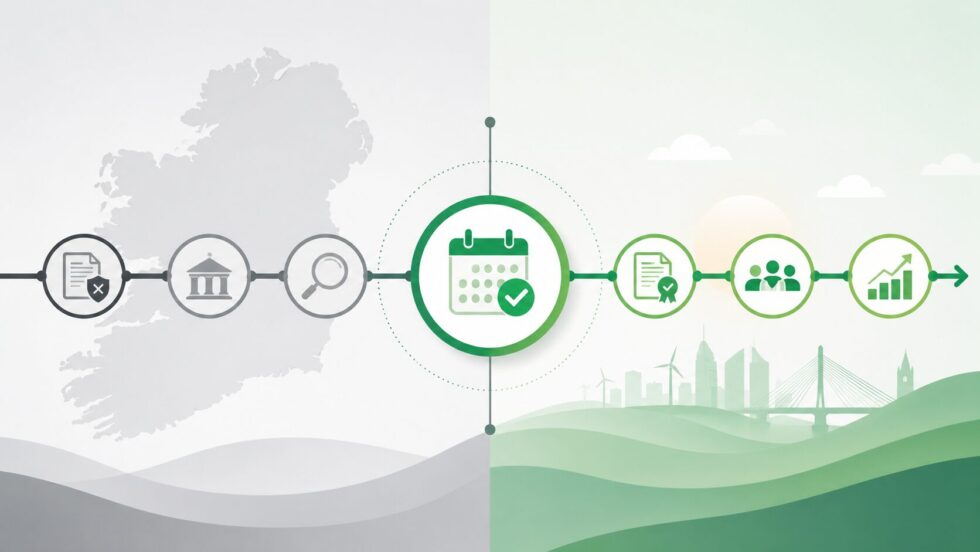
The phased schedule maps directly onto when the old permits run out. The table below summarises the rollout.
| Licence type | First issued by GRAI | What it replaces |
|---|---|---|
| Remote (online) betting — B2C | 1 July 2026 | Revenue remote bookmaker permit |
| In-person (retail) betting — B2C | 1 December 2026 | Revenue land-based permit |
| New market entrants | "As soon as is feasible" | No prior permit |
| Remote betting intermediary | Within B2C framework | Revenue intermediary permit |
Remote operators can receive licenses from 1 July 2026, while in-person operators will transition from their existing licenses on 1 December 2026, when current permissions issued by the Office of the Revenue Commissioners expire. Operators who delayed risk a coverage gap: because a legal notice must be published at least 28 days before an application is submitted, any firm that had not published by 3 June 2026 could not realistically complete its application in time for the 1 July go-live.
Which Operators Need a GRAI Licence
Every business offering betting to Irish consumers falls within scope, and crucially the obligation does not depend on having a physical presence in Ireland. An online sportsbook based abroad that accepts Irish customers needs a GRAI remote betting licence just as a Dublin-based bookmaker does. The Act distinguishes between business-to-consumer (B2C) activity aimed at the public and the underlying licence types that sit beneath it.
The licensing structure breaks down as follows:
- B2C remote betting covers online sports betting and pool betting offered directly to consumers, and is the category that goes live on 1 July 2026.
- B2C in-person betting covers wagering at a physical venue and follows on 1 December 2026.
- Remote betting intermediary licences apply to firms facilitating betting rather than acting as the bookmaker.
- Gaming and lottery licences sit within the wider framework for operators offering those products, with the National Lottery a notable carve-out from GRAI oversight.
For incumbents, the practical message from the regulator has been consistent: apply early. The GRAI's chief executive has urged operators to engage with the process as soon as possible to avoid delays, and the authority has published guidance notes and template documents — including detailed guidance on the relevant obligations for B2C licensees — to help applicants navigate both the application and their continuing duties.
What New Player Protections Arrive With the Licence
The 2024 Act is not solely an administrative tidy-up; it ties licensing to a substantial package of consumer safeguards that operators must meet as a condition of holding a GRAI licence. These provisions reflect the legislation's stated aim of balancing the freedom to gamble against the harms associated with problem gambling, with particular emphasis on protecting children. The core protections include:
- A ban on credit-card gambling. Operators cannot accept credit card transactions or extend credit facilities for gambling. This includes electronic payments funded from a credit card.
- A prohibition on targeted inducements. Personalised perks such as VIP treatment, free bets and free hospitality directed at a specific person or group are no longer permitted, though general public-facing promotions remain possible subject to regulation.
- An advertising watershed. TV and radio gambling ads are banned between 5:30 a.m. and 9:00 p.m., and online advertising is tightened so that operators may only direct gambling ads at individuals who both hold an account and actively follow the operator's social media.
- Mandatory spending controls. Licensees must give customers the ability to set monetary limits on their accounts.
- A ban on ATMs in gambling premises, removing easy on-site access to cash.
These rules apply as licence conditions, meaning a breach is not merely a marketing misstep but a regulatory matter with enforcement consequences.
How Will the National Gambling Exclusion Register Work
A central pillar of the new player-protection architecture is the National Gambling Exclusion Register, a state-administered self-exclusion system broadly comparable to the United Kingdom's GamStop. The register gives individuals a single route to block themselves from licensed gambling rather than having to approach each operator separately.
Once someone enrols, the obligation falls firmly on operators. B2C licensees who provide remote gambling activities will be required to exclude those people from participating in gambling who have applied to the GRAI to be entered in the National Gambling Exclusion Register. In practice this means licensed online operators must block registered users for the duration of their exclusion and stop marketing to them, with no account workarounds permitted, and must also honour any direct self-exclusion requests made to the operator itself. Alongside the register, the Act establishes an industry-funded Social Impact Fund, financed by an annual levy on licensees, to pay for addiction treatment, research, public education and community interventions.
What Are the Penalties for Operating Without a Licence
The GRAI has been handed enforcement powers that mark a sharp departure from the old regime, and the regulator has signalled it intends to use them against both non-compliant licensees and operators serving Irish customers without authorisation. The financial penalties are deliberately severe and scale with the size of the business. The headline sanction is among the toughest in European gambling regulation. The regulator can issue fines of up to €20 million or 10% of a licensee's turnover, whichever figure is higher, where breaches of the Gambling Regulation Act 2024 are established. The authority's toolkit extends well beyond fines.
| Enforcement power | Detail |
|---|---|
| Administrative financial sanction | Up to €20 million or 10% of turnover, whichever is higher |
| Licence action | Power to suspend or revoke a licence issued under the Act |
| Notices of non-compliance | Formal notices requiring corrective action |
| Court applications | Applications to the Circuit Court over contraventions |
| Criminal penalties | Offences carry fines and possible imprisonment; credit-card breaches can draw a Class A fine or up to 12 months on summary conviction, and heavier penalties on indictment |
The GRAI's published strategy also points to a build-up of operational muscle through 2026, with annual inspection programmes and dedicated investigation and enforcement units, signalling that the authority intends active supervision rather than light-touch oversight.
Industry Reaction: "Extremely Self-Defeating"
Not everyone in the sector welcomes the framework, and the debate has centred on whether tighter rules will genuinely reduce harm or simply burden compliant operators. The case for the Act rests on consumer protection; the case against questions its design and unintended effects.
Speaking to the Irish Independent, AK Bets owner Anthony Kaminskas called the system "extremely self-defeating," warning that gambling harm could rise despite the tighter rules and arguing that licensed operators already take compliance seriously (Irish Independent, via Gambling Insider). He suggested that regulatory breaches now pose a bigger business risk to operators than losing money to winning customers. Broadcasters and racing interests have raised separate concerns, with critics warning that the advertising watershed could make televising Irish horseracing commercially difficult. Set against these objections is research commissioned by the GRAI itself, which found strong links between childhood exposure to gambling, parental gambling habits and a higher risk of developing gambling problems later in life — evidence the regulator cites to justify the child-protection emphasis running through the Act.
What Should Operators and Players Do Now
For operators, the immediate priority is administrative readiness rather than strategy. Firms that have not yet published their legal notice are already behind the curve for the 1 July remote-licensing window and should treat the application, supporting documentation and compliance systems as urgent work. Beyond the licence itself, operators need processes in place to honour the National Gambling Exclusion Register, enforce the credit-card ban, redesign promotional activity away from targeted inducements, and meet the advertising watershed — all of which are licence conditions, not optional best practice.
For players, the practical changes will be visible from day one of using a licensed Irish service:
- Credit cards will no longer be accepted for deposits.
- Self-exclusion becomes simpler and more comprehensive through a single national register that covers all licensed online operators at once.
- Account-level spending limits become a standard, mandatory feature.
- Personalised free-bet and VIP offers should disappear, and gambling advertising should be less visible on broadcast media before 9 p.m.
In-person bettors should note that their venues move onto the new regime later, from 1 December 2026, as Revenue permits expire.
FAQ
When exactly do GRAI remote betting licences take effect?
The first GRAI remote betting licences are issued from 1 July 2026, with in-person licences following on 1 December 2026.
Does the Revenue regime disappear immediately?
The old Revenue permit system is replaced as licences expire; remote operators transition from 1 July 2026 and in-person operators from 1 December 2026 when their existing Revenue permissions lapse.
Do foreign-based online operators need a GRAI licence?
Yes. The licensing obligation applies to online operators serving Irish consumers regardless of whether they have a physical base in Ireland.
What is the maximum fine under the Gambling Regulation Act 2024?
Penalties can reach up to €20 million or 10% of a licensee's turnover, whichever is higher, alongside licence suspension or revocation and potential criminal penalties.
What is the National Gambling Exclusion Register?
A GRAI-administered self-exclusion system that blocks enrolled individuals from all licensed online operators and stops them being marketed to for the duration of the exclusion.
Read about the life of Westminster and Pimlico district, London and the world. 24/7 news with fresh and useful updates on culture, business, technology and city life: UK Crypto Tax 2026: HMRC, CARF and what British investors now owe as data reporting begins for 2026