
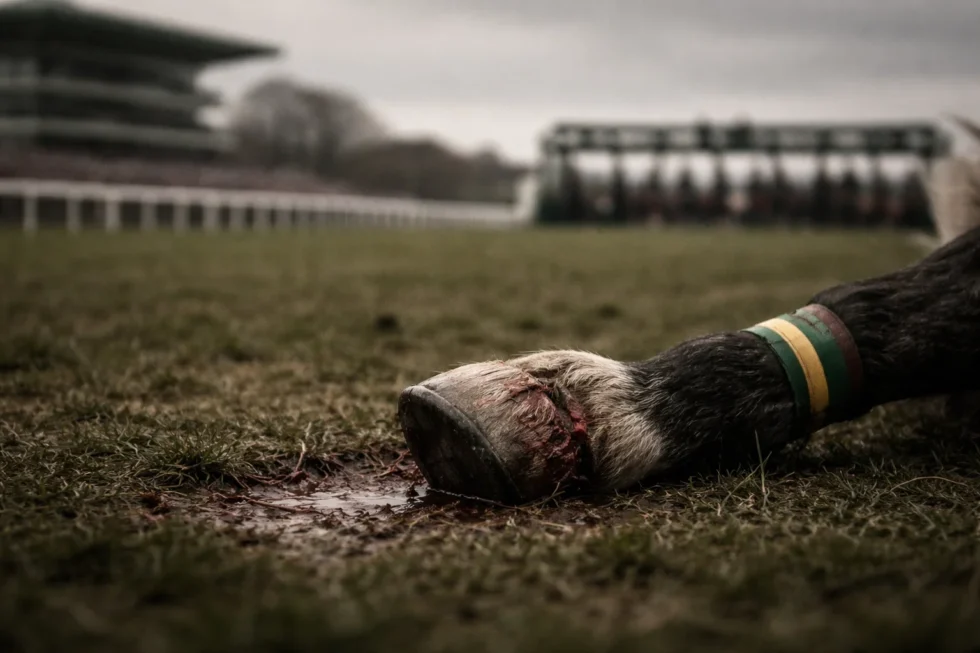
Grand National 2026 as Aintree fatalities confirm two horse deaths on April 10–11 has become the defining issue of this year’s meeting, with Gold Dancer and Get On George both euthanised following race-related injuries sustained under competitive conditions, prompting immediate veterinary intervention and formal review by racing authorities, and intensifying scrutiny over equine safety, racecourse design and regulatory oversight within British jump racing, reported by The WP Times.
The incidents occurred on consecutive race days at Aintree Racecourse rather than during the main Grand National race itself, but are formally recorded within Grand National 2026 deaths data, with both cases characterised by either delayed injury detection after the finish or visible biomechanical failure during the race, reinforcing a structural limitation acknowledged by the British Horseracing Authority — namely that catastrophic injuries can remain undetectable at racing speed and only become evident during deceleration or loss of action, leaving limited scope for real-time prevention despite existing safety reforms.
Grand National 2026 deaths confirmed: what the data shows and how the incidents are classified
The 2026 Aintree Festival recorded two confirmed equine fatalities within a 24-hour period, providing a clear factual baseline for assessing risk at the meeting while also exposing the different ways in which fatal injuries can occur under race conditions. Although the number itself remains limited, the structure of the incidents — one post-finish, one mid-race — makes them analytically significant, particularly in the context of detection limits and intervention timing.
Confirmed fatalities
- Gold Dancer — euthanised after winning the Mildmay Novices’ Chase (10 April)
- Get On George — euthanised after pulling up in a handicap hurdle (11 April)
Both cases fall under the formal definition of race-related fatalities, meaning:
- the injury occurred during or immediately after competitive racing
- the horse was assessed on course by veterinary teams
- euthanasia was carried out on immediate welfare grounds
Text continuation
What distinguishes the 2026 cases is not the number, but the mechanism. One incident developed without visible signs until after the finish, the other unfolded in real time during the race — a combination that underlines the limits of both observation and intervention within the current system. Neither fatality occurred during the Grand National race itself. However, in both regulatory reporting and public interpretation, all incidents across the three-day meeting are consolidated under the Grand National 2026 deathsnarrative. That reflects the reality of Aintree as a single, high-profile event: from a data perspective the races are separate, but from a reputational and analytical standpoint they are inseparable.
Gold Dancer: post-finish fatality and the limits of real-time detection
The case of Gold Dancer represents a high-complexity injury profile in jump racing — where catastrophic trauma occurs during a race phase but is not clinically visible until after completion. Ridden by Paul Townend, the horse maintained competitive form throughout the race, including after a destabilising error at the final fence, before crossing the finish line in a controlled and apparently symmetrical gait.
Sequence of events
- error at final fence involving hind-leg instability
- rapid recovery and continuation under full pace
- no visible asymmetry during run-in
- gait deterioration observed only after deceleration
- immediate dismount and veterinary intervention
Text continuation
From an analytical standpoint, this type of injury highlights a critical limitation: the absence of any practical method to detect internal structural failure under race-speed conditions. Biomechanical compensation, combined with adrenaline response, allows the horse to temporarily stabilise movement, effectively masking the injury until the mechanical load is reduced. Stewards and veterinary officials confirmed that:
- the injury likely occurred at the final obstacle
- no breach of riding protocol took place
- the jockey’s response was immediate and appropriate
This positions the incident within accepted but non-preventable risk parameters, rather than procedural failure.
Get On George: in-race breakdown and compressed response window
In contrast, Get On George presents a more visible failure pattern — one that unfolds during active race conditions and allows for earlier detection, but not necessarily a different outcome.
Observed indicators
- loss of action (primary veterinary trigger)
- disruption to stride rhythm
- inability to sustain forward motion
- immediate withdrawal from race
Text continuation
The horse was pulled up and attended by veterinary teams within a short time frame, yet the injury was deemed irreversible. This underscores a key constraint in race safety systems: while some injuries can be identified earlier, the window for effective intervention remains extremely limited once structural failure has occurred.
From a risk perspective, this case demonstrates that:
- detection and prevention are not equivalent
- earlier intervention does not guarantee survival
- certain injury thresholds remain beyond recovery
Race context: Grand National 2026 and the pressure built into the main race
The 2026 Grand National, run at Aintree on 11 April, did not produce a confirmed fatality in the headline race itself, but the contest still exposed the physical pressure built into Britain’s most demanding steeplechase. I Am Maximus, ridden by Paul Townend, won the race as the 9-2 favourite, becoming the first horse since Red Rum to regain the Grand National crown, while the shape of the race was defined not only by the result but by its unusually heavy attrition rate.
Race metrics
| Metric | Figure |
|---|---|
| Runners | 34 |
| Finishers | 16 |
| Non-finishers | 18 |
| Completion rate | about 47% |
| Winner | I Am Maximus |
| Jockey | Paul Townend |
| SP | 9-2 |
The raw numbers matter. Reuters reported that only 16 of 34 runners completed the course, while the race also produced seven fallers, the highest figure recorded in the race since at least 2015. That level of attrition does not in itself prove abnormal danger, but it does show how narrow the margin remains between completion and elimination in a race that still combines distance, pace, crowding and large fences in a single test.
What made the race especially striking was the contrast between outcome and texture. On paper, the result carried sporting prestige: I Am Maximus regained the title, Willie Mullins collected a fourth Grand National victory to equal a historic training record, and owner JP McManus had three of the first four home. In practice, though, the race unfolded in a way that kept safety in the foreground, with multiple exits, falls and unseated riders shaping the visual and competitive rhythm of the afternoon.
The broader meeting context made that pressure even more important. By the time the Grand National started, Aintree had already been overshadowed by the deaths of Gold Dancer on 10 April and Get On George on 11 April, meaning the main race was being watched not only as a sporting spectacle but as part of a wider safety debate around the 2026 festival. Reuters and other UK coverage made clear that, although no fatality was confirmed in the National itself, the race was staged under the shadow of two earlier deaths at the same meeting.
Why the attrition rate matters
- A field of 34 runners remains large even after previous safety-led reductions.
- Only 16 completed, meaning more than half the field failed to finish.
- Reuters said the race featured seven fallers, the highest number in at least a decade.
- The Guardian described the contest as marked by a higher number of fallers and unseated riders than recent renewals.
That is why a completion rate of roughly 47% should be read as more than a statistic. In a long-distance chase such as the Grand National, non-completion is normal to a degree, but when more than half the field fails to finish, the figures begin to say something wider about the course’s cumulative demands. They point to the layered pressure of four and a quarter miles, sustained jumping, compressed race positioning and the fatigue that builds late in the contest, even in a year when the headline race avoided a confirmed fatality.
Set against the wider Aintree debate, that leaves the main race in a complicated position. It delivered a historically important winner and no confirmed death in the showpiece itself, yet it also reinforced how much physical stress the National still imposes on horses and riders. That is why the 2026 race cannot be written up simply as a clean sporting success: the result belonged to I Am Maximus, but the context of the day remained inseparable from the attrition of the race and the two deaths already recorded at the meeting.
Regulatory and welfare response: how the same facts are read differently
The two fatalities at Aintree drew an immediate response from both regulators and welfare groups, but the reaction was less about disagreement over facts than over how those facts should be understood. From the side of the British Horseracing Authority, the emphasis was clear and consistent. Officials pointed to the structure of the response: veterinary teams were on site, both incidents were dealt with immediately, and procedures were followed as set out in the sport’s welfare protocols. Crucially, no breaches of rules or riding standards were identified. Within that framework, the events sit inside what racing defines as controlled risk — serious, but not outside expectation for a sport built around speed, distance and obstacles.
Welfare organisations see the same sequence differently. Groups such as the RSPCA and the League Against Cruel Sportsargue that the repetition of such incidents, even at lower frequency, points to something structural rather than exceptional. In their view, safety changes have altered the margins but not the underlying exposure, and the continued occurrence of fatalities raises the question of whether those risks should be accepted at all.
What emerges is not a dispute over what happened, but over what it means. Racing operates on the assumption that risk can be reduced and managed within the sport as it exists. Critics challenge that premise, arguing that the threshold itself remains too high. The events of 2026 do not settle that argument. They sit squarely within it.
What the 2026 data actually shows
Set aside the interpretation, and the record of the meeting is straightforward. Two horses — Gold Dancer and Get On George — died during the 2026 Aintree Festival. Both incidents occurred under race conditions. In both cases, the injuries were assessed on course and judged to be beyond recovery, leading to euthanasia on welfare grounds. Neither fatality occurred during the Grand National race itself.
What makes the cases notable is not the number, but the way they unfolded. One injury remained hidden until after the finish; the other developed in real time during the race. Together, they reflect the two principal risk pathways that continue to define jump racing at the highest level. Viewed against recent years, the 2026 meeting does not mark a departure from established patterns. Fatalities have become less frequent over time, and safety measures have changed how the race is run, but the underlying risk has not been eliminated. The Grand National continues to operate within a framework where that risk is controlled rather than removed. At the close of the 2026 Aintree Festival, the factual position is straightforward: two horses — Gold Dancer and Get On George — died during the meeting, and that record forms part of the overall outcome.
Read about the life of Westminster and Pimlico district, London and the world. 24/7 news with fresh and useful updates on culture, business, technology and city life: Grand National 2026 horses at Aintree: time, tickets, race programme, prize money, runners and what to know