
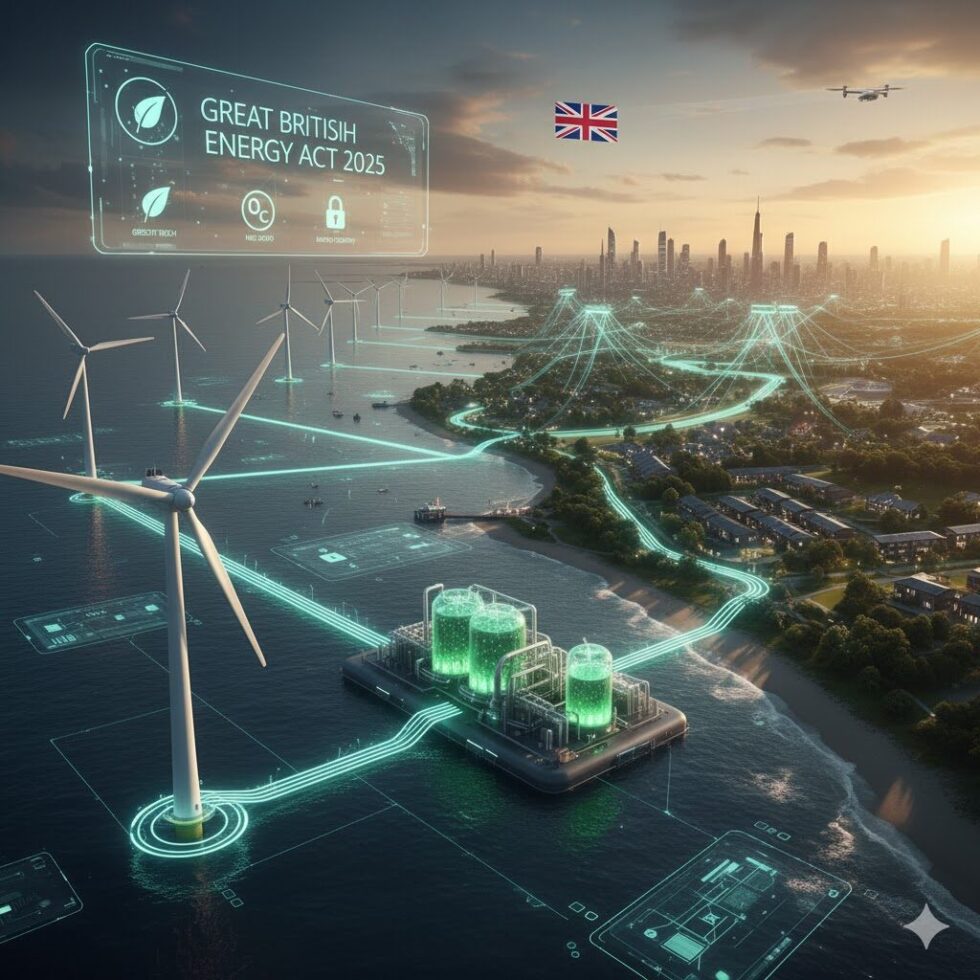
Green technology has ceased to be just an environmental buzzword — it has become the backbone of Britain’s national strategy for resilience, independence, and economic renewal. In 2025, Westminster enacted the Great British Energy Act, a milestone that legally created Great British Energy (GBE) — a state-owned enterprise designed to fast-track the country’s transition to clean, domestic energy. The Act promises to accelerate the UK’s journey toward net-zero emissions by 2050, reduce dependency on volatile foreign fuel markets, and secure stable power for industries and households. In an age of geopolitical energy shocks, this initiative stands as both an ecological imperative and a strategic defence measure. The move also signals the revival of a strong state presence in an energy market long dominated by private corporations. Yet, questions loom large: can public ownership truly deliver innovation, efficiency, and affordability all at once? For Polish readers following the European energy transformation, reported by The WP Times, Britain’s experiment offers a revealing case study of how climate ambition meets hard-nosed geopolitics.
The Birth and Blueprint of the Great British Energy Act 2025
The Great British Energy Act 2025 became law on May 15, 2025, turning a major Labour Party election pledge into concrete legislation. It officially established Great British Energy Ltd., a public company limited by shares but wholly owned by the Crown. The new entity will operate under the oversight of the Department for Energy Security and Net Zero (DESNZ), but maintain commercial independence in its daily operations. Its legal mission: to invest in, own, and manage clean energy infrastructure — from offshore wind farms to green hydrogen hubs — and to reinvest profits into further energy innovation rather than shareholder dividends.
GBE is required to publish annual reports to Parliament, detailing its financial performance, project portfolio, and alignment with the UK’s 2050 net-zero targets. The law also grants GBE powers to form joint ventures with local authorities, private companies, and even foreign partners to co-finance energy projects. Its long-term vision is ambitious: by 2030, Britain should generate 95% of its electricity from clean sources, and by 2035 achieve near-total decarbonisation of power generation.
However, turning legal text into megawatts is a different challenge. Implementation depends on budgetary discipline, effective management, and the government’s forthcoming Strategic Plan — a detailed roadmap that will determine where and how billions in public funds are deployed. The structure of GBE thus positions it as both an investor and an energy producer — a hybrid rarely seen in liberalised European energy markets.
Strategic Investment Pillars: Wind, Hydrogen, Storage, and EV Charging
The Act identifies four core pillars where green technology will drive Britain’s next industrial revolution: wind power, green hydrogen, energy storage, and electric mobility infrastructure. These sectors form the backbone of the new green economy.
The UK already leads Europe in offshore wind, with more than 14 GW installed and another 60 GW planned by 2035. Under the new framework, GBE will spearhead investment in floating wind technology, grid upgrades, and domestic turbine manufacturing. This will not only reduce dependence on foreign suppliers but also create thousands of jobs in coastal regions. However, a persistent problem remains: grid congestion has forced the UK to spend over £1 billion annually curtailing wind generation. Addressing this bottleneck will be critical for progress.
Next comes green hydrogen, the emerging star of energy diversification. Government projections anticipate large-scale hydrogen deployment starting in 2031, with auctions for hydrogen production and storage capacity launching in 2026. The UK’s Hydrogen to Power Business Model aims to make hydrogen profitable for grid balancing and heavy transport. Yet the technology’s costs remain high, with electrolyzers and pipeline infrastructure requiring sustained subsidies.
The energy storage sector, particularly Long Duration Energy Storage (LDES), will anchor system reliability. Britain’s 2024 storage investment scheme aims to support battery and compressed-air projects capable of delivering power for 8–12 hours — essential for balancing intermittent renewables.
Finally, electric mobility is entering its mass-infrastructure phase. The £2.5 billion DRIVE35 programme focuses on scaling EV manufacturing and building a dense national network of chargers. Private companies such as Aegis Energy have already received £100 million to deploy multi-fuel charging hubs for trucks and vans. These measures are expected to position Britain among Europe’s top three EV markets by 2030.
| Sector | Main Initiative | Timeline | Key Challenges |
|---|---|---|---|
| Wind Energy | Floating platforms, domestic supply chain | 2025–2035 | Grid congestion, planning delays |
| Hydrogen | Hydrogen to Power model | 2026–2031 | Infrastructure cost, scalability |
| Storage (LDES) | New investment scheme | 2024 onward | Tech risk, financing gap |
| EV Charging | DRIVE35, private hubs | 2025–2035 | Local coordination, grid upgrades |
Each of these areas intertwines technology with policy, demanding consistent funding and regulatory clarity. Success depends not only on engineering but also on political resolve.
Financing and Political Trade-Offs: Who Pays for the Transition
The financial backbone of GBE is as ambitious as its mission. The initial capitalisation amounts to £8.3 billion for the parliamentary term, distributed across renewable and nuclear projects. However, recent fiscal adjustments redirected £2.5 billion toward small modular reactor (SMR) development — sparking debate about whether this shift dilutes GBE’s renewable focus. The Department for Energy Security and Net Zero also received a 16% budget increase, reaching £12.6 billion by 2029.
Critics argue that excessive nuclear spending could delay progress in wind and hydrogen deployment. Supporters, however, view nuclear as the “baseload backbone” complementing renewables. The government insists the funding split maintains balance between long-term energy stability and rapid decarbonisation.
Another politically charged clause in the Act bans procurement of components linked to forced labour, particularly from Xinjiang. While this strengthens ethical supply chains, it could limit access to low-cost solar panels and batteries, raising overall project costs.
Economically, GBE must become self-financing by 2030, meaning that by the end of the decade, it will operate entirely from revenues generated by its assets. This model mimics the logic of national investment banks: catalyse early projects with public capital, then sustain expansion through reinvested profits. The success of this model will hinge on effective project selection and transparency in spending.
Green Tech as National Security: The Geopolitical Dimension
The Great British Energy Act reframes green transition as a security strategy, not just a climate policy. After the war in Ukraine exposed Europe’s dependency on Russian gas, energy resilience became a top-tier geopolitical concern. The UK government now views domestic clean energy as a shield against global supply disruptions and price volatility.
GBE’s mission dovetails with the National Energy System Operator (NESO), created under the Energy Act 2023, which integrates grid stability and net-zero planning. Together, they form the institutional skeleton of Britain’s “energy sovereignty.” According to government white papers, localising energy generation could reduce import dependence by up to 60% by 2035.
Still, challenges persist. Renewable technologies depend on global supply chains — rare earth metals, lithium, and advanced semiconductors — often sourced from geopolitically sensitive regions. Balancing autonomy with international cooperation will be an ongoing test for GBE.
At the same time, this energy transformation carries significant economic diplomacy potential. The UK could export expertise in offshore wind, hydrogen production, and smart-grid management to allied nations. Such soft power in green innovation might become one of Britain’s key post-Brexit assets.
The Human and Local Dimension: What It Means for People and Communities
Beyond geopolitics, the Act promises tangible effects on citizens, businesses, and communities. For households, the ultimate goal is to stabilise energy bills and protect consumers from fossil-fuel price shocks. In the short term, however, the transition may push prices slightly higher as infrastructure investments are recovered.
For local governments, GBE’s partnership model opens access to co-investment schemes in solar roofs, micro-grids, or small-scale wind projects. Communities hosting clean energy facilities may receive local dividends or lower electricity rates, following models already tested in Denmark and Germany.
Businesses in the construction, manufacturing, and engineering sectors stand to benefit from a surge of procurement contracts tied to GBE projects. Companies meeting high ESG standards — environmental, social, and governance — will gain preferential access.
Meanwhile, public perception remains crucial. Without trust, even the most sustainable projects can face local resistance (the familiar “Not In My Back Yard” syndrome). Transparent communication, community ownership models, and visible social benefits are the best tools to build lasting legitimacy.
Implementation Challenges: Regulation, Supply Chains, and Technology Risks
Despite broad optimism, execution risks are significant. Britain’s planning system remains notoriously slow, with onshore wind projects often taking years to approve. The government pledges to streamline procedures, yet local opposition still delays developments.
Regulatory fragmentation between national and regional authorities also complicates coordination. Ofgem’s new net-zero duty aims to align economic regulation with decarbonisation goals, but its practical impact is yet to be tested.
Supply chain fragility is another major issue. The global demand for lithium, cobalt, and rare earths is expected to triple by 2035, putting pressure on procurement. The ethical sourcing rules add another layer of complexity.
Technologically, the reliance on unproven systems — like long-duration storage or hydrogen turbines — introduces financial and engineering risks. Early pilot projects may underperform or exceed budgets, potentially slowing investor confidence.
Yet the UK’s historical strength lies in innovation. From offshore wind leadership to grid-balancing AI software, British research ecosystems are capable of overcoming these obstacles with targeted funding and collaboration.
European Context: Learning from Continental Precedents
The UK’s state-owned energy company concept is not entirely new in Europe. Denmark’s Energinet manages both power and gas infrastructure under public ownership, while Germany’s KfW acts as a green investment powerhouse, funnelling billions into renewable projects. France maintains strong state control via EDF, albeit in a nuclear-heavy framework.
Britain’s model, however, blends these precedents with its own market liberalism. Unlike France, GBE will not monopolise generation, but rather act as a strategic investor to crowd in private capital. It represents a middle path — balancing public direction with entrepreneurial flexibility.
The lessons from continental Europe are clear: success depends less on ideology and more on execution capacity, regulatory certainty, and transparent governance.
The Road Ahead: Milestones and Measurable Progress
In the coming years, several milestones will determine whether GBE’s promise materialises or fades into bureaucratic inertia:
- Publication of GBE’s Strategic Plan detailing sectoral priorities.
- Launch of hydrogen auctions and storage tenders by 2026.
- Commissioning of first long-duration storage plants under the 2024 scheme.
- Rapid expansion of EV charging corridors via DRIVE35.
- Reduction of wind curtailment costs through grid modernisation.
- Evaluation of GBE’s self-financing status by 2030.
If successful, the UK could emerge as a genuine clean energy superpower, exporting expertise and technology across Europe. If mismanaged, it risks becoming a costly symbol of unfulfilled ambition. The next decade will reveal whether the Great British Energy Act marks the dawn of an energy renaissance — or another missed opportunity in the age of climate urgency.
Read about the life of Westminster and Pimlico district, London and the world. 24/7 news with fresh and useful updates on culture, business, technology and city life: SoftBank to Acquire ABB’s Robotics Division for $53.8 Billion