
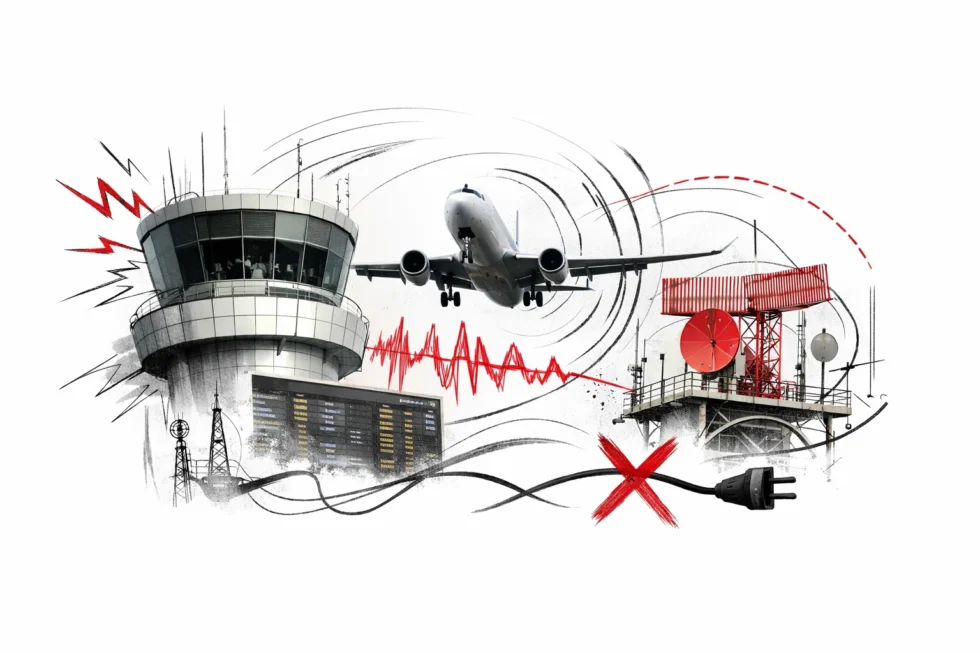
On Sunday 4 January 2026, Greece was hit by one of the most serious aviation crises in its modern history after a nationwide radio-frequency blackout severed air-traffic control communications, grounding flights across Greece, shutting down major airports and leaving thousands of passengers stranded — as reported by The WP Times, citing Reuters.
The failure did not affect a single airport or control tower. It crippled the central air-traffic management system that controls Greek national airspace, including vital international flight corridors between Europe, the eastern Mediterranean and the Middle East, forcing aviation authorities to suspend arrivals and departures for safety reasons.
By mid-morning, live flight-tracking data showed Greek airspace almost completely empty, an extremely rare situation for one of Europe’s busiest tourism and transit hubs, underlining the scale of the air-traffic control failure.
A failure at the heart of Greek airspace
Greek aviation authorities confirmed that the radio-frequency blackout struck simultaneously at the country’s two most critical air-traffic control hubs:
- Athens Area Control Centre
- Macedonia Area Control Centre
These two facilities jointly manage the Athens Flight Information Region (FIR) — a vast block of controlled airspace covering mainland Greece, the Aegean Sea and several of Europe’s most heavily used east–west international flight corridors linking western Europe with the Middle East and Asia.
When the frequencies failed, controllers lost direct contact with aircraft already in the air.
In operational terms, this represents the most severe type of aviation system failure: planes continue flying, but the ground loses the ability to direct, separate or safely sequence them. Within minutes, Greek aviation authorities were forced to suspend all arrivals and departures nationwide, allowing only a small number of overflights to continue under tightly controlled emergency procedures.
What passengers experienced
At Athens International Airport (Eleftherios Venizelos), departures were halted from 09:00 local time.
Terminal halls rapidly filled with stranded travellers as outbound flights were frozen and inbound aircraft were either diverted to foreign airports or held outside Greek-controlled airspace.
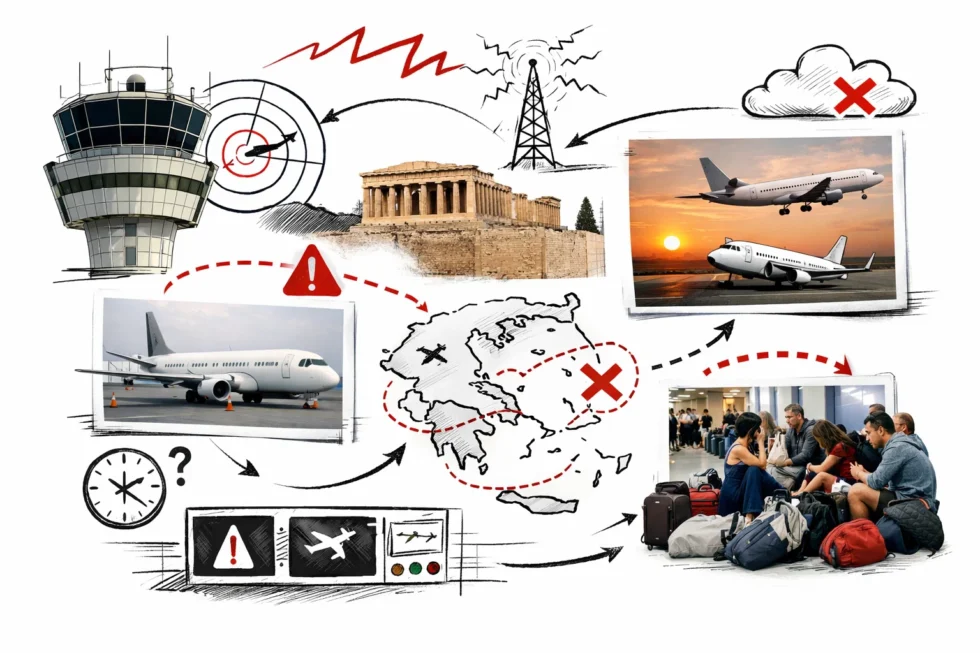
The disruption was instantly visible in the data. Live flight-tracking platforms showed Greek skies almost completely empty — a pattern usually associated with volcanic ash clouds, major military crises or full airspace closures.
How large the disruption was
The Greek Transport Ministry confirmed that more than 75 flights were delayed or cancelled in the first phase of the shutdown alone. In Israel, aviation authorities stated that Greek airspace was closed until at least 16:00 local time, warning passengers across the eastern Mediterranean of severe knock-on disruption to international schedules.
Given Greece’s role as a tourism gateway, regional transit hub and EU aviation corridor, the true scale of the impact is expected to reach hundreds of flights and tens of thousands of passengers once diversions, missed connections and airline recovery operations are taken into account.
What caused the blackout
No official technical explanation has yet been provided. However, Panagiotis Psarros, head of the Association of Greek Air-Traffic Controllers, told state broadcaster ERT that:
“All frequencies were suddenly lost. We could not communicate with aircraft in the sky.”
He added that the collapse appeared to originate in the central radio-frequency systems serving both control centres — indicating a system-wide failure rather than a localised fault.
More significantly, Psarros pointed to a long-standing structural problem: “The equipment we have is virtually ancient. We have raised this many times in the past.” That remark strongly suggests the crisis may reflect years of under-investment, outdated hardware and fragile system architecture, rather than a single unpredictable technical glitch.
Why the shutdown was unavoidable
In modern commercial aviation, continuous radio contact between pilots and air-traffic controllers is not optional — it is a binding safety requirement. Without it, aircraft cannot receive take-off or landing clearances, controllers cannot guarantee safe separation between planes, and runway sequencing becomes impossible.
International aviation regulations leave no room for discretion. If communication is lost, controlled airspace must be closed. Greece’s nationwide grounding was therefore not a political decision or an administrative failure — it was a mandatory safety response to a system collapse.
Why Europe is paying close attention
Greece sits at the centre of one of Europe’s most strategically important airspaces, linking:
- EU aviation corridors
- NATO operational zones
- Middle Eastern and North African flight routes
A technical failure that can empty Greek skies within minutes exposes uncomfortable vulnerabilities. It raises serious questions about the resilience, redundancy and cyber-security of Europe’s air-traffic control infrastructure, and about how well the continent could maintain aviation safety under crisis or hostile conditions. This outage may have been accidental — but regulators across Europe will now be assessing how similar systems would perform under deliberate disruption or geopolitical pressure.
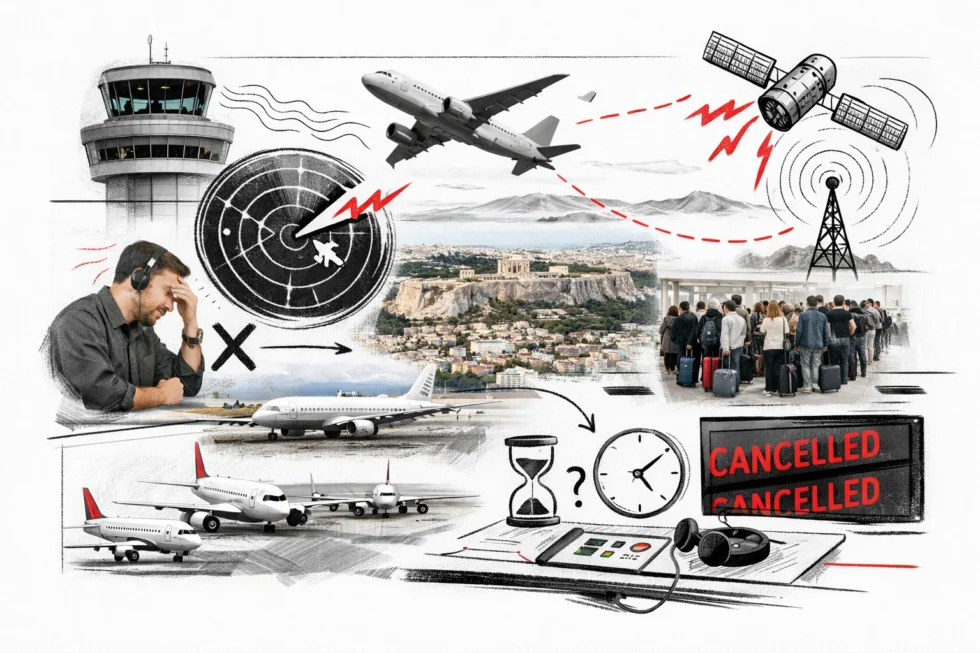
Greek and international aviation engineers are now working to isolate the failure within the country’s air-traffic control network — whether it originated in hardware, software, signal routing, or central system architecture. Until the cause is identified and full communications redundancy is restored, Greek airspace will remain under restricted operations, with traffic managed under emergency safety protocols.
For Greece, the implications go beyond today’s disruption. The blackout exposes systemic weakness in critical aviation infrastructure and is expected to accelerate decisions on modernisation, redundancy and long-delayed investmentacross the national air-traffic control system.
Read about the life of Westminster and Pimlico district, London and the world. 24/7 news with fresh and useful updates on culture, business, technology and city life: Why did Brexit increase UK immigration instead of cutting it? New data compares Britain and Germany