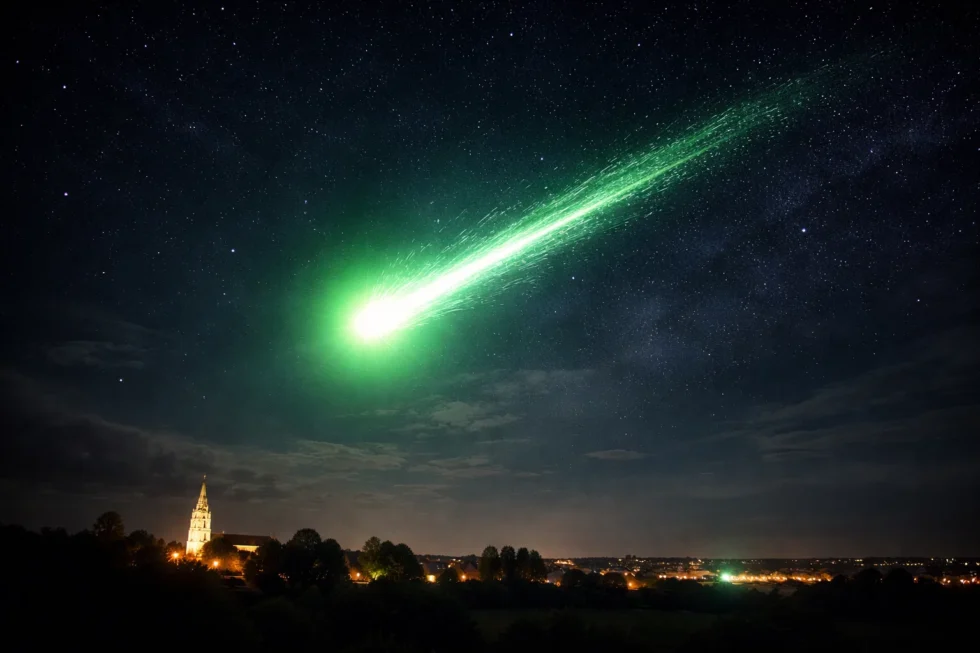
Green fireballs were observed across wide parts of the United Kingdom after multiple witnesses recorded a fast-moving, luminous meteor crossing the sky over eastern England, with confirmed sightings stretching from Northamptonshire to the North Sea coast and further across East Anglia into Yorkshire. The most prominent daytime sighting occurred at approximately 12:30 BST above the A43 near Corby, where a driver described a “huge” glowing object travelling at high speed, while a separate overnight event shortly after midnight over Lindisfarne points to at least two atmospheric entries within hours — indicating a clustered meteor activity rather than a single isolated object, The WP Times reports.
More than 200 observations logged across Britain and parts of northern Europe support the assessment of a short-lived but regionally significant atmospheric event. Data from monitoring networks suggests the objects entered Earth’s atmosphere at extreme velocities estimated between 20,000 mph and 35,000 mph, with at least one trajectory extending over the North Sea before complete disintegration. No confirmed ground impact has been recorded, reinforcing expert conclusions that the phenomena were high-altitude burn-up events rather than meteorites reaching the surface.
what are green fireballs and why they appear unusually bright
Green fireballs represent a rare but well-documented class of meteors characterised by intense luminosity and a distinctive colour signature. Despite often appearing large to observers, the physical objects are typically small — ranging from grain-sized particles to pebble-scale fragments — but their extreme velocity generates immense kinetic energy upon atmospheric entry. As the meteoroid compresses air ahead of it, temperatures rise sharply, causing ionisation and the formation of a glowing plasma trail. This process produces light visible across hundreds of kilometres and, in some cases, even during daylight. The UK event demonstrated several defining characteristics consistent with high-energy fireballs:
- Entry speeds estimated between 20,000 and 35,000 mph
- Visibility lasting several seconds
- Brightness sufficient for daytime detection
- Wide geographic spread across multiple regions
- No confirmed sonic boom in reported cases
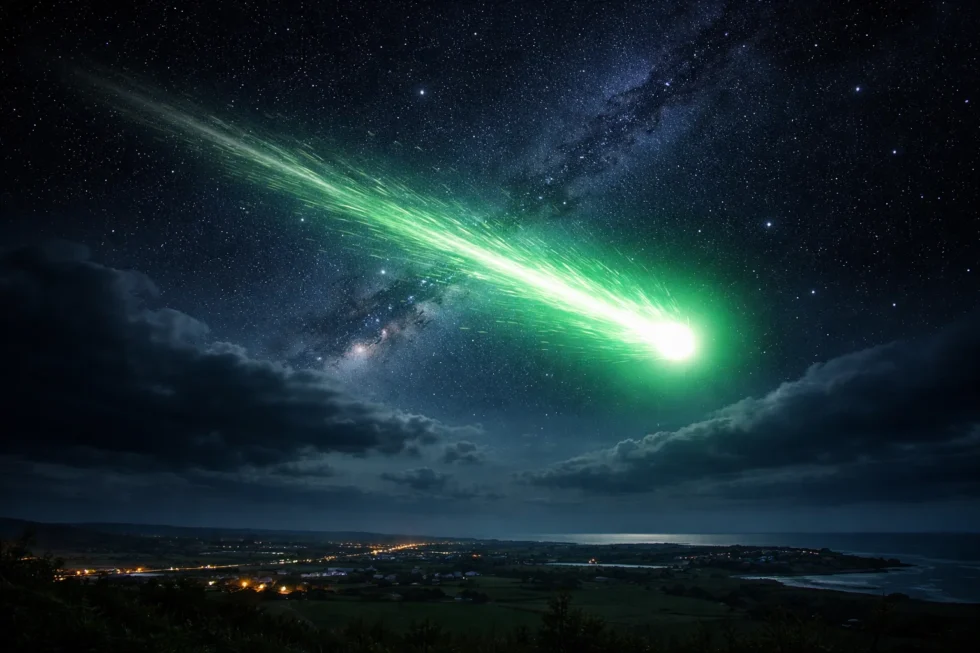
chemical explanation behind the green glow
The vivid green colour reported across the UK is linked to the chemical composition of the meteoroid and the interaction with atmospheric gases. As the object heats and ablates, specific elements emit light at characteristic wavelengths, producing the observed colour spectrum.
| Element | Visual effect |
|---|---|
| Magnesium | Bright green-white flashes |
| Nickel | Deep green tint |
| Ionised oxygen | Enhances green glow at altitude |
This combination creates the emerald appearance frequently described by witnesses, particularly under darker sky conditions where contrast is stronger.
where the green fireballs were seen across the UK
Observation networks, compiled sighting logs and synchronised video evidence indicate that the green fireballs were visible across a wide arc of the United Kingdom, pointing to a high-altitude atmospheric entry rather than a localised घटना. Analysts have used dashcam timestamps, home security footage and eyewitness reports to reconstruct a likely trajectory moving broadly from the Midlands towards the North Sea, with visibility extending far beyond the immediate flight path due to the intensity of the الضوء. Confirmed and corroborated locations include:
- Northamptonshire (A43 near Corby – primary daytime dashcam capture at ~12:30 BST)
- Suffolk (Kesgrave – residential security system recording with clear الضوء trail)
- East Yorkshire and Lincolnshire (multiple independent visual confirmations)
- Cumbria (northern horizon sightings indicating long-range visibility)
- Northumberland coast (Lindisfarne – separate overnight fireball shortly after midnight)
- North Sea corridor (trajectory modelling suggests offshore disintegration zone)
The spatial distribution of sightings — particularly those recorded hundreds of kilometres apart — strongly supports a shallow entry angle at significant altitude, allowing the fireball to remain visible across large parts of eastern and northern Britain.
witness accounts and recorded evidence
Eyewitness testimony across multiple regions shows a striking level of consistency, with descriptions aligning closely with known high-energy meteor behaviour. Observers repeatedly emphasised the sudden onset, extreme brightness and rapid الحركة, often noting that the object appeared far larger than conventional aircraft or спутники. Reported observations include:
- A driver near Corby stating the object was “so huge and so bright” that it dominated the sky for several seconds
- Witnesses near Lindisfarne reporting an immediate эмоциональная реакция, saying they “all screamed” as the fireball cut across the night sky
- A homeowner in Suffolk identifying the event retrospectively after reviewing doorbell footage that captured a sharp flash followed by a fading luminous trail
Several recordings show a persistent trail lasting briefly after the main object had passed, a known characteristic of high-speed meteors where ionised gases continue to glow before dissipating. The consistency between independent accounts and video material significantly strengthens the reliability of the event reconstruction.
expert analysis and trajectory assessment
Preliminary analysis from meteor observation groups indicates that at least one of the objects entered Earth’s atmosphere at a shallow angle, prolonging visibility and increasing geographic coverage before fragmentation and полного сгорания.
“Smallish meteor, travelling at approximately 35,000 mph,” (John Maclean, UK Meteor Observation Network, UK briefing).
Key expert conclusions based on early modelling:
- No confirmed association with a recognised meteor shower, indicating a sporadic origin
- Likely composition consistent with metallic asteroid fragments rather than cometary debris
- Fragmentation occurred at high altitude, preventing any significant mass from reaching the surface
- Probable debris field located offshore in the North Sea, based on projected مسیر
The absence of sonic boom reports further suggests that the objects disintegrated at altitude sufficient to dissipate shock waves before reaching ground level.
why April is a peak period for fireball activity
Astronomers often describe late winter and early spring as “fireball season”, a period during which statistical наблюдения show a noticeable increase in bright meteor events. While the exact mechanisms remain under active study, long-term datasets reveal a consistent seasonal uplift. Key observational patterns:
- Peak activity typically falls between February and April
- Fireball detection rates increase by approximately 10% to 30% compared with other periods
- Earth’s orbital position intersects regions with higher concentrations of meteoroid debris
This alignment increases the вероятность of larger or faster-moving particles entering the atmosphere at angles that maximise visibility from the ground.
what happens when a meteor enters Earth’s atmosphere
The formation of a fireball follows a well-established physical sequence driven by velocity, pressure and thermal interaction with the atmosphere:
- Entry at космическая скорость, typically tens of thousands of miles per hour
- Rapid compression of air ahead of the object, generating extreme temperatures
- Ablation as surface material vaporises and sheds mass
- Fragmentation caused by structural stress and pressure differentials
- Emission of intense light, producing the visible fireball and trailing plasma
In most cases, including this event, the meteoroid is completely vaporised at altitude, leaving no recoverable fragments on the ground.
possible outcomes of such events
| Scenario | Likelihood |
|---|---|
| Complete burn-up in atmosphere | Very high |
| Small fragments reach land | Low |
| Ocean impact | Moderate (offshore trajectories) |
| Ground damage | Extremely rare |
There are no verified reports of impact or damage associated with the UK sightings, reinforcing the conclusion that the objects fully disintegrated before reaching the surface. Although meteors enter Earth’s atmosphere ежедневно, only a small fraction generate fireballs bright enough to be observed simultaneously across multiple regions. This event is notable not for its rarity in origin, but for the clarity and scale of observation. Contributing factors include:
- Exceptionally clear atmospheric conditions across eastern and northern Britain
- High entry velocity amplifying luminosity and visibility range
- Dual timing (daylight and night observations) increasing detection probability
- Metallic composition enhancing the distinctive green emission
Together, these elements produced a high-visibility event that, while scientifically typical, became unusually well documented. Accurate public reporting remains critical for scientific analysis of transient astronomical events, particularly those not detected in advance by automated systems. Experts recommend:
- Recording the precise time and geographic location of the sighting
- Retaining any video or photographic evidence without alteration
- Noting direction of travel, duration and relative brightness
- Submitting observations to recognised meteor networks for triangulation
Such data allows researchers to refine trajectory models, estimate composition and improve long-term monitoring of near-Earth objects.
Read about the life of Westminster and Pimlico district, London and the world. 24/7 news with fresh and useful updates on culture, business, technology and city life: When is Lyrid meteor shower UK 2026 peak and how to see fireballs across UK skies