
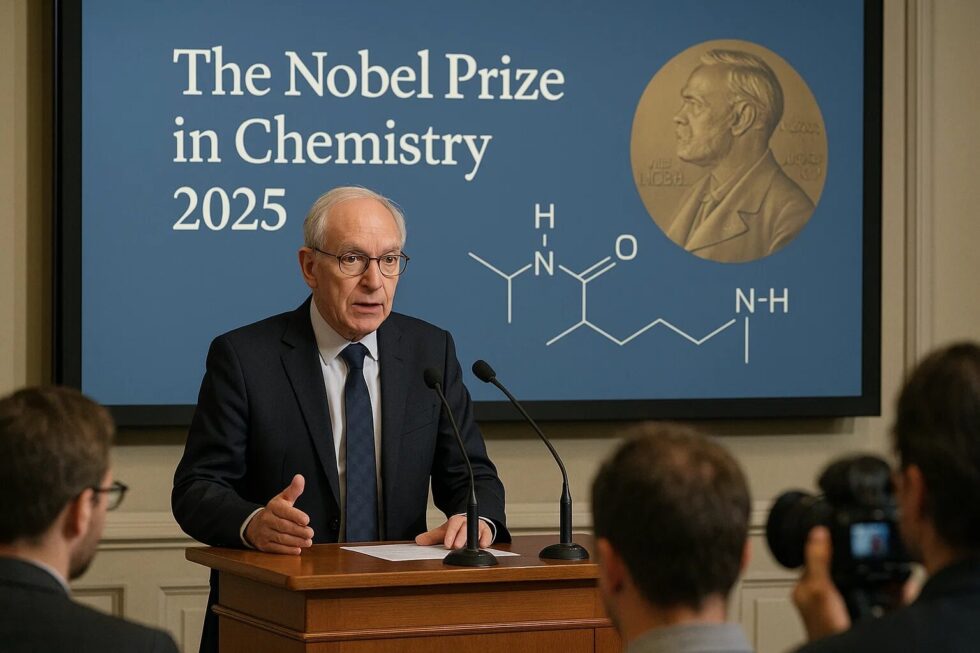
Chemie Nobelpreis 2025 was officially revealed on October 8, when the Royal Swedish Academy of Sciences announced that Susumu Kitagawa, Richard Robson, and Omar M. Yaghi would share the award for their groundbreaking work on metal-organic frameworks (MOFs). As the livestream unfolded from Stockholm, scientists and journalists around the world tuned in to witness the historic moment.
The declaration was both technically rich and emotionally charged, celebrating decades of molecular innovation that could change how we capture carbon, purify water, and build future materials.
As highlighted by The WP Times, the announcement sparked an immediate wave of global reactions across academia and industry, highlighting how modern chemistry shapes environmental and technological progress.
This feature reconstructs the full timeline of the Chemie Nobelpreis announcement, introduces the laureates, explains their discoveries, and explores what this means for the future of science and sustainability.
The moment of the announcement – a live look from Stockholm
At 11:45 CEST on October 8, 2025, the Nobel Committee for Chemistry gathered at the Royal Swedish Academy of Sciences to reveal the year’s winners.
In the minutes before the broadcast, the press room buzzed with expectation. Cameras rolled, journalists whispered predictions, and the Academy’s chair prepared the envelope. Moments later, the decision was read aloud:
Susumu Kitagawa, Richard Robson, and Omar Yaghi are awarded the Nobel Prize in Chemistry for the development of metal-organic frameworks (MOFs).
The livestream showed photos of the laureates and structural images of MOF networks, accompanied by applause and gasps of relief from researchers who had long anticipated their recognition.
The committee explained that these molecular architectures—built from metal ions connected by organic molecules—can trap and transport gases in vast, porous cavities. After the announcement, the laureates joined via video link to answer questions about potential applications: CO₂ capture, hydrogen storage, and water purification.
The press conference concluded with a short film summarizing how MOFs evolved from fragile prototypes into some of the most promising materials in chemistry today.
Who are the 2025 laureates
Each of the three winners contributed a vital piece to the MOF revolution.
| Laureate | Birth / Nationality | Affiliation (2025) | Key Contribution to MOF Research |
|---|---|---|---|
| Susumu Kitagawa | 1951, Japan | Kyoto University | Demonstrated “breathing” MOFs that expand and contract during gas absorption |
| Richard Robson | 1937, United Kingdom / Australia | University of Melbourne | Built the first MOF prototypes in 1989 using copper ions and organic linkers |
| Omar M. Yaghi | 1965, Jordan / United States | University of California, Berkeley | Created stable, modular MOFs and founded reticular chemistry |
Together, their discoveries laid the foundation for a new class of materials capable of storing enormous amounts of molecules within minuscule volumes.
Today, MOFs are used to trap greenhouse gases, filter toxins, and even harvest drinking water from air — innovations that may redefine sustainable technology in the 21st century.
Why MOFs matter – the science behind the award
Metal-organic frameworks are crystalline materials composed of metal ions and organic linkers, forming open networks with tunable cavities.
Their surface area is extraordinary: a single sugar-cube-sized piece of MOF can contain as much internal area as an entire football field. This enormous capacity allows them to “soak up” gases like hydrogen, methane, and carbon dioxide.
The Nobel Committee emphasized that this discovery merges molecular precision with environmental relevance. MOFs can selectively capture CO₂ from industrial emissions, remove “forever chemicals” from polluted water, and serve as storage media for renewable fuels.
Chemical companies such as BASF and industrial research centers are already exploring large-scale applications of MOFs in gas separation and filtration.
Researchers also foresee MOFs contributing to medical science, acting as nanocapsules for targeted drug delivery.
In short, the 2025 Chemie Nobelpreis recognizes not just elegant molecular design, but a transformative bridge between chemistry and sustainability.
How Nobel announcements work behind the scenes
The Nobel Foundation follows a strict and secretive process.
Every year, more than 1,000 professors, researchers, and former laureates receive invitations to nominate candidates.
The deliberations, drafts, and vote results remain sealed for 50 years under Swedish law.
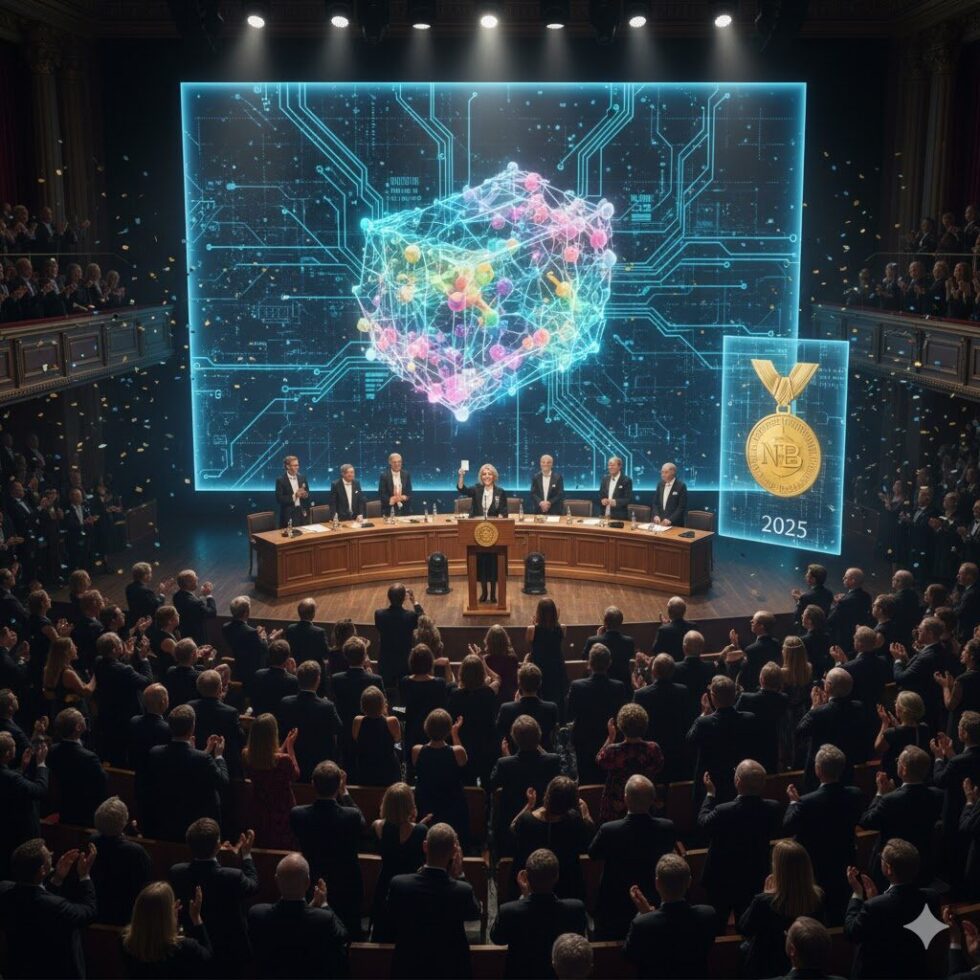
When the Chemistry decision is finalized, the Royal Swedish Academy prepares official press documents: the announcement, “popular information” for general readers, and a detailed scientific background for experts.
During the live event, simultaneous updates appear on NobelPrize, accompanied by visuals, interviews, and downloadable materials.
The Nobel Prizes for Physics, Medicine, Literature, and Peace are presented throughout the same week, with the official award ceremony held every December 10 — the anniversary of Alfred Nobel’s death.
Unlike the other prizes, the Peace Prize is presented in Oslo, a tradition whose historical reason remains uncertain.
This elaborate schedule ensures that each prize receives global attention while maintaining Nobel’s vision of independent recognition.
Global reactions and expert insights
Within minutes of the announcement, major media outlets described the winners as “architects of molecular sponges.”
Scientific journals and think tanks praised the committee’s decision as a recognition of long-awaited achievements in materials science.
Researchers emphasized that MOFs could revolutionize climate technologies by enabling efficient carbon capture and hydrogen storage.
Environmental experts celebrated their potential to combat global warming and provide clean water in arid regions.
Some industry analysts, however, pointed to the high cost of large-scale MOF production and the need for improved stability under real-world conditions.
Universities from Tokyo to Berkeley reported immediate spikes in interest from students applying to chemistry programs.
Meanwhile, investors are watching the emerging market of MOF-based startups, hoping to commercialize these materials within the next decade.
Overall, the 2025 Chemie Nobelpreis is seen as a signpost toward green innovation and cross-disciplinary cooperation.
Key moments from the announcement
- Press room opened to global media at 11:00 CEST
- Livestream countdown and introductory remarks by the Nobel Committee
- Official announcement of Kitagawa, Robson, and Yaghi as laureates
- Explanation of MOF chemistry and its significance
- Immediate broadcast of the winners’ photos and scientific visuals
- Q&A session on potential applications and challenges
- Publication of press materials on NobelPrize.org
- Rapid spread of news across media, universities, and industry networks
Each step reflected the precision and ceremony for which the Nobel tradition is famous.
Implications for science, industry, and policy
The announcement’s impact extends beyond the laboratory.
For scientists, it validates decades of MOF research and encourages new funding for advanced materials.
For corporations, it signals opportunities in clean energy, filtration, and green chemistry.
Governments may integrate MOF-based solutions into climate and water management policies.
Academic institutions are likely to expand research centers dedicated to reticular chemistry and sustainable materials.
In venture capital circles, the recognition has sparked new interest in startups that commercialize MOF technologies.
The Nobel announcement thus becomes not just a moment of recognition — but a catalyst for global scientific and economic development.
Read about the life of Westminster and Pimlico district, London and the world. 24/7 news with fresh and useful updates on culture, business, technology and city life: Where can you experience ayahuasca in London – what it is, how it works, and what to expect