
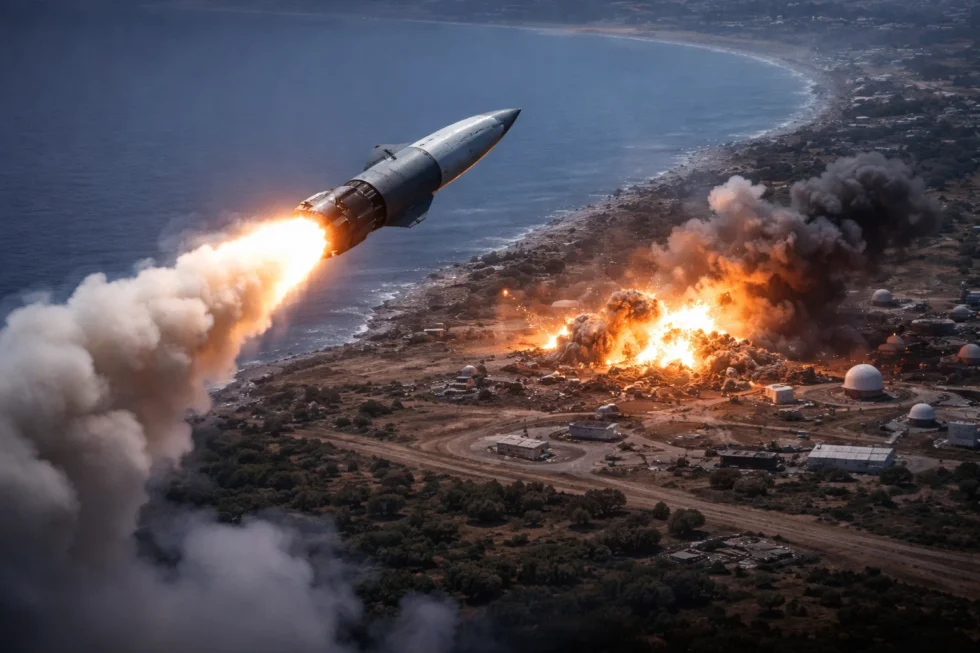
In a significant development amid escalating Middle East conflict, Iran launched two missiles in the direction of Cyprus, where the United Kingdom maintains key military bases, British Defence Secretary John Healey said Sunday. Healey told broadcasters that while the projectiles flew toward the Mediterranean island during Iran’s wider retaliatory strikes, British officials believe it is not yet clear whether the missiles were intentionally targeting UK facilities. He added that the incident highlights the indiscriminate nature of Tehran’s response to recent joint US‑Israeli military strikes on Iranian targets. Healey also disclosed that around 300 UK military personnel were stationed close to other Iranian attacks in Bahrain, underscoring the risk to British forces in the region. The UK government has emphasised that Britain was not directly involved in the US‑Israeli operation but remains on high alert, with defensive operations ongoing from RAF bases in Cyprus and Qatar. Officials in Nicosia have disputed claims that the island was ever specifically targeted, a point of tension between London and Nicosia amid fast‑moving developments. This is reported by The WP Times, via Reuters.
Background to the Regional Escalation
Since February 28, after joint US and Israeli strikes on Iran, which reportedly included attacks on senior Iranian military leadership, Tehran has launched a series of missile and drone counterattacks across the Middle East, targeting multiple nations and military positions. Those strikes followed assertions by US leadership that the offensive was designed to degrade Iran’s capability to project power, including through long‑range weapons systems. Iran’s actions have triggered international concern about broader escalation and instability across the region.
What Defence Secretary Healey Reported
John Healey outlined several key points on Sunday:
- Two Iranian missiles were fired in the direction of Cyprus, an island hosting British military facilities at RAF Akrotiri and Dhekelia.
- British officials do not believe the missiles were deliberately aimed at UK bases.
- The missiles were reportedly intercepted before impacting Cyprus airspace or territory.
- Approximately 300 UK personnel were stationed near targeted sites in Bahrain during separate Iranian strikes, some within several hundred yards of impacts.
- The Defence Secretary characterised Iran’s retaliation as “indiscriminate” and warned of the dangers posed to regional security.
- UK warplanes from Cyprus and Qatar have been deployed to defend allied airspace and assets against Iranian missiles and drones.
- Healey reiterated that all UK defensive operations are conducted in accordance with international law.
"My first job as Defence Secretary is to protect British people and British bases, reinforce regional security, and do all we can to prevent further regional escalation."
— Ministry of Defence 🇬🇧 (@DefenceHQ) March 1, 2026
Defence Secretary @JohnHealey_MP on the situation in the Middle East. pic.twitter.com/HFRTskaiUy
Conflicting Statements from Cyprus
Despite the UK account, officials in Nicosia have strongly denied that any missiles were fired toward Cyprus or that their territory was under threat during Iran’s retaliatory actions. Cypriot authorities described reports suggesting missiles were headed for the island as inaccurate, asserting that no such threat materialised. This contradiction highlights diverging assessments between allied governments about the nature and flight path of the Iranian projectiles.
Strategic Importance of Cyprus Bases
British military facilities in Akrotiri and Dhekelia serve as critical logistics and support hubs for operations in the Middle East. The bases host Royal Air Force assets and provide staging points for surveillance, air defence, and logistical missions. The possible involvement of these bases in regional air defence — including the interception of hostile missiles — may increase their strategic exposure amid heightened tensions.
Broader Regional Security Implications
The launches occur within a tense regional security environment that includes:
- Iranian missile and drone strikes across Gulf states and Israel, claimed as retaliation for US‑Israeli airstrikes.
- Disruption of civilian airspace and international flights in multiple countries.
- Heightened alert levels for coalition forces, including British and allied units.
- Diplomatic efforts to de‑escalate hostilities amid global concerns about a wider Middle East war.
The UK emphasises defensive operations only and has not joined offensive strikes against Iran. Prime Minister Sir Keir Starmer has convened emergency briefings (Cobra) and maintained communication with Cypriot leadership to clarify the status of threats. Defence officials continue to monitor the situation closely and remain ready to protect personnel and strategic assets in the region.
Read about the life of Westminster and Pimlico district, London and the world. 24/7 news with fresh and useful updates on culture, business, technology and city life: Oxford Street pedestrianisation 2026: when will London’s shopping street go car-free and how will bus routes change