

Passive vaping health risk is at the centre of renewed public health debate after the UK government on Friday, 13 February 2026, announced plans to ban vaping in cars carrying children and to extend smoke-free rules to playgrounds and areas outside schools. The Department of Health and Social Care said the measures are designed to reduce children’s exposure to second-hand aerosol from e-cigarettes and heated tobacco devices. The proposal follows research published in 2024 by University College London (UCL), which found that indoor exposure to second-hand vapour leads to measurable nicotine levels in children, although significantly lower than from cigarette smoke. Legislation is expected later in 2026, reports The WP Times.
Passive vaping health risk: what current data shows
The central question is whether second-hand vapour from e-cigarettes poses a measurable threat to bystanders, particularly children. The National Health Service states that, unlike passive smoking, there is currently no strong evidence that vaping causes significant harm to people nearby at levels observed in typical environments.
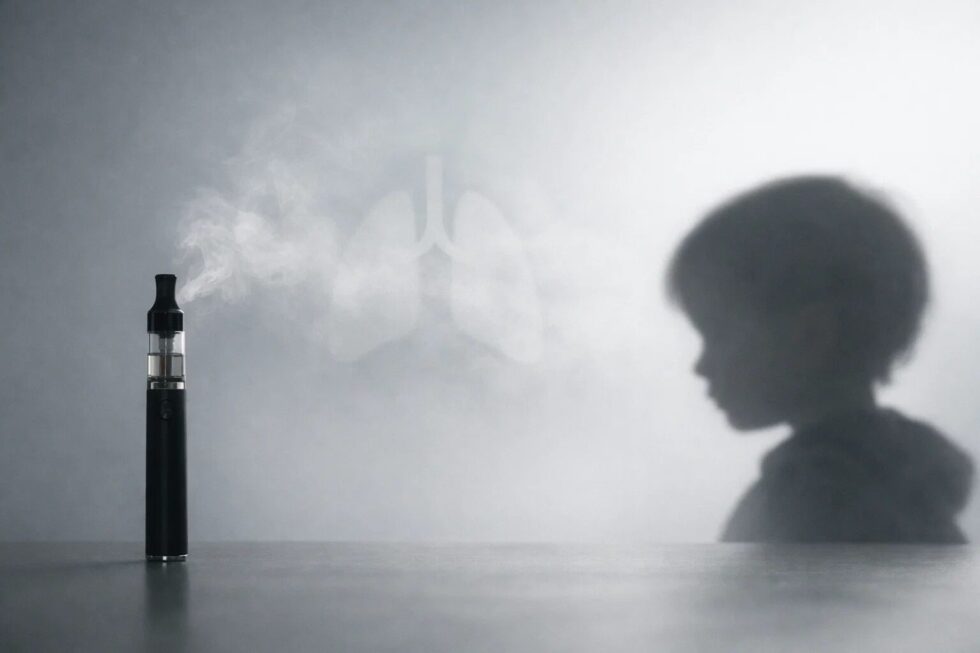
However, absence of strong evidence is not equivalent to confirmed safety. A 2024 UCL study measured nicotine exposure in children living in homes where indoor vaping occurred. Researchers found that children exposed to second-hand vapour indoors had 84% lower nicotine levels compared with children exposed to cigarette smoke. At the same time, nicotine concentrations were higher than in children not exposed to vaping at all.
The study concluded that while overall exposure is substantially lower than with tobacco smoke, passive vaping is not exposure-free. Nicotine in this context acts as a marker of inhalation of aerosol components. Although combustion does not occur, e-cigarette vapour may contain ultrafine particles, flavouring compounds and trace metals released from heating elements.
Government vaping ban in cars with children: legal framework and penalties
On 13 February 2026, the Department of Health and Social Care confirmed that it plans to introduce legislation prohibiting vaping in private vehicles when anyone under 18 is present. The proposed rule mirrors existing restrictions on smoking in cars with children, which came into force in England in October 2015 under the Children and Families Act 2014.
Under current smoking rules, drivers or passengers who smoke in a car carrying a minor can receive a £50 fixed penalty notice, rising to £100 if unpaid within 28 days. Although final fine levels for vaping have not yet been confirmed, officials indicated that enforcement mechanisms would align with existing tobacco regulations. Police forces would oversee enforcement.
The rationale for focusing on vehicles is based on concentration levels. In enclosed spaces with limited ventilation, aerosol particles can accumulate rapidly. Even with open windows, particulate concentrations can exceed background air levels. Researchers argue that short-term exposure in confined environments is proportionally higher than in outdoor settings.
The government has indicated that draft legislation will be published in spring 2026, with parliamentary debate expected in summer 2026 and potential implementation in early 2027 if approved.
Second-hand vapour vs passive smoking: combustion as the key difference
The scientific distinction between cigarette smoke and e-cigarette vapour centres on combustion. Conventional cigarettes burn tobacco at high temperatures, producing smoke that contains thousands of chemicals, including tar, carbon monoxide and multiple carcinogens. Smoke is released both from the burning tip and through exhalation, creating continuous sidestream exposure.
E-cigarettes, by contrast, heat a liquid mixture to produce an aerosol. There is no burning tobacco and no sidestream smoke. Aerosol is mainly emitted during exhalation by the user.
Public health reviews in the UK have consistently reported that exposure to harmful substances from passive vaping is significantly lower than from passive smoking. Nevertheless, measurable levels of fine particles and nicotine can be detected indoors following vaping.
Comparative exposure overview
| Exposure type | Combustion | Continuous emission | Relative nicotine exposure | Evidence of established harm |
|---|---|---|---|---|
| Passive smoking | Yes | Yes | High | Strong, long-term evidence |
| Passive vaping | No | No | Much lower (−84% in study) | Limited, not zero |
| No exposure | No | No | Baseline | None |
This comparison underpins the government’s argument that risk levels differ, while precautionary measures remain justified for children.
Playground and school perimeter restrictions: policy objectives
The proposed legislation would also prohibit vaping, smoking and use of heated tobacco devices in playgrounds and directly outside school gates. Officials state that the policy aims to reduce children’s exposure and limit the visibility of nicotine use.
In open outdoor spaces, aerosol disperses rapidly. Researchers indicate that direct passive exposure outdoors is likely to be very low except at close range. However, policymakers cite behavioural considerations as a secondary objective. Reducing visible nicotine consumption around schools is intended to decrease normalisation among adolescents.
According to national statistics published in December 2025, approximately 9% of children aged 11 to 15 in England reported having tried vaping at least once. The Department of Health has identified youth uptake as a central public health concern in its broader tobacco and nicotine control strategy.
Local authorities are expected to receive implementation guidance once the legislation is enacted. Enforcement in playgrounds would likely rely on local council officers rather than police intervention in most cases.
Heated tobacco devices: regulatory consistency
The government announcement specifies that heated tobacco products will be included in the same restrictions. These devices heat processed tobacco without burning it, producing an inhalable aerosol.
Officials state that aligning regulatory treatment of cigarettes, vaping devices and heated tobacco systems aims to simplify enforcement and prevent loopholes. The Tobacco and Related Products Regulations 2016 form the existing legislative framework governing nicotine products in the UK. Amendments would be required to incorporate location-specific vaping bans.
Industry representatives are expected to participate in the consultation phase scheduled for spring 2026. Medical associations and child health advocacy groups have also signalled that they will submit evidence.
What people should know: practical steps and verification
Until legislation is passed, vaping in cars with children remains legal in England. If the proposal becomes law, drivers and passengers will need to ensure that no vaping occurs in vehicles carrying minors.
For individuals seeking clarity:
- Monitor parliamentary proceedings for the tobacco and nicotine control bill.
- Review official Department of Health announcements for confirmed enforcement dates.
- Check local council updates for implementation guidance.
- Consult NHS advice regarding vaping and smoking exposure.
Parents concerned about exposure can reduce potential risks by avoiding vaping indoors, increasing ventilation where vaping occurs, and not vaping in enclosed vehicles when children are present.
The proposed law does not regulate vaping inside private homes. Public health authorities have acknowledged that exposure indoors may be higher than outdoors but have not indicated plans to legislate in domestic settings.
Scientific uncertainty and policy approach
The current policy direction reflects a precautionary model rather than evidence of severe risk. Existing research indicates that passive vaping exposure is significantly lower than passive smoking, but measurable and not absent. Long-term epidemiological data on second-hand vaping are limited due to the relatively recent adoption of e-cigarettes.
Health authorities continue to maintain that vaping is substantially less harmful than smoking for adult smokers attempting cessation. At the same time, regulators emphasise that children and non-smokers should not be exposed to nicotine products.
If enacted, the new restrictions would extend smoke-free environments into additional child-centred settings, reinforcing a regulatory trend that treats nicotine visibility and confined-space exposure as policy priorities rather than waiting for conclusive long-term health outcome data.
Read about the life of Westminster and Pimlico district, London and the world. 24/7 news with fresh and useful updates on culture, business, technology and city life: You’re damaging your skin: eight everyday habits that quietly make eczema worse