
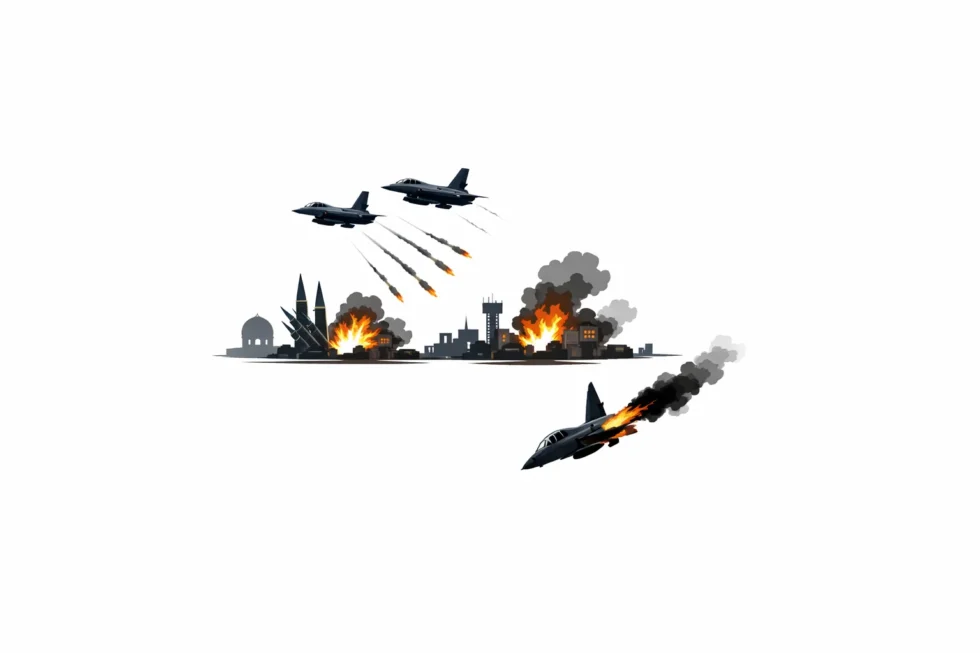
On 4 March 2026, Israeli military operations against Iran continued to expand as the Israeli Air Force carried out overnight strikes on Iranian military assets in Isfahan and Shiraz, according to statements from the Israel Defense Forces (IDF). The strikes targeted missile infrastructure, storage facilities and air-defence systems. Separate defence reports also indicated that an Iranian yak-130 aircraft may have been shot down during aerial operations over Tehran. About this reports The WP Times, citing official briefings by the IDF and coverage from The Times of Israel and Reuters.
According to the IDF, the wave of strikes hit more than 20 military targets across central and southern Iran. Military officials said the attacks formed part of an ongoing campaign aimed at weakening Iran’s missile capabilities and limiting its ability to launch long-range ballistic and cruise missiles. The Israeli military added that several of the targets were linked to storage and deployment infrastructure for Iranian missile forces.
IDF says missile storage facilities were targeted
During a press briefing, IDF spokesman Brigadier General Effie Defrin said Israeli aircraft struck a number of strategic military locations overnight. Among the targets were two facilities in Isfahan where Iranian forces were believed to be storing advanced Ghadr ballistic missiles. The Ghadr missile is a medium-range ballistic missile developed by Iran and considered an upgraded variant of the Shahab-3. Defence analysts estimate that the missile can reach ranges of approximately 1,600 to 2,000 kilometres, potentially allowing it to strike targets across the Middle East.
According to Defrin, the facilities targeted in Isfahan were used to store and maintain such missiles before potential deployment. The IDF said destroying these locations could reduce Iran’s ability to launch ballistic attacks in the near term. In addition to the missile storage sites, Israeli aircraft also struck cruise missile depots, logistical infrastructure and air-defence positions, according to the military statement. The IDF said the strikes were designed to “degrade Iranian aerial defence and missile capabilities” and to limit the country’s operational readiness during the ongoing conflict.
First reported Israeli strikes in these areas during campaign
Israeli military officials said the attacks marked the first time during the current campaign that Israeli aircraft had targeted military assets in the Isfahan and Shiraz regions. Isfahan is one of Iran’s most strategically important provinces. The region hosts multiple military installations, aerospace facilities and nuclear-related infrastructure. Although the IDF did not state that nuclear sites were targeted, analysts note that several Iranian defence industries are located in and around the city.
Shiraz, located in southern Iran, is also home to several military bases and logistical centres used by the Iranian armed forces. The IDF did not provide detailed information about the exact locations of the strikes or the types of aircraft involved in the operations.
Video shows strikes on older Iranian fighter jets
Separately released footage from Israeli military sources showed precision strikes on Iranian aircraft located at an airport in Tabriz, in north-western Iran. The video appears to show Israeli munitions hitting two aircraft on the runway, identified by the IDF as F-5 and F-4 fighter jets belonging to the Iranian Air Force. The footage suggests the aircraft were struck while preparing to take off, according to the Israeli military statement. Both aircraft types were originally manufactured in the United States and sold to Iran before the 1979 Iranian Revolution, when the country maintained close military ties with Washington. Since the revolution and the imposition of international sanctions, Iran has struggled to modernise its air fleet. Many of its aircraft date back to the Cold War and require extensive maintenance to remain operational.
Iran’s ageing fighter fleet
Iran’s current air force still operates several vintage US-made fighter aircraft, including the McDonnell Douglas F-4 Phantom II and the Northrop F-5. The F-4 Phantom II entered service with the United States in the early 1960s and was widely used during the Vietnam War as both a fighter and a fighter-bomber. Over the following decades it was gradually replaced by newer aircraft such as the F-15 Eagle, F-16 Fighting Falcon and F/A-18 Hornet.
Despite its age, the aircraft remains in limited service in several countries, including Iran. Defence estimates suggest Iran may still operate around 60 F-4 aircraft, though not all are believed to be fully operational. Iran also continues to operate fewer than 50 F-5 fighters and a small number of F-14 Tomcats, which were also purchased from the United States before the revolution. Maintenance challenges, spare-parts shortages and international sanctions have significantly reduced the readiness of these aircraft.
Reports of yak-130 shootdown over Tehran
At the same time, regional defence reporting indicated that an Iranian yak-130 aircraft may have been shot down during aerial combat over Tehran. The yak-130 is a Russian-designed advanced jet trainer capable of performing light attack missions. Iran has reportedly used the aircraft to train fighter pilots and potentially support combat operations. According to reports circulating on Wednesday, an Israeli F-35 stealth fighter engaged the yak-130 during operations in Iranian airspace. The reports described the incident as one of the first known aerial engagements involving an Israeli aircraft over the Iranian capital during the current conflict. Neither the Israeli military nor Iranian authorities immediately confirmed detailed information about the incident.
Wider military escalation continues
The latest strikes come amid a rapidly escalating regional conflict involving Israel, Iran and allied forces. Over the past several days, Israeli and US military operations have targeted a range of Iranian military facilities, missile infrastructure and command sites. Iran has responded with missile and drone attacks targeting Israeli territory and US-linked military locations in the region.
The IDF has said that ongoing operations are aimed at reducing Iran’s military capabilities, particularly its missile forces and air-defence networks. Iranian officials have stated that the country will continue to respond to what they describe as foreign aggression. Military analysts say the situation remains highly volatile, with the possibility of further strikes and counter-strikes across the region in the coming days.
Technical profile: Iranian yak-130 trainer aircraft
The yak-130 is a Russian-designed advanced jet trainer that can also perform light combat missions. Developed by Russia’s Yakovlev design bureau, the aircraft is intended primarily to train pilots for modern multirole fighters such as fourth- and fifth-generation jets. However, it can also be equipped with weapons and used for limited attack missions.
Iran received yak-130 aircraft as part of efforts to modernise pilot training for its air force. The aircraft is significantly more modern than many fighters currently operated by Iran, which still include Cold War-era platforms such as the F-4 Phantom II and F-5.
The yak-130 is designed with digital avionics and fly-by-wire controls, allowing it to simulate the flight characteristics of modern fighter aircraft during training missions.
Key technical characteristics of the yak-130

| Specification | Details |
|---|---|
| Aircraft type | Advanced jet trainer / light attack aircraft |
| Manufacturer | Yakovlev Design Bureau (Russia) |
| First flight | 1996 |
| Crew | 2 (pilot and instructor) |
| Length | 11.49 metres |
| Wingspan | 9.72 metres |
| Maximum speed | About 1,060 km/h |
| Combat range | Approx. 2,100 km |
| Service ceiling | Around 12,500 metres |
| Engines | 2 × AI-222-25 turbofan engines |
| Maximum take-off weight | About 10,300 kg |
| Hardpoints | Up to 9 external weapon stations |
| Possible weapons | Air-to-air missiles, bombs, rockets, gun pods |
| Role | Pilot training, light attack missions |
The aircraft’s avionics system allows it to replicate the behaviour of different combat aircraft types, making it suitable for training pilots who will later operate advanced fighters such as the Su-30, MiG-29, or other modern jets.Although it can carry weapons, the yak-130 is not designed as a frontline fighter and would normally operate in training roles or light ground-attack missions.