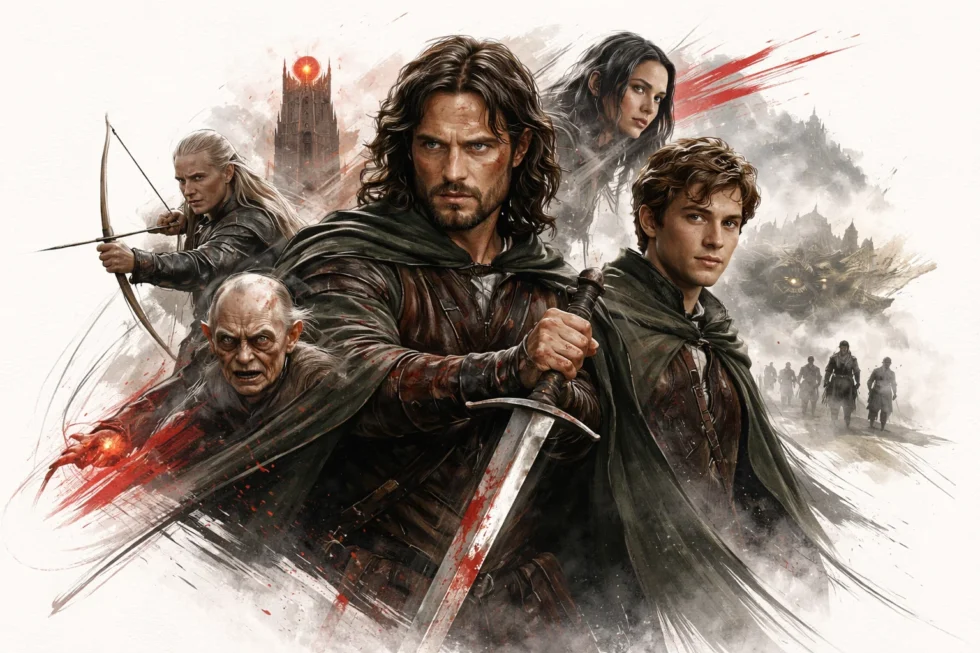
Jamie Dornan has been confirmed as Aragorn in The Lord of the Rings: The Hunt for Gollum, with Warner Bros formally unveiling the core cast and narrative direction during CinemaCon 2026. The film, directed by Andy Serkis, is positioned as a prequel to The Fellowship of the Ring, focusing on Aragorn’s covert mission to track Gollum before the Ring’s existence becomes widely known. The announcement establishes both the timeline and the strategic intent behind the project, combining legacy characters with new additions such as Leo Woodall, while anchoring the story in previously referenced but unseen events in Tolkien’s world, The WP Times reports within confirmed studio disclosures.
The project introduces a structural shift for the Lord of the Rings franchise by moving away from large ensemble arcs toward a focused, character-driven narrative centred on Aragorn, known during this period as Strider. The casting of Jamie Dornan in a role originally defined by Viggo Mortensen signals a deliberate generational transition, while the inclusion of returning actors—such as Ian McKellen and Elijah Wood—maintains continuity. The story is designed to fill a critical gap in the timeline, explaining how Gollum was captured and how information about the Ring was contained before the events that triggered the original trilogy, with Warner Bros confirming at CinemaCon that the film will explore Aragorn’s early hunt for Gollum in the years leading up to The Fellowship of the Ring (BBC Newsbeat, Las Vegas, April 2026).
Jamie Dornan as Aragorn: timeline, character positioning and narrative function
The decision to cast Jamie Dornan as Aragorn reflects a focus on a specific phase of the character’s life that has not been fully explored on screen. In Tolkien’s broader chronology, Aragorn spends years operating as a ranger, moving through Middle-earth under the name Strider while working in secrecy alongside Gandalf. This period is marked by intelligence gathering, surveillance and the containment of threats linked to Sauron’s growing influence.
In The Hunt for Gollum, Aragorn’s role is expected to centre on the systematic tracking of Gollum across multiple regions, requiring a blend of stealth, endurance and strategic judgement. Unlike the more visible leadership role depicted in the original trilogy, this version of Aragorn operates largely in isolation, with limited support and high stakes tied to information control. The narrative emphasis is therefore not on large-scale battles, but on pursuit, decision-making and the consequences of delay or failure.
The comparison with Viggo Mortensen’s portrayal is structurally important but contextually different. Mortensen’s Aragorn emerges as a leader in a time of open conflict, whereas Dornan’s version exists in a pre-conflict phase where the outcome is uncertain and the mission is preventative rather than reactive. This distinction allows the film to explore psychological continuity and operational pressure in a way that complements, rather than replicates, the established character arc.
Leo Woodall, Halvard and the expansion of Middle-earth narrative
Leo Woodall joins the cast as Halvard, a new character created specifically for The Hunt for Gollum. While not directly sourced from Tolkien’s primary texts, Halvard is positioned within the narrative as part of the broader ecosystem of Middle-earth, enabling the story to extend beyond the limited scope of existing references. This approach allows the filmmakers to introduce new dynamics without altering the established canon.
Halvard’s function within the story is expected to support Aragorn’s mission while also representing localised conflicts and perspectives that were not previously depicted. This may include interactions with regional populations, territorial tensions and logistical challenges associated with tracking a moving target such as Gollum. The inclusion of original characters like Halvard provides narrative flexibility, enabling the film to build tension and scale without relying exclusively on known figures.
Kate Winslet’s casting as Marigol follows a similar pattern, introducing another original character whose role has not been fully disclosed but is expected to intersect with the central storyline. Together, these additions indicate a hybrid narrative model that combines canonical continuity with controlled expansion.
The Hunt for Gollum: plot structure, timeline and connection to the trilogy
The Lord of the Rings: The Hunt for Gollum is set in the period leading up to The Fellowship of the Ring, focusing on the search for Gollum after he leaves Mordor. In Tolkien’s texts, this pursuit is referenced as a critical operation carried out by Aragorn at Gandalf’s request, resulting in Gollum’s eventual capture and interrogation.
The film expands this brief reference into a full narrative arc, structured around several key elements. First, the geographical scope of the search spans multiple regions, reflecting the difficulty of tracking a subject who is both elusive and constantly moving. Second, the stakes are defined by the risk that Gollum could reveal information about the Ring to Sauron, making the mission time-sensitive and strategically vital. Third, the interaction between Aragorn and Gandalf provides a framework for decision-making and coordination.
The timeline aligns with established canon in that it occurs before Frodo inherits the Ring and before the Fellowship is formed. This positioning allows the film to function as a direct narrative bridge, connecting background events to the main storyline without altering known outcomes. The emphasis is therefore on process rather than resolution, focusing on how events unfold rather than what ultimately happens.
Returning cast and continuity within Lord of the Rings
The film includes several returning actors from the original and related trilogies, reinforcing continuity within the franchise. Ian McKellen reprises his role as Gandalf, maintaining the character’s central position in the investigation of the Ring. Elijah Wood returns as Frodo Baggins, although his role is expected to be limited given the timeline. Andy Serkis both directs the film and returns as Gollum, ensuring consistency in the portrayal of one of the franchise’s most complex characters. Lee Pace also returns as Thranduil, linking the film to The Hobbit trilogy.
This continuity serves both narrative and commercial purposes. From a storytelling perspective, it ensures that character behaviour and tone remain aligned with previous films. From an industry standpoint, it provides a degree of familiarity that supports audience engagement. The combination of established and new cast members reflects a calculated balance between stability and renewal.
Industry context: franchise strategy and production model
The development of The Hunt for Gollum reflects broader trends within the film industry, particularly the expansion of established intellectual properties through targeted prequels and character-focused narratives. Rather than attempting to replicate the scale of the original trilogy, Warner Bros appears to be prioritising depth and specificity, using smaller narrative windows to explore underdeveloped areas of the source material.
The choice of Andy Serkis as director is significant, given his long-standing association with the franchise and his expertise in performance capture technology. His dual role as director and actor allows for a unified creative approach, particularly in scenes involving Gollum, where performance and visual effects are closely integrated.
Production is expected to follow a multi-phase timeline, including pre-production and script development in 2026, principal photography across 2026–2027 and post-production aligned with high-level visual effects requirements. The release date of 17 December 2027 positions the film within the peak holiday window, traditionally associated with major franchise releases.
Audience response and expectations
Initial audience reactions following the CinemaCon announcement have focused on casting decisions, particularly the replacement of Viggo Mortensen with Jamie Dornan in the role of Aragorn. This response reflects the enduring association between actors and characters within long-running franchises, as well as the challenges of introducing new interpretations.
At the same time, there is measurable interest in the film’s narrative focus, particularly the opportunity to explore a previously unseen part of the timeline. The inclusion of new characters such as Halvard has generated curiosity, while the return of familiar figures provides a point of continuity. Audience expectations are likely to centre on three factors: fidelity to Tolkien’s world, coherence with existing films and the ability of the new cast to sustain narrative credibility. The film’s reception will depend on how effectively these elements are balanced.
The next phase of The Lord of the Rings: The Hunt for Gollum moves from casting confirmation into active production, with Warner Bros expected to shift into principal photography across 2026–2027. Immediate milestones include the first trailer, further cast announcements and confirmed filming locations, which will define tone, scale and how Aragorn—played by Jamie Dornan—is positioned within the Lord of the Rings timeline. These outputs will serve as early indicators of whether the film aligns with established Middle-earth visual language or adopts a more contained, character-led structure focused on the hunt for Gollum.
Expectations are centred on three factors: canon accuracy, technical execution and casting credibility. The film must follow Tolkien’s timeline while integrating new elements such as Halvard, played by Leo Woodall; deliver visual effects that match the technical benchmark set by earlier films, particularly in the portrayal of Gollum; and establish Jamie Dornan’s Aragorn as a coherent earlier version of the character defined by Viggo Mortensen. These indicators will be tested through trailers, production stills and early screenings ahead of release.
| Indicator | What to watch | Why it matters |
|---|---|---|
| Canon consistency | Timeline accuracy, character behaviour | Determines credibility |
| Visual effects | Gollum integration, world scale | Sets technical benchmark |
| Casting | Dornan as Aragorn, Woodall as Halvard | Drives audience acceptance |
| Narrative focus | Pursuit vs action balance | Affects pacing |
| Production scale | Locations, set design | Signals scope |
The central risk remains audience comparison with legacy portrayals, particularly the transition from Viggo Mortensen to Jamie Dornan as Aragorn. At the same time, the film must introduce new characters without disrupting continuity and deliver a coherent narrative within a narrower timeframe. In practical terms, The Hunt for Gollum functions as a test of a more focused storytelling model within the Lord of the Rings franchise. Its performance will inform how future Middle-earth projects balance canon, character and scale.
Read about the life of Westminster and Pimlico district, London and the world. 24/7 news with fresh and useful updates on culture, business, technology and city life: The Walking Dead: Dead City season 3 signals creative reset as AMC refocuses on Maggie and Negan