
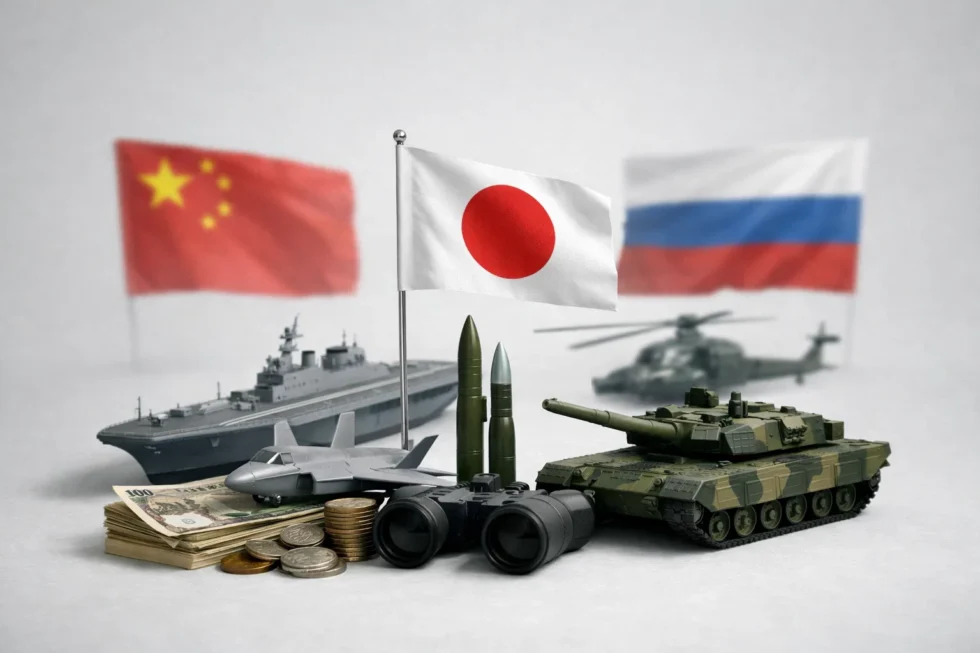
Japan has formally approved its largest defence budget in modern history, dramatically accelerating the country’s military rearmament as security tensions rise across East Asia.
The Japanese cabinet signed off on a ¥122.31 trillion ($785bn) national budget for the next financial year, of which more than ¥9 trillion ($58bn) will be spent on defence. The move represents a 9.4 per cent increase over 2025 and continues Tokyo’s four-year programme to lift military spending to 2 per cent of GDP, reaching the NATO benchmark two years earlier than originally planned. This is reported by The WP Times, citing The Associated Press.
Missiles and autonomous warfare
A core pillar of the 2026 budget is the rapid expansion of Japan’s strike and surveillance capabilities. The government has allocated ¥970bn ($6.2bn) for the development and deployment of long-range missile systems, designed to deter potential attacks from China and North Korea.
An additional ¥100bn ($640m) will fund the creation of SHIELD, a mass-scale autonomous drone defence networkthat will operate across air, sea and undersea domains. The system is intended to monitor Japan’s vast coastline and protect key maritime routes and islands, with full deployment scheduled by 2028. The emphasis on unmanned systems reflects Japan’s ageing population and shrinking pool of military personnel, forcing defence planners to replace manpower with automation.
International fighter jet programme and AI weapons
Japan will spend over ¥160bn ($1bn) on the joint development of a sixth-generation fighter aircraft with the United Kingdom and Italy, one of the most ambitious weapons projects in the country’s post-war history. The aircraft is scheduled to enter service in 2035. Further funding will go towards artificial-intelligence-driven drones, autonomous combat platforms and battlefield data systems, positioning Japan at the forefront of next-generation warfare.
Almost ¥10bn ($64m) has been allocated to expand Japan’s defence industrial base and support arms exports, marking a significant shift for a country that has traditionally imposed strict limits on weapons sales abroad.
Why Japan is spending more
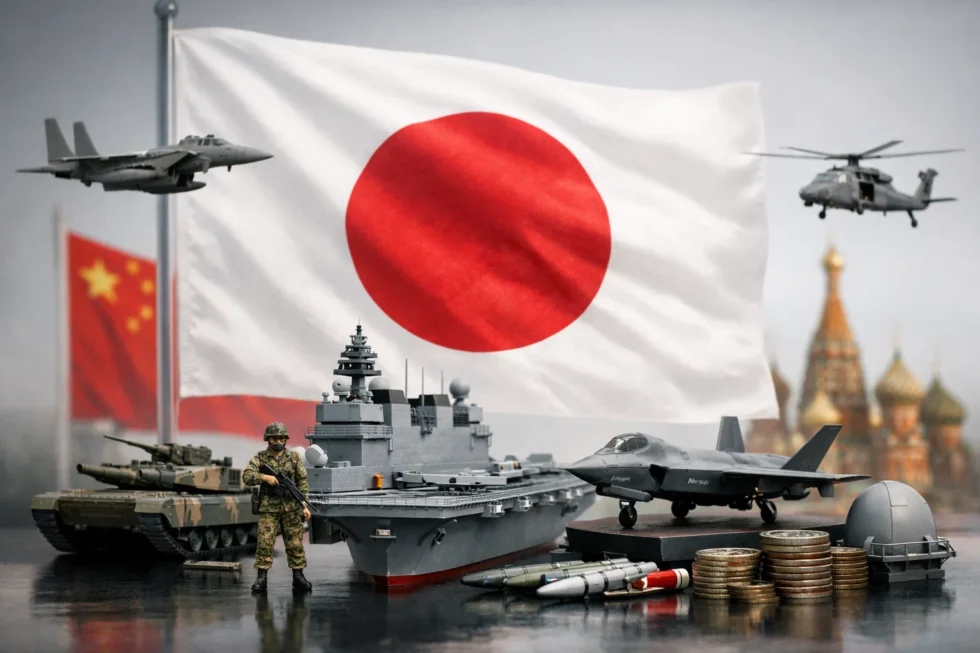
The budget increase is driven by rising concern over China’s military expansion, growing pressure around Taiwan, and the increasingly close military coordination between Moscow and Beijing. Earlier this year, Japanese fighter jets were scrambled after two Russian Tu-95 nuclear-capable strategic bombers flew from the Sea of Japan into the East China Sea, where they joined two Chinese H-6 bombers for a long-range joint patrol over the western Pacific.
Defence officials regard such operations as a clear signal that Russia and China are preparing for coordinated military pressure across multiple regions.
NATO Secretary-General Mark Rutte has warned that a Chinese attack on Taiwan could be accompanied by simultaneous Russian pressure on Europe, reinforcing Tokyo’s view that future conflicts will be global and synchronised rather than regional. Japan is also accelerating the import of drones, missile systems and surveillance equipment from Turkey and Israel, enabling faster deployment than domestic production would allow.
Read about the life of Westminster and Pimlico district, London and the world. 24/7 news with fresh and useful updates on culture, business, technology and city life: France issues statement on peace talks ahead of meeting between Zelenskyy and Macron