
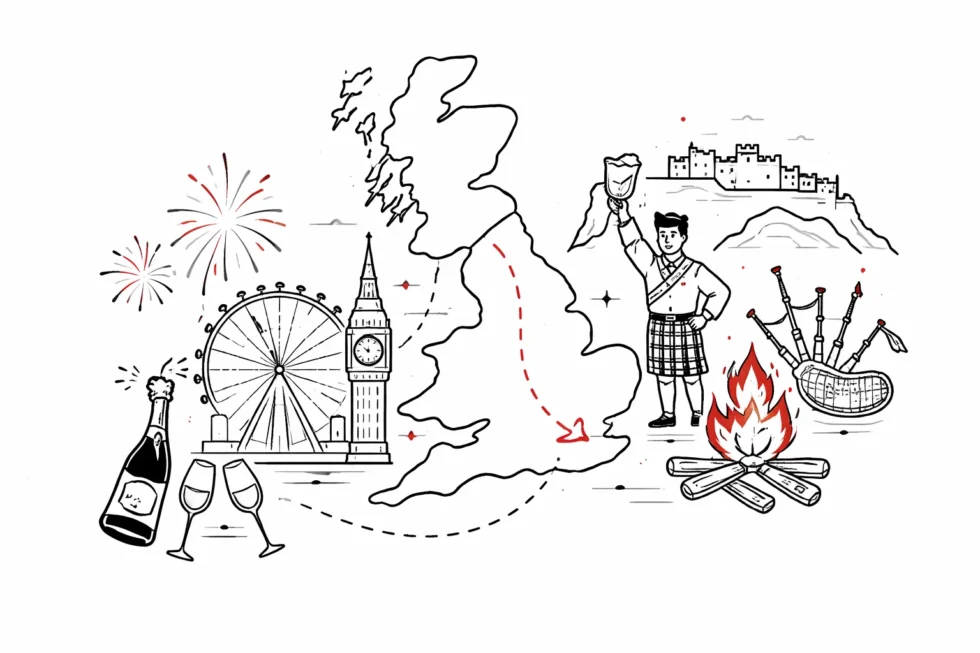
As New Year 2026 in London approaches, millions of people across Britain are preparing not just for fireworks and champagne, but for a moment they believe can quietly decide their money, relationships and personal success for the entire year ahead. From London New Year 2026 rituals performed in compact city flats to Hogmanay traditions in Scottish homes, midnight is treated as a powerful reset point rather than a simple celebration. Doors are opened to let the old year leave, coins are held to attract wealth, candles are lit to focus wishes and carefully chosen first guests cross the threshold to lock in luck, stability and love. These British New Year traditions continue to shape how people in London, England and Scotland approach the future long after the fireworks over the Thames and Edinburgh Castle have faded, as The WP Times editorial team reports.
While Eastern Europe famously burns wishes on paper and drinks the ashes, Britain follows a different logic. Here, wishes are not swallowed — they are acted out. The British New Year is a choreography of space, objects and people. Who enters your home, what you hold in your hands, and what crosses your doorstep in the first minute of January is believed to write the story of your next twelve months.
Why the first minutes of the year matter so much in Britain
In British and especially Scottish folklore there is a powerful concept called threshold magic — the idea that doorways, borders and beginnings are spiritually charged. Midnight on New Year’s Eve is seen as a literal doorway between two realities. What you let cross that threshold determines what kind of year you will live.
That is why people are deeply careful about:
- who enters first,
- what objects they bring,
- whether doors are open or closed,
- and what is physically present in the home.
In modern London this is rarely spoken of as superstition, but the behaviour remains. People still plan it, even if they describe it as “tradition” rather than belief.
Scotland’s First Footing — the most powerful New Year ritual in Britain
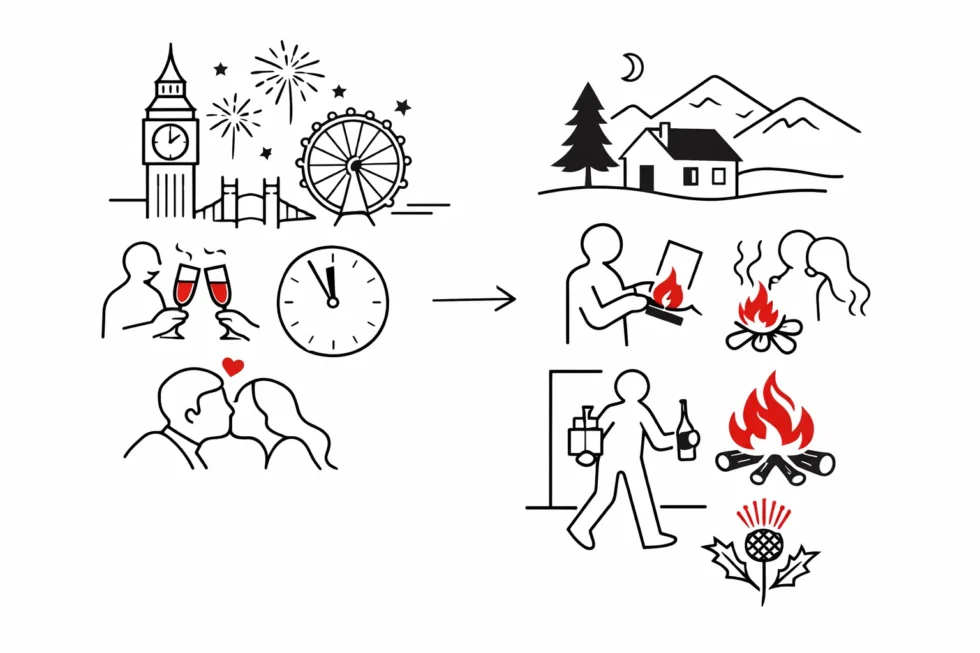
First Footing sits at the heart of Hogmanay (Scottish New Year) and is still treated as a serious “luck-setting” moment rather than a cute folk story. The principle is blunt: the first person to cross your threshold after midnight brings the tone of the year with them — prosperity, warmth, stability, or, in older beliefs, the opposite if the wrong person arrives.
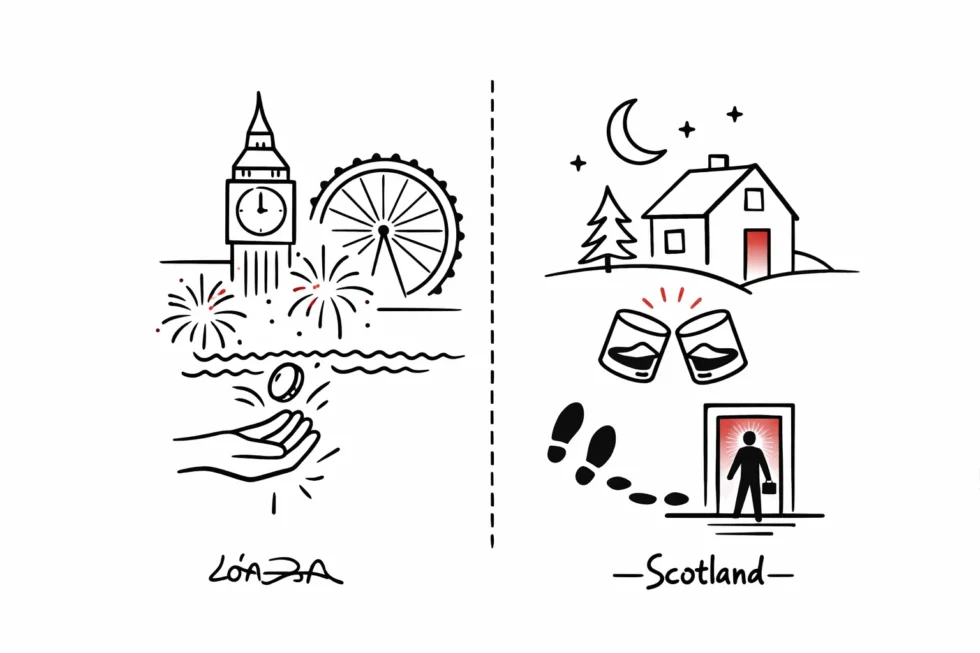
In Scotland, this matters enough that households plan it like a small operation: who is invited, who stays inside, who steps out at 23:58, and what exactly is carried through the door at 00:01.
Who should be the first footer — and why it matters
Traditionally, the “best” first footer is:
- a tall man
- dark-haired
- not a member of the household
The logic comes from older Scottish folklore: dark-haired strangers were seen as a safer omen than fair-haired visitors, linked historically (rightly or wrongly) to fears of Viking raiders. Today, many Scots treat it as tradition, but they still keep the pattern because it feels like “doing it properly”.
Practical modern rule: the first footer should be someone you associate with good outcomes — reliable, upbeat, financially stable, and not bringing drama. In modern Edinburgh, people sometimes say the “real” lucky first footer is simply the friend who shows up sober, smiling and on time.
What the first footer should bring
The items are not random. Each is a symbolic “contract” for the year:
- Coal or wood — warmth, security, a home that does not “go cold” (financially or emotionally).
Modern swap: a small piece of coal, a fireplace log, even a decorative wood stick if you live in a flat. - Bread or shortbread — food, comfort, a year without shortage.
Modern swap: oatcakes, a roll, or a small packet of biscuits if you’re in London and everything is closed. - Money — financial luck and cashflow.
Modern swap: a coin, a £10 note, or even a foreign coin kept as a lucky token. - Whisky — joy, celebration, good company, “spirit” in the house.
Modern swap: a miniature bottle, or for non-drinkers: sparkling water/ginger ale — the idea is still “a toast enters the home”.
Life hack (London-ready): prepare a small “first-foot kit” in a gift bag by the door: a pound coin, shortbread, and a mini bottle. If your friend is arriving late, you still keep the ritual clean and calm.
How it’s done in real homes (Edinburgh example)
A classic Edinburgh scene looks like this:
- At 23:55, family members finish the last countdown preparations indoors.
- At 23:58–23:59, the chosen friend (or neighbour) steps outside, even if it’s freezing.
- At 00:01, he knocks, is welcomed in, and crosses the threshold with the gifts in hand.
- Someone usually says a simple greeting like “Happy New Year” or in Scots “A guid New Year tae ye”, and then the household shares a toast.
In many families, the first footer is expected to stay for at least a short drink and conversation — because luck is also social: you don’t rush prosperity; you welcome it.
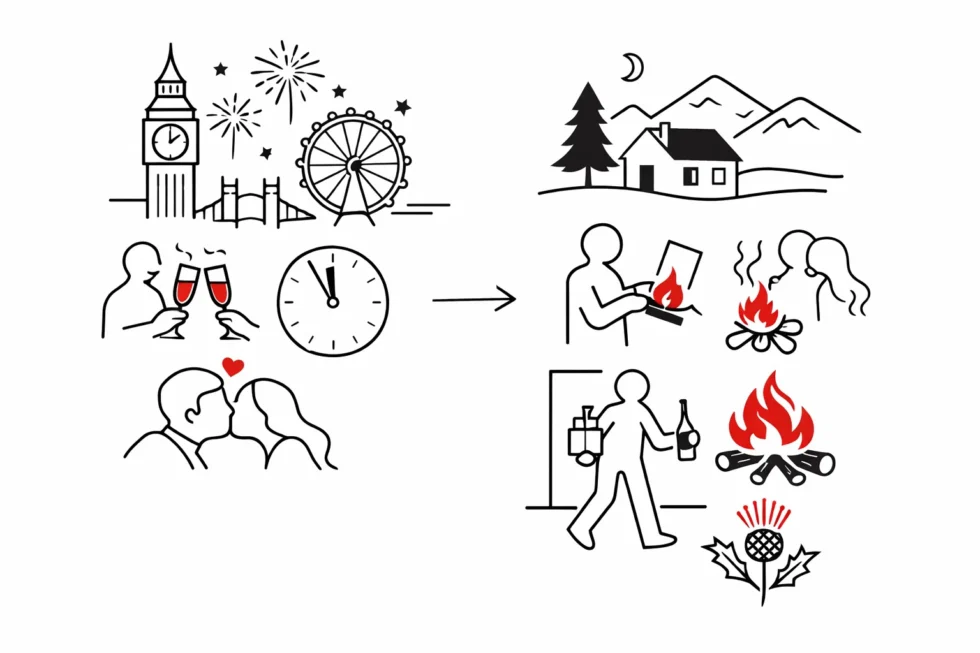
How Scottish families adapt it in London flats
In London, people adapt the ritual to apartment buildings and modern life:
- The first footer waits in the corridor, stairwell, or just outside the building door.
- At 00:01, they knock, enter first, and hand over the items.
- In areas with big Scottish communities — Hammersmith, Islington, Camden — it’s common for friends to coordinate in advance so the “right” person enters first.
Some even coordinate with neighbours: one friend first-foots two households in the same building, moving door-to-door with the gift bag like a small “luck delivery”.
Life hack (for solo Londoners): if you live alone, step outside your flat at 23:59 with a coin and shortbread in your pocket, then re-enter at 00:01. You become your own first footer — and it still works within the logic of the tradition: something good crosses your threshold first.
Common mistakes that ruin the ritual (and how to avoid them)
To keep the tradition “clean”, Scots usually avoid:
bringing negativity (complaints, bad news, arguments)
Fix: make the first 5 minutes deliberately upbeat — it’s part of the ritual.
the wrong person entering first by accident (a neighbour popping in to borrow something)
Fix: lock the door briefly before midnight, then open intentionally at 00:01.
entering empty-handed
Fix: keep the “kit” ready by the door.
Opening the door to release the old year — how Britain resets its luck at midnight
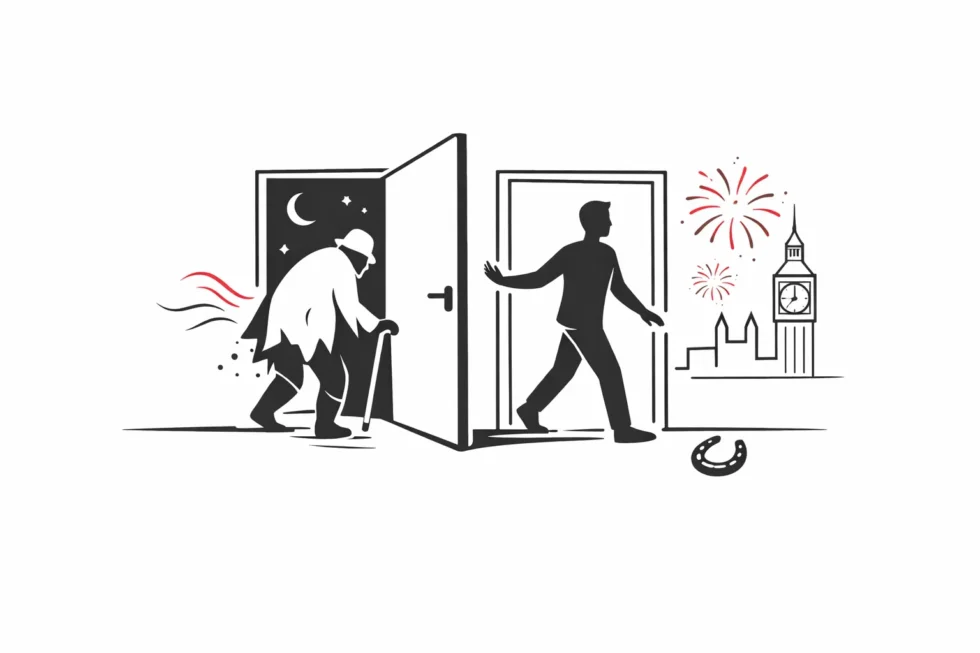
In Britain, doors are not just architectural features — they are spiritual boundaries. That is why, at exactly midnight on New Year’s Eve, many households across London, England and Scotland deliberately open their front door, even if it is cold, windy or raining. The action is not decorative. It is a physical signal that the old year — with all its problems, losses and unfinished business — is being told to leave. The belief is very practical: nothing new can enter if the old energy is still standing in the doorway.
What people actually do in real homes
In a London flat, this usually means:
- opening a balcony door,
- opening a kitchen window,
- or briefly opening the front door to the hallway.
In a house, especially in suburbs and in Scotland, people open the main front door for 30 to 60 seconds just after midnight. Some families even open both the front and back door to “let the year pass through”. During this minute, people stay quiet or speak gently — because it is believed that whatever atmosphere is present at that moment will follow you for the next twelve months.
Why this ritual matters most after a hard year
This ritual is taken especially seriously by people who experienced:
- illness or hospital stays
- financial stress or debt
- divorce or emotional loss
- job loss or business failure
For them, opening the door is not superstition — it is psychological closure. It is a way of telling the mind and the household: that chapter is over.
In parts of Scotland, people even say, “Out with the old, in with the new” while the door is open — a verbal reset combined with the physical one.
How Londoners combine this with money and success rituals
In London, many people merge this door ritual with financial intention. They stand in the doorway holding:
- a wallet,
- a bank card,
- or cash.
The symbolism is clear: the old year leaves empty-handed, the new one enters with money.
Some even place coins on the doorstep so wealth “steps inside” with the new year.
Life hacks to do it properly
- Open the door after the clock passes midnight, not before.
- Do not slam it — close it calmly, as if you are welcoming a guest.
- Make sure the house is tidy: clutter at the threshold symbolises blocked opportunities.
This is not just a poetic gesture. In British tradition, the door at midnight is the moment where loss exits and luck is invited in.
Holding money at 00:01 — how London programs wealth into the year
In London, money at midnight is not symbolic — it is directional. People believe that whatever is physically in their hands when the year turns is what their life will hold more of. That is why many Londoners deliberately avoid spending on 31 December and make sure that at 00:01 they are literally “in possession of wealth”.
In modern Britain this is done in very practical ways — not only with cash, but with cards, wallets and even investment apps opened on a phone. The goal is to start the year in a state of financial ownership, not financial need.
People usually:
- hold cash in their hand
- keep a wallet open on the table
- hold a bank card or phone with their banking app open
- place coins or notes next to a candle at midnight
Some Londoners also place a pound coin under the front doormat so money “walks into the home” all year.
Never taking out the rubbish on 1 January — why London keeps its luck inside
In English tradition, the first thing you remove from your home in the new year symbolises what you lose. That is why throwing out rubbish on 1 January is believed to throw away more than waste — it throws away luck, income and future opportunities.
This superstition is taken seriously enough that in many London apartment blocks, bins remain inside until 2 January, even if the kitchen starts to smell. The discomfort is considered a small price to pay for a financially smoother year.
People avoid:
- taking rubbish outside
- emptying vacuum cleaners
- getting rid of old clothes
- throwing out paperwork
The idea is simple: nothing valuable leaves the home on the first day of the year.
Not borrowing and not lending — how Britain protects cashflow in January
The first financial transaction of the year is believed to define all others. Borrowing means a year of debt. Lending means a year of loss.
That is why in Britain people avoid any kind of loan on 1 January — even small amounts. If someone needs help, the British solution is to give a gift rather than a loan, so money does not “circle back” as loss.
People avoid:
- borrowing cash
- transferring money
- lending small amounts
- asking for financial favours
The goal is to begin the year in a position of independence, not dependency.
Candles instead of burning wishes — how Britain sends intentions into the year
Britons do not burn wishes — they let them travel with time. Candles are the chosen medium. Each flame represents a specific area of life, and as it burns, the intention is believed to move forward into the future.
This ritual is especially common in Scotland, Wales and among spiritual communities in London.
Candles are usually dedicated to:
- money and career
- health and energy
- love and relationships
- family and stability
People sit quietly while the candle burns, focusing on their goals. When the flame goes out naturally, the wish is considered “released”.
Whisky as a contract with the year
In Scotland, the first sip of whisky after midnight is treated as a personal contract with the future. The words spoken before drinking are not casual — they define what you are asking from the year.
People say:
“To health, to wealth, and to good luck.”
Then they drink, sealing the intention. It is not about alcohol — it is about commitment.
No crying, no fighting — emotional discipline at midnight
British New Year culture treats emotion as contagious. Whatever emotional tone dominates the first minutes of the year is believed to expand through the months that follow.
That is why even unhappy couples and tense families avoid:
- arguments
- tears
- serious conversations
- emotional breakdowns
The goal is to start the year in calm, even if problems exist.
Wearing something new — stepping into a new identity
New clothes on New Year are not fashion — they are psychological positioning. You are showing yourself and the world that a new version of you has arrived.
People often wear:
- new socks
- a new scarf
- a new accessory
- something never worn before
Even something small is enough to mark change.
Coins at the door — inviting money to cross the threshold
Coins placed at the entrance represent money entering the home. In Britain, wealth must be invited — not chased.
People place:
- coins on the doorstep
- money under the doormat
- a wallet near the door
The symbolism is that prosperity walks into the house on its own.
Cold water in Scotland — washing away the old year
In many parts of Scotland, people wash their face with cold water on 1 January morning. This is meant to remove last year’s fatigue, illness and emotional residue.
It is a physical and mental reset.
The first guest of the year
Who visits you first sets the social tone of the year. People try to make sure the first visitor is:
- successful
- kind
- emotionally stable
- good with money
You are believed to “absorb” their energy.
Not starting the year alone
An empty house at the start of the year symbolises isolation. That is why Britons try to have at least one person present or visiting on 1 January.
Bread and salt on the table
Bread represents food security. Salt represents preservation and stability. Together they symbolise a year without shortage.
The first journey of the year
Where you go first becomes the direction of your life. Many people choose:
- a nice café
- a walk in a park
- a visit to someone successful
They avoid hospitals, offices and places associated with stress.
What all these rituals really mean for your year
Behind every British New Year tradition — from opening doors in London flats to First Footing in Scotland — lies one powerful idea: your life follows the tone you set when the clock resets. These rituals are not about superstition. They are about creating a clear, focused psychological and emotional starting point for the year ahead.
Britons do not try to force the future. They create the right conditions for it. They make sure that when the new year arrives, it walks into a home that is:
- open, not blocked
- calm, not chaotic
- stocked with money, not debt
- filled with people, not emptiness
When you hold money, open your door, light a candle, wear something new and welcome the right person into your space, you are doing something very practical: you are telling your nervous system, your mind and your social world that a better year is already happening. That is why these rituals have survived for centuries in Britain. They work not because of magic, but because they align intention, environment and behaviour — and that combination quietly changes everything that follows.
Read about the life of Westminster and Pimlico district, London and the world. 24/7 news with fresh and useful updates on culture, business, technology and city life: Happy New Year 2026 in Britain: warm wishes, quotes and messages to start the year with heart