
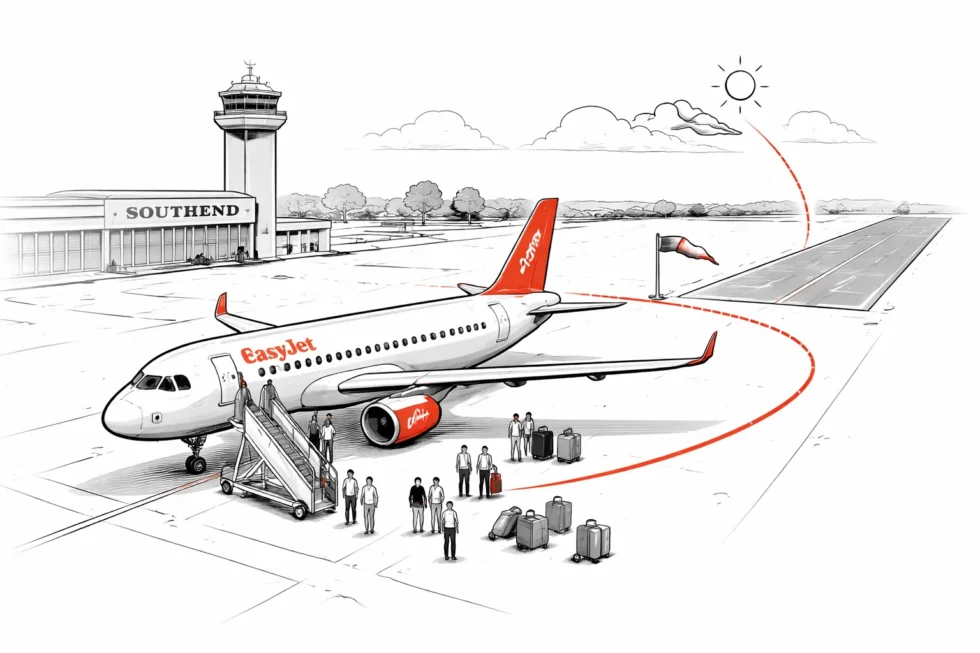
London Southend Airport EasyJet weight limit became an operational constraint on 11 April 2026 when five passengers volunteered to leave a morning flight to Málaga after final performance checks showed the aircraft exceeded safe take-off limits under the prevailing conditions; the WP Times reports, citing BBC News and ITV News. These calculations—completed shortly before departure—combine aircraft weight, runway length and real-time weather data to determine whether sufficient lift and acceleration can be achieved within certified safety margins.
The constraint is structural: at London Southend Airport, where the runway is 1,856 metres, performance margins are tighter than at larger UK airports. Small changes in wind direction, air density or payload can push a flight beyond its allowable take-off envelope, requiring immediate weight reduction, typically by offloading passengers or baggage.
why the aircraft was too heavy in this case
Take-off performance is defined by a simple constraint: the aircraft must generate enough lift to exceed its weight within the available runway distance. Lift increases with speed and air density; weight does not change. The heavier the aircraft, the more speed—and therefore distance—it needs to become airborne. In this case, the aircraft was not overweight in absolute terms, but outside its certified take-off envelope for that specific moment. The limiting factors combined in a way that reduced performance margins:
- short runway length restricting acceleration distance
- reduced or ineffective headwind, removing aerodynamic assistance
- near-full payload (passengers, baggage, fuel) increasing required take-off speed
- ambient air conditions lowering engine thrust and lift efficiency
In operational terms, even a small shortfall—tens of metres in required take-off distance—triggers a no-go decision. If the calculated take-off run exceeds the runway available, departure is not permitted under safety regulations.
runway length and operational limits at Southend
Runway length determines how much distance an aircraft has to reach take-off speed. At shorter runways, performance margins are narrower and more sensitive to change.
| Airport | Runway length | Operational flexibility |
|---|---|---|
| London Southend | 1,856 m | Limited |
| London Luton | ~2,162 m | Moderate |
| London Stansted | ~3,049 m | High |
At London Southend Airport, the shorter runway creates three direct constraints:
- reduced acceleration distance, limiting maximum allowable weight
- dependence on headwind to shorten the take-off roll
- lower tolerance for variability, where small changes quickly exceed limits
This explains why an aircraft operating normally elsewhere may require payload reduction at Southend under identical loading.
wind conditions as the decisive factor
Wind is a primary variable in take-off calculations. A headwind increases airflow over the wings without increasing ground speed, effectively reducing the runway distance required. In this case, analysis cited by BBC News indicates the wind was misaligned with the runway, providing little or no effective headwind. Operational consequences of reduced headwind:
- longer take-off roll required to reach lift-off speed
- lower lift at a given ground speed
- higher sensitivity to aircraft weight and payload
At a short-runway airport, this combination is critical. Without headwind support, the aircraft must rely entirely on runway length and engine thrust—if that is insufficient, the only immediate solution is to reduce weight.
Passengers on board were informed that the aircraft could not depart under current conditions unless weight was reduced, with crew requesting volunteers to disembark. One passenger said the captain initially asked for several people to leave and that the announcement “felt like a joke at first” before it became clear it was a safety requirement (passenger account, cited by ITV News). Within minutes, five passengers agreed to leave the aircraft, were transferred to alternative flights and offered compensation. The aircraft departed shortly afterwards with a limited delay, indicating the required weight reduction was marginal but necessary to meet performance limits.
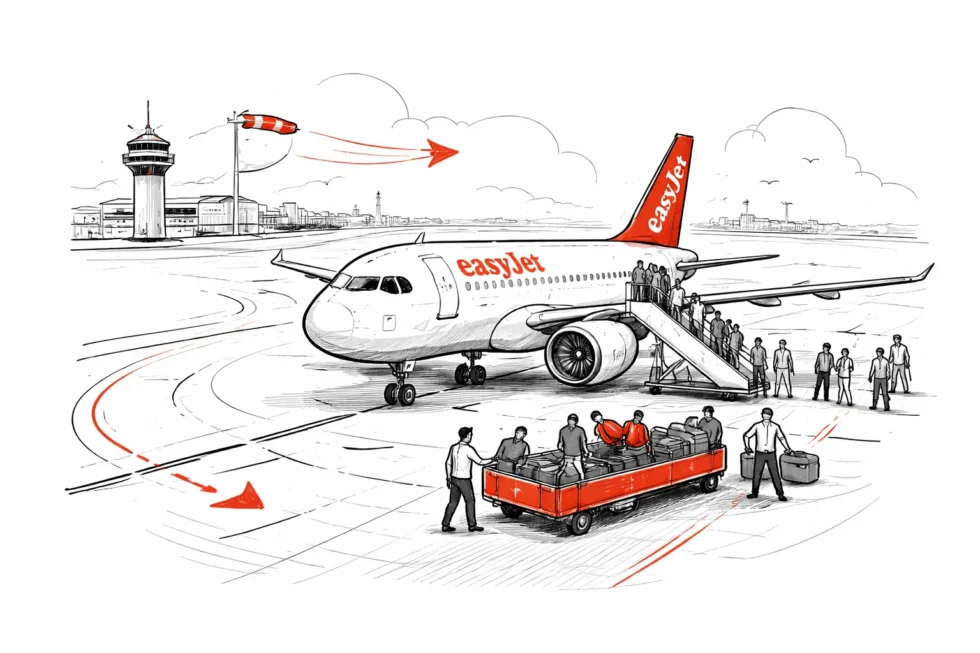
The timing reflects how take-off calculations are finalised. While weight and balance are prepared before boarding, the decisive performance check is completed close to departure using updated weather data, particularly wind. A late change in wind direction or strength can alter required take-off distance. Industry sources note that such late-stage adjustments, while not routine, are consistent with operational procedures when conditions shift shortly before departure (ITV News).
Weight-related restrictions occur periodically, primarily at airports with shorter runways, single-runway layouts and high-load leisure flights. A similar situation on the Southend–Málaga route was recorded in 2014, indicating a recurring operational constraint. Airlines calculate total load using standard passenger weight assumptions rather than individual measurements, meaning cumulative variation—combined with weather factors—can push an aircraft beyond its allowable take-off envelope. When limits are exceeded, the procedure is fixed: the aircraft cannot depart until weight is reduced. Volunteers are typically requested first, followed by rebooking and compensation in line with passenger rights. The aircraft only departs once calculations confirm compliance with certified safety margins.
Aviation analysis indicates that such cases may become more frequent as operating conditions change. Higher temperatures reduce air density, while shifts in prevailing wind patterns can affect runway alignment. Airports such as London Southend Airport, with shorter runways and limited flexibility, are more sensitive to these variables. The incident demonstrates that aircraft are constrained by dynamic performance limits rather than fixed weight thresholds. Even a small reduction in load can determine whether a flight can depart. The response—identifying the constraint, reducing weight and proceeding within limits—follows standard safety protocol.
Read about the life of Westminster and Pimlico district, London and the world. 24/7 news with fresh and useful updates on culture, business, technology and city life: Was the UK green fireball a meteorite? CCTV captures bizarre flashes over Durham in April 2026