
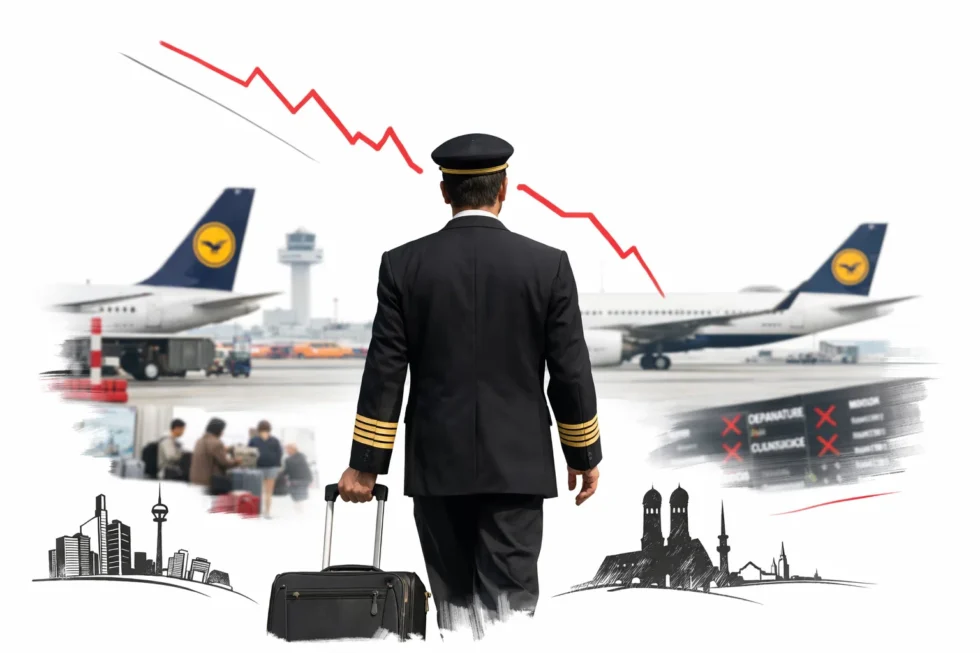
Lufthansa pilots strike again for two more days as Germany’s flagship airline faces deepening operational disruption across its core hubs, with fresh walkouts scheduled for Thursday and Friday, 16–17 April 2026, following a 48-hour strike earlier this week that grounded hundreds of flights across Frankfurt and Munich, while parallel cabin crew action extends disruption across nearly the entire working week, compounding pressure on Europe’s busiest aviation corridors and intensifying an already entrenched labour dispute, The WP Times reports, citing Deutsche Welle. The escalation, led by the Vereinigung Cockpit (VC) union, follows stalled negotiations over pensions and pay structures, leaving Lufthansa unable to restore operational stability as cancellations approach system-wide levels across its network.
The disruption is no longer episodic but cumulative, with successive strike days eroding recovery capacity across aircraft rotations, crew allocation and long-haul connectivity, meaning delays and cancellations are now cascading beyond Germany into the wider European system. By midweek, the overlap of pilot and cabin crew stoppages is expected to produce six consecutive days of disruption, significantly constraining network recovery windows, overshadowing the airline’s centenary events and increasing political and reputational pressure on management as senior officials gather in Frankfurt alongside visible union demonstrations.
Lufthansa pilots strike again: disruption spreads across Frankfurt and Munich
The latest strike action follows severe disruption earlier in the week, when hundreds of flights were cancelled in a single day, with around 900 cancellations recorded across Frankfurt and Munich alone at the peak of the stoppage. These two hubs form the backbone of Lufthansa’s network, and their partial shutdown has a multiplier effect, disrupting feeder routes, long-haul departures and intercontinental connections.
| Area | Impact level | Details |
|---|---|---|
| Frankfurt Airport | Severe | Hub congestion, mass cancellations |
| Munich Airport | Severe | High volume of grounded aircraft |
| European routes | High | Missed connections and rolling delays |
| Long-haul network | Moderate to high | Dependent on feeder stability |
| Middle East routes | Limited disruption | Selected flights exempt from strikes |
The union has confirmed that certain flights to Middle East destinations will continue to operate despite the strike, citing regional instability. This includes routes to countries such as Israel, Saudi Arabia and the United Arab Emirates, creating a limited operational corridor within an otherwise heavily reduced schedule. However, this exception does little to offset the broader collapse in capacity across European and domestic routes.
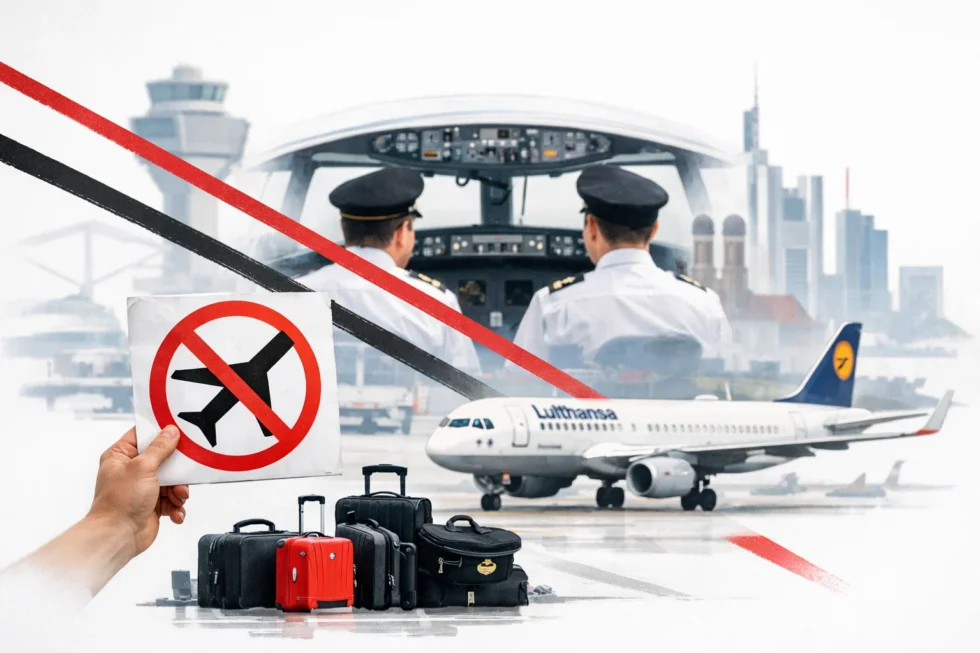
Labour dispute intensifies as negotiations stall
At the centre of the conflict is a breakdown in negotiations over pensions and collective wage agreements across multiple Lufthansa divisions, including Lufthansa Cargo, CityLine and Eurowings. Union leadership has made clear that earlier strike action failed to shift the employer’s position, prompting the decision to escalate.
“The situation remains unchanged — there has been no movement whatsoever on the part of the employers,” said Andreas Pinheiro (Vereinigung Cockpit, Frankfurt, April 2026). “Neither Lufthansa nor Lufthansa Cargo has presented an offer regarding the company pension plan, nor is there a viable offer from Lufthansa CityLine for a new collective wage agreement or from Eurowings regarding the company pension plan.”
The union has signalled a willingness to move towards arbitration, but no breakthrough has been achieved, leaving both sides entrenched. At the same time, cabin crew represented by the UFO union are pursuing parallel demands, further complicating negotiations and extending disruption across operational layers. Lufthansa has pushed back strongly against union demands, particularly on pensions. The airline described the cabin crew union’s proposals as “absurd and unfulfillable,” warning that continued strike action risks undermining the company’s financial stability and could trigger deeper restructuring measures. Chief executive Carsten Spohr has reinforced the company’s strategic position, stating: “We operate aircraft exclusively where they generate value” (Frankfurter Allgemeine Zeitung, April 2026), signalling a continued focus on efficiency and profitability despite mounting labour pressure.
Centenary overshadowed by industrial action and political pressure
The timing of the strike wave is particularly acute, coinciding with Lufthansa’s 100th anniversary celebrations at its Frankfurt headquarters, where Friedrich Merz and Patrick Schnieder are expected to attend amid visible union demonstrations and ongoing disruption across the airline’s core network. Although pilots are not formally striking on Wednesday, cabin crew action ensures that operational instability continues without interruption, effectively extending disruption across the entire week and turning what would normally be a controlled recovery window into a continuous strain on scheduling, staffing and aircraft positioning. For passengers, the immediate implication is practical rather than symbolic: midweek travel offers no stability advantage, as overlapping strike phases mean that cancellations, delays and last-minute schedule changes remain likely even on non-pilot strike days. Short-haul feeder routes into Frankfurt and Munich are the most exposed, which directly affects long-haul departures, increasing the risk of missed connections even where flights are technically operating.
The broader implication is a structural shift from isolated labour disputes to sustained operational instability, where recovery cycles between strike phases are too short to restore normal service. Lufthansa’s hub-based model amplifies this effect, meaning each additional day of disruption compounds delays across the European network and reduces the airline’s ability to reposition aircraft and crews efficiently.
In practical terms, travellers should assume rolling disruption rather than fixed strike windows, monitor flight status continuously on the day of departure, and prioritise direct routes over connections where possible. Rebooking flexibility, early airport arrival and avoiding tight transfer windows are now critical decisions rather than optional precautions, as system-wide reliability remains dependent on a negotiated settlement that has yet to materialise.
Read about the life of Westminster and Pimlico district, London and the world. 24/7 news with fresh and useful updates on culture, business, technology and city life: Lufthansa strike on April 14 disrupts Manchester flights as cancellations hit UK routes via German hubs