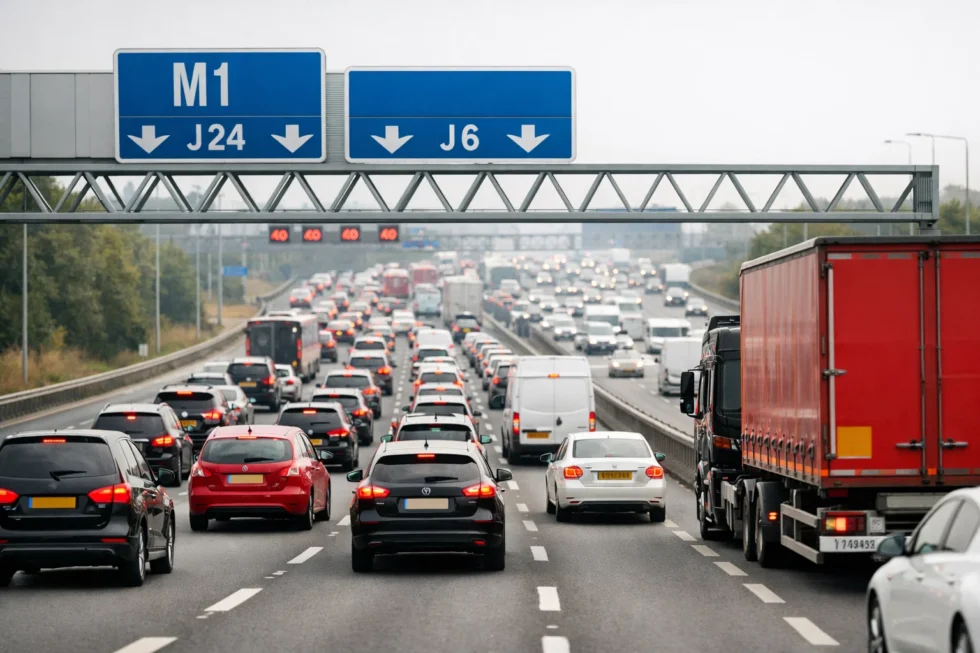
M1 traffic today is slowing across multiple sections of the motorway network, with congestion reported at key junctions including J6 and J24, creating delays along one of the United Kingdom’s most important transport corridors linking London with the Midlands and the North. Traffic monitoring systems indicate that the disruption is not caused by a single incident but by simultaneous pressure points at entry and exit slips, where vehicle volume has exceeded capacity during the afternoon peak, leading to queueing traffic and reduced speeds across several segments of the route, The WP Times reports.
The current pattern reflects a build-up of traffic density rather than a major collision or emergency closure, with additional pressure recorded at the M1 J21 connector with the M69 and at southbound access points such as J24A. Forecasts suggest that conditions may gradually stabilise between 17:00 and 17:30, although the spread of congestion across multiple junctions increases the risk of extended delays if flow does not recover evenly across all affected sections.
where delays are building across the M1 today
The most significant slowdowns are concentrated at junctions that act as key interchange points for regional traffic, particularly where local road networks feed into the motorway. At J6, northbound exit congestion is creating a backlog that is feeding onto the main carriageway, while at J24, heavy traffic is slowing both entry and exit movement, reducing throughput and causing ripple effects along adjacent stretches of the motorway. The connector at J21 with the M69 is also experiencing pressure, where merging traffic is forcing intermittent braking and stop-start conditions.
This multi-point congestion pattern is structurally different from isolated incidents, as it spreads load across the network and makes recovery dependent on overall traffic reduction rather than clearance of a single blockage. As a result, even moderate increases in vehicle flow can sustain delays for longer periods, particularly during late afternoon travel.
Current situation by junction:
| Junction | Direction | Issue | Expected normalisation |
|---|---|---|---|
| J6 | Northbound exit | Congestion | 17:15–17:30 |
| J24 | Northbound exit | Heavy traffic | 17:00–17:15 |
| J24A | Southbound entry | Congestion | 17:00–17:15 |
| J21/M69 | Southbound connector | Queueing traffic | 16:45–17:00 |
why traffic flow is slowing instead of stopping completely
Traffic on the M1 is continuing to move, but at significantly reduced speeds, as the system shifts into a high-density flow state where braking distances shorten and lane changes become more frequent. This type of slowdown typically occurs when multiple entry points inject vehicles into the motorway simultaneously, exceeding the rate at which traffic can disperse further along the route. Unlike full closures, this condition allows continuous movement but reduces overall efficiency and increases journey times.
The absence of emergency incidents means that no rapid intervention is currently in place to clear the congestion, leaving natural traffic dissipation as the primary mechanism for recovery. This process depends heavily on a reduction in inflow from feeder roads and a gradual smoothing of traffic patterns as peak demand begins to decline.
Drivers are also contributing to the slowdown through reactive driving behaviour, including sudden braking and late lane changes near junctions, which amplifies the congestion effect and extends delays beyond the original pressure points.
what drivers should expect and how conditions may develop
Conditions are expected to improve gradually into the early evening, but the timing of recovery will depend on how quickly traffic volumes decrease across the affected junctions. If inflow remains high, particularly at J24 and surrounding access points, delays could persist beyond the current forecast window. The distributed nature of the congestion means that even as one junction clears, others may continue to experience slower movement.
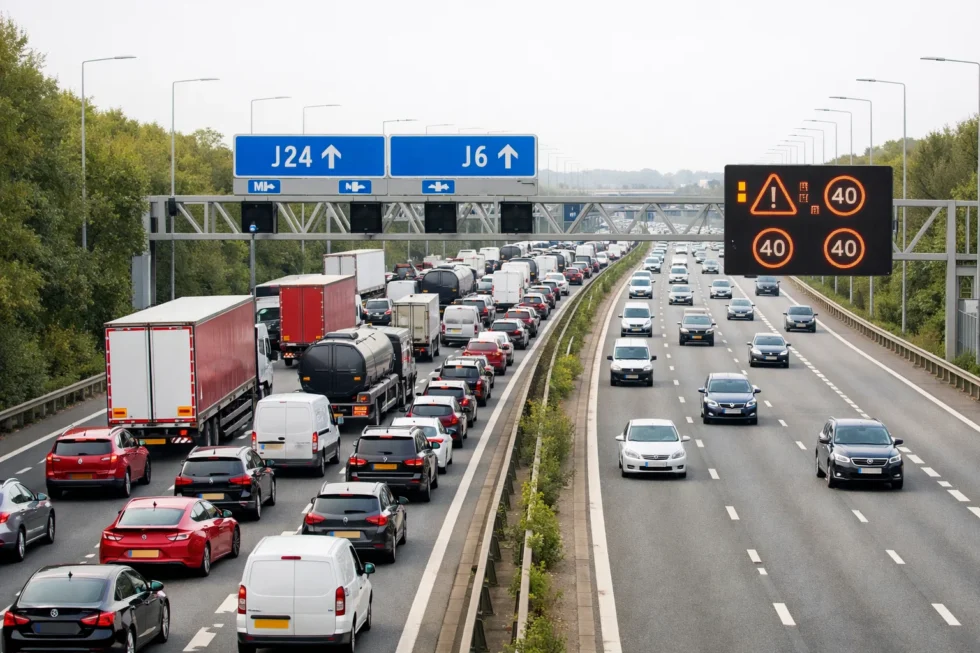
Drivers are advised to:
- allow additional travel time during peak hours
- monitor live traffic updates before departure
- consider alternative routes where possible
- avoid unnecessary lane changes near junctions
Transport monitoring services indicate that while no severe incidents are currently reported, the accumulation of congestion across multiple nodes makes the situation sensitive to further increases in demand. Even minor disruptions or sudden spikes in traffic could temporarily intensify delays.
planned roadworks and additional pressure later this week
Beyond the current congestion, planned roadworks on sections of the M1 are expected to introduce additional constraints on traffic flow in the coming days. Lane closures between junctions such as J8 and J9, as well as works around J28 and J29, are scheduled to take place, with some activities involving multiple lane restrictions or overnight closures.
These works are part of ongoing infrastructure maintenance, including barrier repairs and surface improvements, but they are likely to coincide with existing traffic demand patterns, increasing the probability of further delays. The combination of live congestion and scheduled restrictions creates a layered disruption scenario in which recovery periods may become shorter and more variable. While today’s slowdown is primarily driven by traffic volume, the upcoming roadworks introduce structural limitations that could affect journey times beyond the immediate peak period.
Read about the life of Westminster and Pimlico district, London and the world. 24/7 news with fresh and useful updates on culture, business, technology and city life: “If I weren’t in the White House, Leo wouldn’t be in the Vatican”: Trump attacks Pope over Iran war stance