
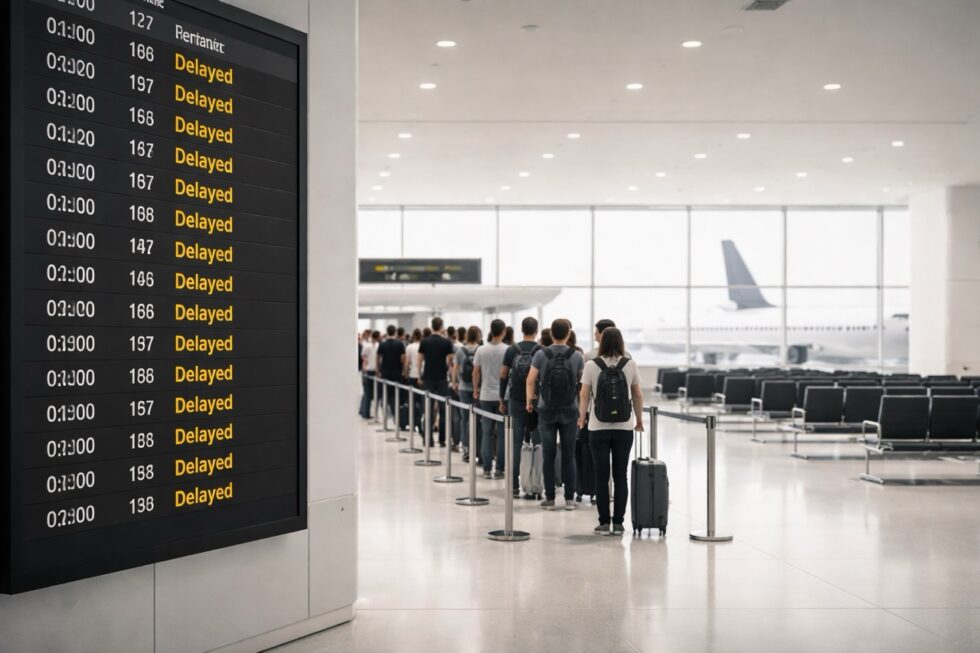
Manchester Airport delays today are affecting departures and arrivals from the early morning wave on Sunday, April 12, 2026, with disruption building from approximately 06:00 BST and continuing through late morning as peak Easter traffic moves through the UK’s third-busiest airport. More than 1.7 million passengers are expected to pass through the airport over the holiday period, according to data from Manchester Airport, with current pressure concentrated across outbound European leisure routes, reported by The WP Times.
By around 10:00–12:00 BST, rolling delays and selected cancellations had begun to stabilise into a system-wide pattern, driven by late inbound aircraft, compressed turnaround windows and congestion across Terminals 1, 2 and 3. Live operational updates cited by Manchester Evening News indicate that the airport remains fully operational but under sustained load, as outbound holiday departures overlap with returning passenger flows at the end of the school break, particularly on routes to Spain, the Canary Islands and Turkey.
Manchester Airport delays April 12: what is happening across flights and terminals
By late morning on Sunday, April 12, the disruption pattern at Manchester Airport had shifted from isolated delays to a sustained system-wide load, with all three terminals processing overlapping passenger flows within a compressed operational window. Sunday represents a known pressure point in the aviation cycle, but the end-of-holiday return traffic combined with outbound departures has intensified throughput beyond a typical weekend profile.
At Manchester, this effect is amplified by the concentration of short-haul leisure flights departing in tightly scheduled waves between 06:00 and 14:00 BST, where even minor delays in early rotations begin to cascade across the network.
Core disruption drivers observed today:
- Peak Easter demand exceeding standard Sunday throughput baselines
- High aircraft rotation frequency on European leisure routes
- Late inbound arrivals reducing turnaround margins
- Gate and stand allocation constraints during peak hours
- Increased baggage processing volumes under full load conditions
Terminal 2, the primary focus of the airport’s £1.3 billion redevelopment programme, is handling a disproportionate share of passenger volume and is operating close to maximum capacity between mid-morning and early afternoon, with flow management measures visible across security and boarding zones.
Flights to Spain, Canary Islands and Turkey see highest delays
As of late morning, the delay concentration is clearly clustered around outbound leisure corridors, particularly those with high-frequency departures and fast turnaround expectations.
Routes most affected on April 12:
- Spain — Alicante, Malaga, Palma de Mallorca
- Canary Islands — Tenerife, Lanzarote, Gran Canaria
- Turkey — Antalya, Dalaman
These routes are structurally more vulnerable to disruption due to tight scheduling cycles typical of low-cost and charter operations, where aircraft utilisation rates leave limited buffer time between sectors. Airlines including Jet2 and easyJet have already issued passenger advisories in recent days, warning of extended queue times and slower processing both at UK departure points and EU arrival airports, particularly during Easter peak travel.
How delays escalate: operational chain reaction inside the airport
The disruption observed today follows a predictable operational sequence, where initial delays propagate across subsequent departures rather than remaining isolated.
Typical delay escalation sequence
| Stage | Operational impact |
|---|---|
| Late inbound aircraft | сокращает доступное время на разворот |
| Disembarkation delays | смещают подготовку борта |
| Cleaning and catering lag | увеличивает turnaround time |
| Baggage handling backlog | замедляет загрузку |
| Gate congestion | ограничивает доступ к стоянкам |
| ATC slot restrictions | фиксируют более поздний вылет |
Once this cycle is established, recovery within the same operating day becomes increasingly constrained, particularly during peak departure banks between late morning and early afternoon.
Passenger conditions today: queues, boarding delays and gate changes
By late morning on April 12, passenger flow through Manchester Airport shows sustained pressure across all stages of the journey, with conditions shifting from standard peak congestion to extended processing times at key control points. Travellers are encountering delays not at a single bottleneck, but across the entire airport sequence — from security to gate — reflecting system-wide load rather than isolated disruption.
Observed passenger conditions
- Security queues extending beyond standard peak ожиданий, particularly between 08:00 and 12:00 BST
- Boarding processes running behind schedule as aircraft preparation overruns allocated turnaround windows
- Frequent last-minute gate changes linked to stand availability and inbound delays
- Noticeable congestion in departure lounges, most visible in Terminal 2 high-traffic zones
- Extended boarding cycles on high-capacity leisure routes, especially to Southern Europe
Operationally, these conditions indicate that aircraft readiness — rather than passenger processing alone — is the primary constraint affecting departure timing.
(“Passengers should expect movement delays throughout the airport, not just at security,” airport operations update, April 12)
Recommended passenger actions (operational guidance)
- Arrive a minimum of 2–3 hours before departure, with additional buffer during peak hours
- Rely on real-time airline updates rather than scheduled departure boards
- Monitor gate information continuously, as allocations may change at short notice
- Allow extended connection windows where applicable
The passenger experience today is defined less by individual delays and more by cumulative timing shifts across each stage of the airport process, with conditions expected to fluctuate throughout the afternoon.
£1.3bn airport upgrade faces peak stress test
The current Easter surge represents the first full-capacity operational test of Manchester Airport’s transformation programme. Key infrastructure now under load includes:
- Expanded Terminal 2 processing capacity
- New retail and food zones, including high-footfall areas
- Redesigned passenger flow architecture
- Installation “Atmospheric Reflections of the North” within terminal space
While designed to support long-term growth, peak demand conditions such as those observed on April 12 expose real-time constraints in throughput, particularly at interface points such as security, boarding gates and baggage systems.
Why Easter creates concentrated disruption in UK aviation
Easter differs from summer travel peaks in that demand is compressed into a shorter, more volatile time window, increasing operational sensitivity. Key structural factors:
- Simultaneous outbound departures and return traffic
- High share of leisure travellers with checked baggage
- Family travel increasing processing and boarding times
- Heavy reliance on short-haul European routes with tight rotations
(“Easter peaks create compressed demand spikes rather than sustained flow,” UK aviation operations note, April 2026)
As of early afternoon on Sunday, April 12, operations at Manchester Airport remain active with no terminal closures or critical incidents reported. Disruption is best characterised as moderate but system-wide, with timing affected across multiple departures rather than structural failure of airport systems. The situation remains fluid into the afternoon departure window, with further delays dependent on inbound aircraft recovery rates and air traffic control slot availability across UK and European airspace.
Read about the life of Westminster and Pimlico district, London and the world. 24/7 news with fresh and useful updates on culture, business, technology and city life: Lufthansa strike Germany flights: Hundreds of cancellations hit Frankfurt and Munich as unions escalate dispute