
Matt Weston skeleton: the phrase now captures one of the most persistent paradoxes in modern Olympic sport. Great Britain, a country without a single permanent ice track, continues to dominate one of the most technical and equipment-sensitive winter disciplines in the world. On Friday at the Milan–Cortina Winter Olympics, that contradiction sharpened once again as Matt Weston secured historic men’s skeleton gold, extending Team GB’s unmatched record in the sport. This analysis is written by The WP Times, with factual reporting and confirmation based on BBC Sport.
No domestic sliding tracks. No mountain training hubs. And yet no nation has extracted more Olympic success from skeleton than Great Britain. Weston’s gold was not an outlier or a sudden breakthrough. It was the latest outcome of a system refined over more than two decades — a system built to function under constraint, pressure and extreme scarcity of opportunity.
A legacy reinforced, not rewritten
Skeleton returned to the Olympic programme in 2002, and since then Great Britain have treated the sport less as a winter pastime and more as a precision project. The medal tally tells its own story. Amy Williams opened Britain’s Olympic account in Vancouver in 2010. Lizzy Yarnold followed with gold in Sochi in 2014 and repeated the feat in PyeongChang in 2018. Weston’s triumph in Milan–Cortina made him the first British man to stand on the top step of the Olympic skeleton podium and brought Team GB’s total medal haul in the sport to ten. That consistency is unprecedented given the structural disadvantages Britain faces. Skeleton is decided by thousandths of a second, shaped by ice familiarity, track memory and aerodynamic efficiency. Yet Britain produces Olympic champions with fewer than 150 competitive runs per year — a number that many rival nations exceed in a matter of weeks.
Six minutes that define a Games
Former champion Yarnold has repeatedly described Britain’s defining advantage as psychological clarity. When athletes arrive at a new Olympic track, they are permitted just six official training runs before competition begins. In skeleton terms, that equates to roughly six minutes of total sliding time.
British athletes approach those six minutes with forensic preparation. Each run is pre-planned. Each corner has a defined objective. Each error is immediately logged, analysed and corrected. Where other nations rely on familiarity built through volume, Britain rely on purpose built through discipline. This approach has turned scarcity into structure. British sliders do not experiment on ice. They execute.
The Bath push track: Britain’s hidden engine
At the centre of this philosophy is an unassuming facility on the University of Bath campus. A small wooden hut houses the start of Britain’s only push track — a 140-metre strip where skeleton and bobsleigh athletes spend their summers refining explosive starts.
In skeleton, the first five seconds are critical. A faster start translates into higher entry speed, which compounds through every subsequent corner. Britain have become world leaders in start mechanics, strength conditioning and sprint efficiency, compensating for limited ice exposure with relentless off-ice preparation. Athletes spend months refining stride length, foot placement and body angle. By the time they reach the ice, the only unknown is the surface itself.
Engineering without excess
Technology has played a role, but not an unchecked one. British skeleton innovation dates back to the 1990s, when a PhD student named Kristan Bromley was asked to design a sled for military recreation. With no test pilot available, he raced it himself, later becoming a four-time Olympian.
Since then, British skeleton has selectively collaborated with high-performance engineering partners, including McLaren and British Aerospace. Advances have focused on sled geometry, vibration control and airflow management rather than radical redesigns. Before the Milan–Cortina Games, the team even used wind tunnel testing to optimise body positioning and equipment interaction. Not every innovation has succeeded. At these Games, Team GB were prevented from using newly designed helmets after the Court of Arbitration for Sport ruled they had been specifically engineered to enhance aerodynamic performance. Four years earlier in Beijing, equipment miscalculations contributed to Britain leaving the Games without a skeleton medal for the first time since 2002.
Funding pressure and programme resilience
The Beijing disappointment had immediate consequences. UK Sport reduced skeleton funding from £6.5m in the 2022 cycle to an initial £4.8m for the Milan–Cortina period, later revised to £5.8m. Even with the cut, skeleton remained among Britain’s most generously funded winter sports, reflecting its long-term medal efficiency. Weston’s gold has since reframed that investment. Rather than an indulgence, it has once again appeared as one of the most reliable returns in British Olympic sport.
Where British skeleton athletes come from
Britain does not produce skeleton athletes through grassroots winter programmes. Instead, it recruits them. UK Sport’s talent identification schemes actively search for elite physical profiles in other disciplines — speed, power, coordination and mental resilience. Weston himself came from taekwondo and rugby union. Yarnold transitioned from heptathlon. Laura Deas, Olympic bronze medallist in 2018, followed a similar path. These athletes arrive already conditioned to high-performance environments, with skeleton becoming a second elite career rather than a developmental experiment. This recruitment model reduces technical learning time and accelerates adaptation, allowing athletes to focus on execution rather than physical development.

Coaching as a competitive advantage
In 2022, Britain secured one of the most significant coaching appointments in winter sport. Martins Dukurs, widely regarded as the greatest skeleton slider of all time, joined Team GB as head coach after retiring from competition.
A six-time world champion with more than 60 World Cup victories, Dukurs brought unparalleled technical knowledge to a programme already defined by efficiency. He was joined by his long-time collaborator and sled designer Matthias Guggenberger, adding further depth to Britain’s equipment and setup expertise. Dukurs trained for most of his career at Sigulda in Latvia, where constant access to ice was taken for granted. Joining a system without a home track required adaptation, but he has repeatedly highlighted the scale of Britain’s achievement under such conditions.
Knowledge shared, not guarded
Perhaps the most distinctive feature of British skeleton is its internal culture. Athletes compete fiercely, but train collaboratively. Line choices, corner strategies and technical solutions are shared openly. Marcus Wyatt, who finished ninth in Cortina, has previously described how this collective approach effectively multiplies limited ice exposure. One athlete’s mistake becomes another’s solution. Rivalry exists, but secrecy does not. Weston has echoed the same sentiment. On race day, teammates are competitors. In training, they are collaborators solving the same problem from different angles.
Why Team GB keep winning: analytical overview
| Factor | British approach | Competitive impact |
|---|---|---|
| Ice access | Extremely limited | Forces precision and planning |
| Start training | Push-track focused | Faster initial velocity |
| Athlete recruitment | Cross-sport talent ID | Elite physical base |
| Engineering | Targeted innovation | Marginal gains without excess |
| Coaching | World-class expertise | Tactical and technical edge |
| Team culture | Knowledge sharing | Accelerated learning curve |
Built for pressure, not comfort
The defining strength of British skeleton is not infrastructure, technology or funding in isolation. It is adaptability under constraint. Limited ice time, funding fluctuations and equipment restrictions have not weakened the programme. They have sharpened it. Weston’s gold in Milan–Cortina was therefore not a surprise ending, but a logical outcome. Britain have built a system designed for exactly this scenario: six minutes of preparation, one chance to deliver, and no margin for error. As the Games continue, further medals remain possible. But even if none follow, the central question will remain — and so will the answer. Great Britain are not good at skeleton despite lacking an ice track. They are good at skeleton because they learned how to win without one.
Background: who is Matt Weston
Matt Weston is one of Britain’s most accomplished skeleton athletes of the modern era and the figurehead of Team GB’s current Olympic success. Born in 1996, Weston did not begin his sporting career on ice. Before switching to skeleton, he competed at a high level in taekwondo and rugby union, developing the explosive power, coordination and mental resilience that later defined his sliding career. He was identified through UK Sport’s talent transfer system and transitioned rapidly into skeleton, a discipline that rewards raw athleticism and technical precision over early specialisation.
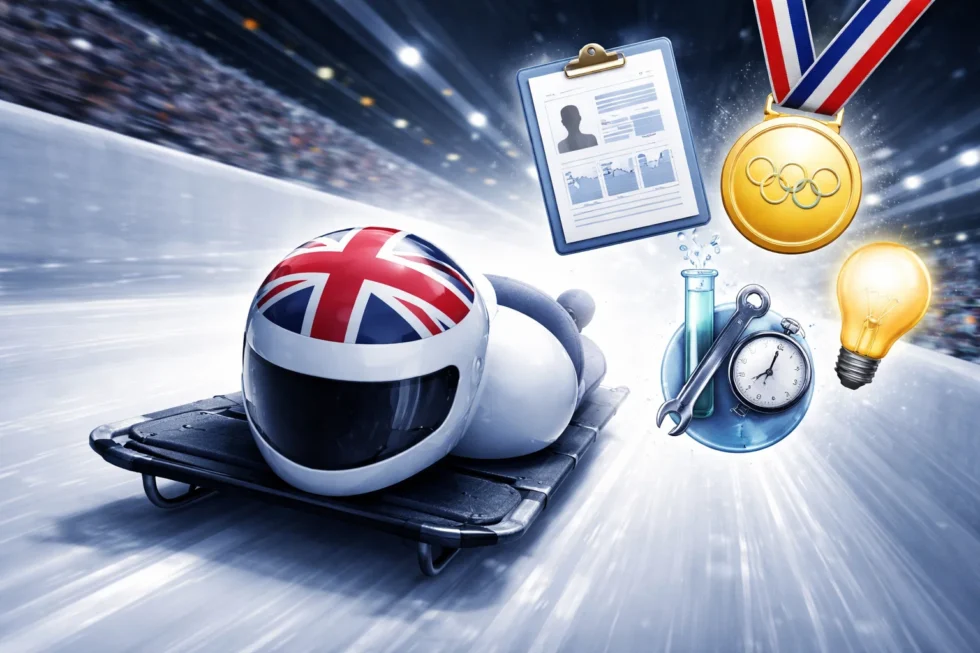
Weston established himself on the international stage as a two-time world champion before his Olympic breakthrough, consistently ranking among the fastest starters on the World Cup circuit. Known for his controlled aggression, technical discipline and analytical approach to racing, he has become a reference point within the British team setup. His Olympic gold in Milan–Cortina marked not only a personal milestone but a historic first for British men’s skeleton, reinforcing his status as a central figure in Team GB’s long-term dominance of the sport.
Read about the life of Westminster and Pimlico district, London and the world. 24/7 news with fresh and useful updates on culture, business, technology and city life: Olympics Games Milano Cortina 2026: what defines the Winter Games as competition intensifies