

London, Tuesday 6 January 2026 — Britain’s largest customer-owned bank has opened the window for what could become the country’s biggest cash giveaway of the year, as millions of households move to secure the Nationwide bonus expected to pay out this summer. The WP Times reports this, citing official Nationwide Building Society guidance, MoneySavingExpert analysis and current bank switching offers from Lloyds, Santander and First Direct.
The Nationwide bonus — formally called the Fairer Share Payment — has paid £100 to qualifying customers in each of the past three years, distributing £400 million to four million people in 2025 alone. While Nationwide will not confirm the 2026 payment until its full-year results are published in May, eligibility is already being locked in between 1 January and 31 March, making the first quarter of the year financially decisive for millions of customers.

How the Nationwide bonus works
Nationwide is not a conventional shareholder bank. It is a building society owned by its customers, which means it can return profits directly to members rather than external investors. Since 2023, that has taken the form of the Fairer Share Payment — a flat £100 cash bonus paid into eligible members’ accounts each June.
In 2025:
- £400 million was paid out
- 4 million members received £100 each
In 2024:
- £385 million was shared between 3.85 million people
Nationwide has confirmed that a decision on whether the scheme will run again in 2026 will be announced in May, in line with previous years.
Who is likely to qualify in 2026
If Nationwide follows the same approach it has used since 2023, eligibility for the 2026 Nationwide bonus, formally known as the Fairer Share Payment, will be decided using a snapshot of customers’ accounts at the end of March. In practical terms, this means your relationship with Nationwide during the first three months of the year will determine whether you receive £100 in June.
To qualify, you must have a Nationwide current account that is still open on 31 March 2026 and remains open when the payment is made. It is not enough to have used Nationwide earlier in the year if the account is closed before the spring deadline, because Nationwide only pays the bonus into active current accounts and does not issue it by cheque or alternative payment.
Nationwide also expects customers to show that they genuinely use their account as a day-to-day bank. For standard accounts such as FlexAccount, FlexDirect and FlexBasic, this has meant either paying in at least £500 a month and making some normal spending or bill payments, or using the account frequently through debit card purchases and Direct Debits, in two of the three months between January and March. Customers who move their banking to Nationwide through the official Current Account Switch Service usually meet this activity requirement automatically, which is why many people choose to switch rather than trying to track monthly transactions.
Students and young people on FlexOne or FlexStudent accounts have previously faced much lighter requirements, typically only needing to make one transaction in March, while FlexPlus customers have only had to keep paying their monthly account fee.
Alongside using a current account, customers must also show they have a financial stake in Nationwide. This has usually meant having at least £100 in Nationwide savings or owing at least £100 on a Nationwide mortgage at some point in March. Many people meet this by leaving a small balance in a Nationwide savings account such as the Flex Regular Saver, which currently pays a competitive variable rate and allows withdrawals.
For couples and families, it is worth noting that Nationwide has treated joint accounts and mortgages as qualifying separately for each holder, meaning two people on the same account can each receive a payment if the rules are met.
Nationwide will not formally confirm whether the Fairer Share scheme will run again in 2026 until it publishes its full-year results in May, but in previous years the structure has stayed largely unchanged, with payments usually arriving in June.00 into Nationwide’s Flex Regular Saver, which currently pays 6.5% interest and allows withdrawals.
Why switching banks now can pay even more
The race to secure the Nationwide bonus in 2026 is being supercharged by what consumer finance experts are calling the most aggressive bank-switching market Britain has ever seen. High-street banks are paying hundreds of pounds in cash to attract customers at exactly the same moment that Nationwide members are positioning themselves to receive a potential £100 Fairer Share payment in June.
For many households, that means January and February 2026 are not just the start of a new financial year, but a rare chance to lock in £250 to £275 in risk-free cash simply by moving their current account.
All of the major offers use the Current Account Switch Service (CASS) — the UK’s regulator-backed switching system that moves direct debits, standing orders and incoming payments automatically, typically within seven working days, and with consumer protection if anything goes wrong.
Current account switching deals – January 2026
| Bank | Cash bonus | Deadline | Key benefits | When paid |
|---|---|---|---|---|
| Lloyds (Club Lloyds) | £250 | 6 Jan – 3 Feb 2026 | Disney+, cinema tickets or magazine subscription, 6.25% monthly saver, fee-free overseas card use | Within 30 days of switch completing |
| Nationwide (FlexDirect) | £175 | Ongoing | 6.5% regular saver, 0% overdraft buffer | Within 10 days of meeting criteria |
| Santander (Edge) | £200 | Ongoing | 1% cashback on household bills, 6% easy-access saver | After switch conditions met |
| First Direct (1st Account) | £175 | Ongoing | 7% regular saver, £250 interest-free overdraft | By the 20th of the month after qualifying |
For anyone targeting the Nationwide bonus, switching to Nationwide is not just about the £175 upfront — it also makes it far easier to qualify for the £100 Fairer Share payment in June. That means a single move can generate £275 in cash, on top of high-interest savings and everyday banking perks.
At the same time, Lloyds’ £250 deal is the largest straight cash switch incentive currently available on the UK high street, turning early 2026 into what many analysts see as a once-a-year money window for households willing to change banks.
How people are combining the deals
Financial advisers say the biggest winners in 2026 are likely to be those who combine:
- A £175 Nationwide switch bonus, and
- A £100 Fairer Share payment in June
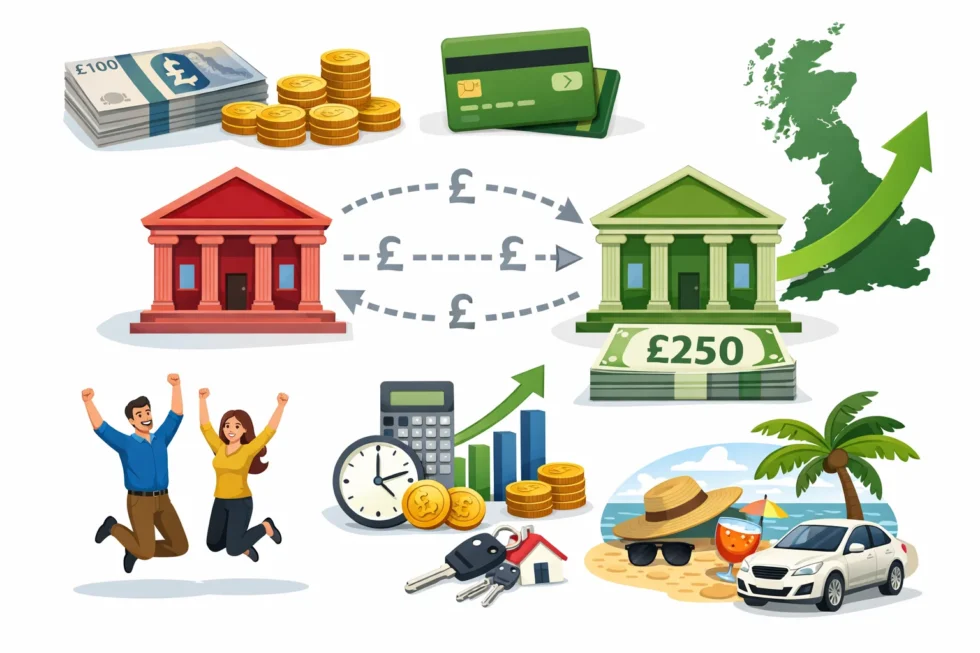
That creates a potential £275 payout for a single bank move.
Is the £100 taxable
In previous years, the Fairer Share payment was treated as taxable savings income. However, most people do not pay tax on it because of the Personal Savings Allowance, which allows:
- Basic-rate taxpayers to earn £1,000 a year in savings interest tax-free
- Higher-rate taxpayers to earn £500
Nationwide reports the payment directly to HMRC.
The surge in bank switching and cash incentives in early 2026 is not happening in isolation. It reflects a period of sustained pressure on household finances, as mortgage rates remain elevated, rents continue to rise across most regions of Britain, and energy and food costs stay well above pre-pandemic levels. Against that backdrop, high-street banks are competing more aggressively than at any point in the past decade for customers’ everyday money.
What makes this year different is the way two forces are converging at once. On one side, banks such as Lloyds, Santander and First Direct are offering record-level switching bonuses, paying up to £250 simply to attract new current account holders. On the other, Nationwide — the country’s largest customer-owned lender — is once again preparing to decide whether to distribute hundreds of millions of pounds in profits directly to its members through the Nationwide bonus scheme.
For many households, this creates a narrow financial window. The qualifying period for the Nationwide payment runs through the first quarter of the year, while the biggest switching offers are concentrated in January and early February. Missing either side of that equation could mean losing access to money that, for a growing number of families, now covers a month of council tax, part of an energy bill, or a week’s food shopping.
Read about the life of Westminster and Pimlico district, London and the world. 24/7 news with fresh and useful updates on culture, business, technology and city life: Why has UK inflation fallen to 3.2% and is the Bank of England now forced to cut rates