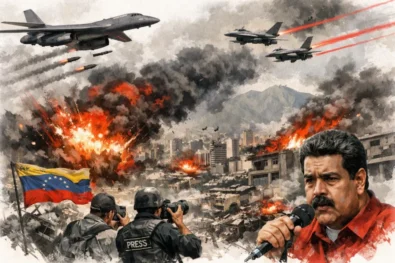
When the White House confirmed that Nicolás Maduro had been detained in a US-led operation and removed from Venezuela, it sent shockwaves through Latin America, global energy markets and international diplomacy, marking the most dramatic political rupture in the region since the death of Hugo Chávez. For more than 13 years, Maduro ruled the world’s largest proven oil state through economic collapse, hyperinflation, mass emigration, electoral manipulation, political repression and deepening international sanctions. If his removal is verified, it brings to an end a revolutionary system that reshaped Venezuela’s institutions, economy and geopolitical alignment for an entire generation, reports The WP Times.
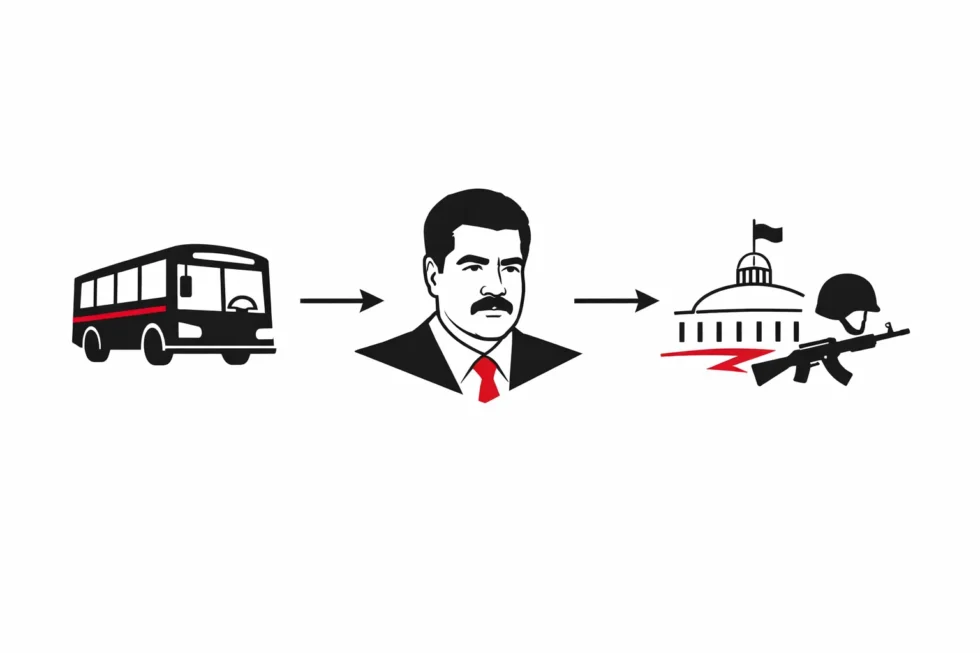
Maduro’s ascent embodies the contradictions of that system. Born in 1962 into a union family in Caracas, educated outside Venezuela’s elite circles and shaped by labour activism rather than technocratic training, he rose from city bus driver to president — becoming one of the most powerful, most sanctioned and most polarising leaders in the Western Hemisphere.
A family shaped by labour and religion
Nicolás Maduro Moros was born in Caracas in 1962 into a household rooted in organised labour and religious discipline. His father, Nicolás Maduro García, worked in public transport and was active in trade-union politics, while his mother, Teresa Moros, was a practising Catholic who emphasised duty, order and moral restraint.
The family lived modestly but politically engaged. Discussions about workers’ rights, class inequality and the failures of Venezuela’s ruling parties were part of everyday life. Unlike the children of the country’s political and business elites, Maduro did not attend private schools, foreign academies or elite universities. He was educated in state schools and left formal education early to enter the workforce.
That background would later become central to his political persona. In a country long dominated by technocrats and oil-wealth elites, Maduro presented himself as an outsider — a leader shaped by labour rather than privilege, and by ideology rather than finance — a contrast that would define both his appeal and his governing style.
Life as a bus driver
In his early twenties, Nicolás Maduro took a job behind the wheel of Caracas’s Metrobus system, operating diesel-powered buses across some of the capital’s most densely populated and politically volatile districts. The work was gruelling. Shifts often stretched to 10 or 12 hours, with drivers navigating broken roads, traffic jams, fuel shortages and constant fare disputes in a city already sliding into economic strain.
Each day he transported thousands of office workers, factory labourers and market traders between the working-class suburbs and the city centre. The bus was not only a means of transport but a moving cross-section of Venezuelan society — a place where anger over inflation, corruption and collapsing public services was expressed openly.
The depots where drivers gathered between shifts functioned as informal political clubs. Leaflets were distributed. Strikes were organised. Debates over socialism, Cuba and Venezuela’s ruling parties were routine. Maduro became active in the transport workers’ union and quickly built a reputation for discipline, reliability and ideological commitment rather than charismatic leadership.
He later described this period as the moment his politics were forged. “On the bus,” he said in interviews, “you see the country as it truly is — not from offices, but from the streets.” It was through these union networks that he was recruited into underground left-wing movements influenced by Cuban revolutionary doctrine, setting him on a path that would ultimately lead from the driver’s seat to the presidential palace.
From labour activist to Chávez insider
Maduro’s encounter with Hugo Chávez in the mid-1990s proved decisive. Chávez, a former army officer preparing a populist insurgency against Venezuela’s political class, was assembling a tightly disciplined political machine. Maduro, shaped by trade-union organising rather than electoral politics, fit that model precisely.
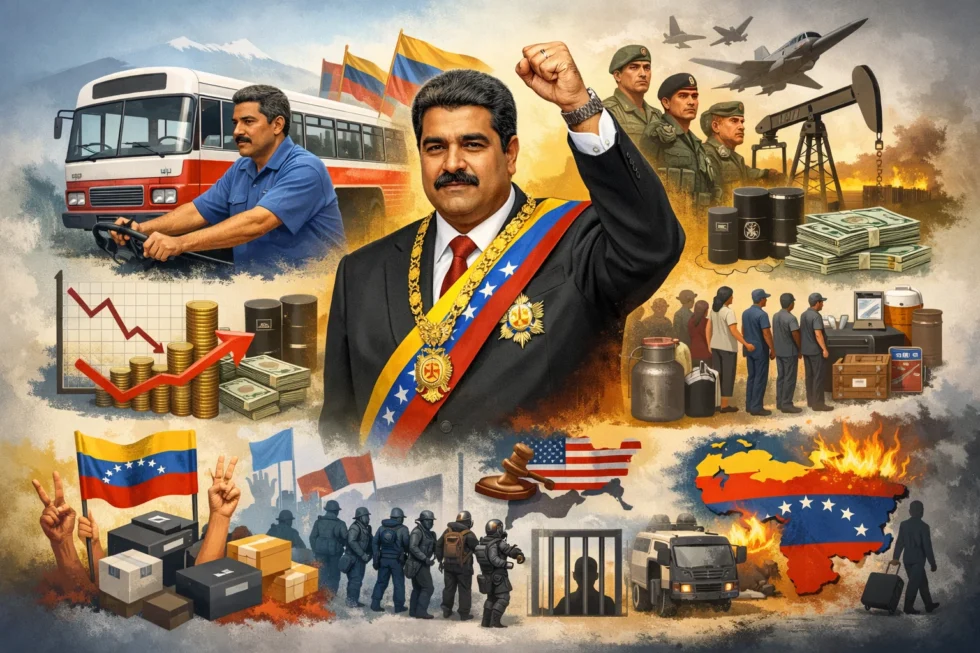
While Chávez dominated rallies and television, Maduro worked in the movement’s organisational core — recruiting activists, coordinating labour groups and maintaining links with Cuban advisers who were already helping to shape the Bolivarian project. When Chávez won the presidency in 1998, Maduro was rewarded with a seat in parliament and later key party positions, emerging as one of the few figures trusted with both ideology and internal control.
By 2006 he was appointed foreign minister, giving him responsibility not only for diplomacy but for constructing the international survival strategy of the revolution.
Architect of Venezuela’s new alliances
As foreign minister, Maduro engineered Venezuela’s pivot away from the United States and towards an alternative geopolitical bloc. Oil-for-credit deals with China brought billions in financing. Russia supplied weapons, security equipment and political backing. Iran helped bypass sanctions. Cuba embedded intelligence and security advisers inside the state.
These relationships were transactional, not ideological. They gave the government access to cash, arms and diplomatic cover precisely when Western governments were withdrawing recognition and imposing sanctions. When Maduro later faced isolation, these alliances became the backbone of his survival.
In 2012 Chávez, dying of cancer and increasingly dependent on Cuban doctors and security advisers, appointed Maduro vice-president — overriding more prominent military and political figures. Within the system, the message was unambiguous: Maduro was the heir.
A presidency of centralisation
Maduro took power in 2013 at a moment when Venezuela’s economic model was already breaking. Rather than liberalising or opening the oil sector, he tightened price controls, expanded state ownership and reinforced currency restrictions that strangled imports and fuelled black markets.
Oil revenues were channelled into patronage networks rather than infrastructure. As production at the state oil company PDVSA collapsed, so did government income. Hyperinflation followed. Shortages became structural.
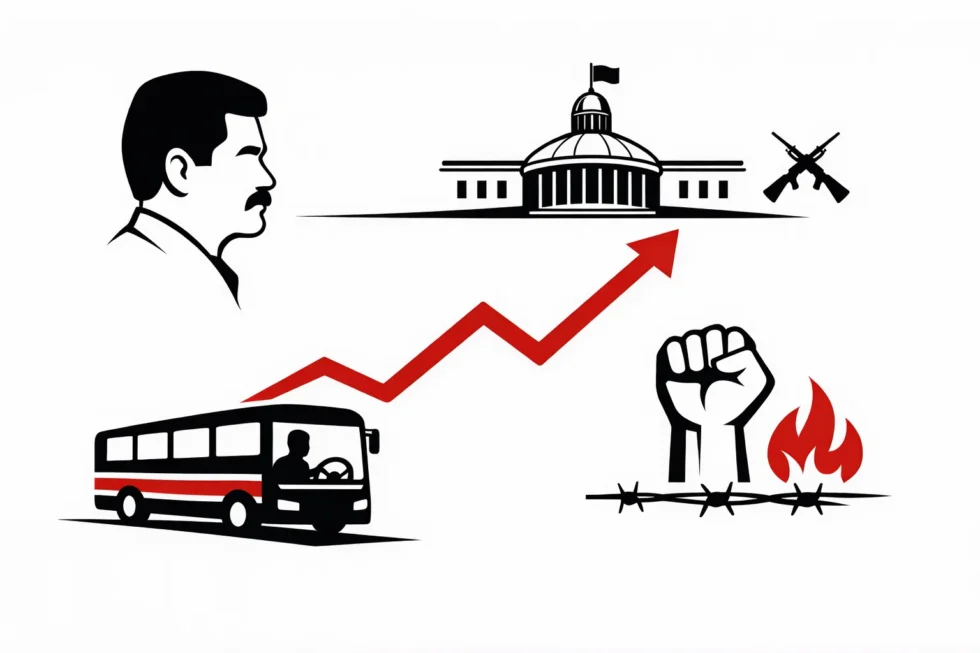
Maduro’s response was political, not economic. The military was placed in charge of food distribution, ports, energy and customs. Parallel institutions were created to bypass parliament after the opposition won control in 2015. The state was reorganised around loyalty, not competence.
Survival through repression and foreign backing
Elections under Maduro never disappeared — they were redesigned. The electoral commission was placed under loyalist control, opposition parties were stripped of legal status, and key candidates were barred from standing. When voters delivered an opposition victory in parliamentary elections in 2015, the supreme court — packed with government allies — effectively neutralised the legislature, transferring its powers to pro-Maduro bodies.
The security apparatus expanded rapidly. The intelligence services and military were embedded in civilian administration, overseeing ports, food imports, fuel distribution and border control. Protest leaders, journalists and opposition organisers were detained under anti-terror and public-order laws, while hundreds of political prisoners were held in military facilities.
At the same time, Western sanctions cut Venezuela off from dollar markets and restricted its ability to sell oil and access international finance. Russia stepped in with loans, weapons and energy partnerships. China provided credit lines backed by future oil shipments. Iran helped reroute exports and supplied refined fuel to keep the economy running. Cuba provided the regime with surveillance systems, intelligence officers and counter-dissent expertise.
Maduro did not survive because Venezuela stabilised. He survived because power was militarised, revenue was externally underwritten, and dissent was systematically contained by a security state protected by foreign allies.
What remains — 3 January 2026
If his fall is confirmed, Nicolás Maduro’s career will rank among the most extreme political transformations of the modern era — from Caracas bus driver to foreign minister, from vice-president to entrenched autocrat removed by foreign force.
To his supporters, he will remain a symbol of resistance against Western pressure and a guardian of Hugo Chávez’s revolution. To history, he is more likely to be remembered as the man who presided over the collapse of one of Latin America’s richest oil states, leaving behind mass poverty, emigration and institutional decay.
On 3 January 2026, Venezuela stands at a turning point. Whether this moment leads to democratic recovery, renewed authoritarianism or prolonged instability will depend on who now controls the military, the oil sector and the state itself. Maduro may be gone — but the system he built, and the geopolitical forces around it, are still very much alive.
Read about the life of Westminster and Pimlico district, London and the world. 24/7 news with fresh and useful updates on culture, business, technology and city life: Trump confirms “successful operation” against Venezuela: Maduro detained and removed from the country