
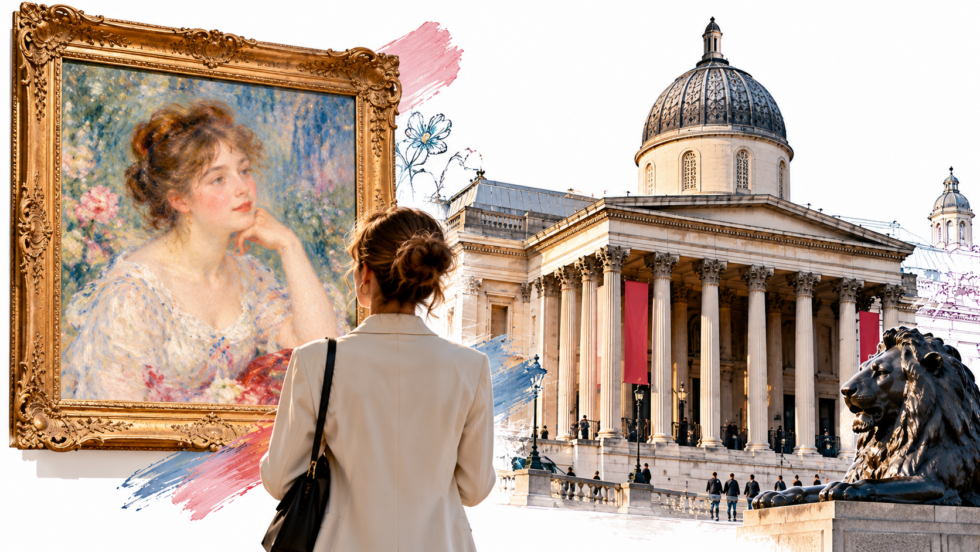
3 October 2026 marks the public opening of Renoir and Love at the National Gallery in London, a major exhibition bringing together 45 works by Pierre-Auguste Renoir and concentrating on roughly two decades in which love, friendship, flirtation, family life and the social rituals of modern Paris became central to his painting. Running in the Sainsbury Wing until 31 January 2027, the exhibition moves from Renoir’s early scenes of taverns and courtship through cafés, streets, dances and suburban leisure to family relationships and the more sculptural style that emerged in the 1880s. Among its principal loans are Dance at the Moulin de la Galette from the Musée d’Orsay, Dance at Bougival from the Museum of Fine Arts, Boston, The Promenade from the J. Paul Getty Museum and The Great Bathers from Philadelphia, alongside the National Gallery’s own The Umbrellas. It is the most substantial UK exhibition devoted to Renoir for 20 years and has been organised jointly by the Musée d’Orsay, the National Gallery and the Museum of Fine Arts, Boston, The WP Times reports.
Tickets are now on sale and the pricing needs a little explanation because there is no single adult price for every date. Standard admission is £20 from Sunday to Thursday during the normal off-peak period and £25 on Fridays and Saturdays, while every day during the exhibition’s first two weeks is charged at £25. Under-18s and National Gallery Members enter the exhibition free. From Friday 23 October 2026 to Friday 15 January 2027, the Gallery will also run Pay What You Wish on Friday evenings, allowing visitors to book for as little as £1. General admission to the National Gallery’s permanent collection remains free, so the charge applies specifically to this temporary exhibition rather than entry to the building as a whole.
What is Renoir and Love and which paintings are in the National Gallery exhibition
The National Gallery Renoir exhibition is not a career retrospective covering every stage of Pierre-Auguste Renoir’s life. Its tighter subject is the period from the mid-1860s to the mid-1880s, when the painter was developing the language associated with Impressionism while repeatedly returning to human relationships as a subject. The National Gallery says more than a third of the canvases Renoir produced in these two decades show modern love and social interaction. That includes romantic attraction, but the exhibition uses “love” more broadly: friendship, physical proximity, conversation, male companionship, family bonds, courtship and the sociability of cafés, theatres, dance halls and suburban leisure all appear in the seven-room sequence.
The choice matters because Renoir’s familiar reputation can make his paintings appear easier than they are. The exhibition does not present a succession of generic scenes of Parisian pleasure. Its works were made during a period in which Paris itself was changing, with new boulevards, cafés, theatres and leisure spaces providing places where social classes encountered one another and where clothing, gesture and public behaviour became increasingly visible parts of modern urban life. Renoir’s figures sit, dance, walk, talk and look at one another within those spaces, and the curators have organised the exhibition around the changing ways he painted those connections.
The National Gallery’s final press material lists 45 works. The public exhibition page describes visitors moving through around 40 paintings drawn from collections around the world, while the more detailed press release gives the broader 45-work figure for the complete exhibition. The London presentation follows the exhibition’s earlier run at the Musée d’Orsay in Paris and precedes its move to the Museum of Fine Arts, Boston, in February 2027.
The exhibition’s subject is not romance alone: it is Renoir’s treatment of human proximity and social life during the years in which his Impressionist language was taking shape.
The first room begins before Renoir became the painter of Parisian leisure
The opening section goes back to Renoir’s early years and includes Mother Antony’s Tavern of 1866, borrowed from Nationalmuseum in Stockholm. The picture is useful to the exhibition’s argument because it already gives ordinary social life the physical scale and seriousness traditionally associated with grander historical or religious subjects. Instead of presenting modern life as a minor anecdote, Renoir enlarges it. People eating, drinking, sitting together and inhabiting informal spaces become material for ambitious painting.
That approach establishes an idea that continues through the later rooms. Renoir’s paintings of social relations are often built from moments that would barely qualify as events: a conversation, a shared meal, two people walking, somebody looking across a room or a family sitting together. The exhibition is interested in the way he transformed those temporary encounters into large, carefully constructed compositions. The apparent ease of the scene and the ambition of the painting are often very different things.
Renoir turns the fête galante into modern Paris
The second room concentrates on Renoir’s “gallant” scenes of the 1870s. His reference point was partly the 18th-century French tradition represented by artists such as Watteau, Fragonard and Boucher, particularly the fête galante: elegant groups meeting in outdoor settings where music, flirtation and courtship unfold without a fixed narrative. Renoir updates that language for modern life rather than copying it, replacing aristocratic fantasy with contemporary dress, new leisure spaces and recognisable forms of Parisian sociability.
The Promenade of 1870, on loan from the J. Paul Getty Museum in Los Angeles, is one of the major works in this room. A man appears to lead a woman along a wooded path, but Renoir gives the viewer little narrative certainty about who they are or exactly what is happening. The physical relationship between the figures, their movement through the landscape and the quickness of the encounter matter more than a literary story.
The much larger Dance at the Moulin de la Galette of 1876 pushes the same interest into a crowded public setting. Renoir painted the Sunday dance at the Moulin de la Galette in Montmartre, filling the composition with couples, friends, conversation and constantly shifting light. It is one of the defining works of his Impressionist period and one of the central loans to the London exhibition from the Musée d’Orsay.
The importance of the picture to Renoir and Love is not simply that couples are dancing. Renoir makes social interaction itself the structure of the painting. Figures overlap, turn away, lean towards one another and move in and out of groups; the eye is not directed towards a single dramatic incident. That fragmented pattern allows the room to connect an old artistic language of courtship with the behaviour of modern Paris.
“Renoir sketches a joyful and light-hearted portrait of modern romance in 19th-century Paris.” (Chiara Di Stefano, exhibition co-curator, National Gallery)
Chiara Di Stefano, Associate Curator of Post-1800 Paintings at the National Gallery and one of the London curators, describes an artist avoiding conventional drama and anecdote. That distinction is visible throughout the show: the paintings often imply attraction, familiarity or affection without converting the interaction into a clearly narrated love story.
Cafés and streets become stages for modern relationships
The third section moves from gardens and dance grounds into the public spaces of Paris. Among its works are La Place Clichy of 1880 from the Fitzwilliam Museum in Cambridge and Leaving the Conservatory, painted in 1876–77 and lent by the Barnes Foundation in Philadelphia.
These pictures fit the exhibition because the city changes the conditions under which people meet. A street corner or café is public rather than private, yet Renoir repeatedly uses these environments for small moments of attention and contact. Clothes signal status; physical distances between figures matter; looking can become as significant as touching. The subjects belong to a recognisably modern urban culture in which leisure and visibility increasingly overlap.
The Gallery’s related course on Renoir and modern France makes that wider context explicit. It identifies cafés, riverside resorts, gardens and dance halls as spaces through which Renoir developed a visual language for modern leisure, while also connecting his paintings to questions of class, fashion, gender and changing social identity. Those concerns sit behind the exhibition even when the pictures themselves appear light in mood.
The fourth room leaves central Paris for Chatou and Bougival
One of the most concentrated groups of major loans comes in the fourth room, devoted to leisure on the outskirts of Paris. It contains Oarsmen at Chatou from the National Gallery of Art in Washington, Dance in the Country from the Musée d’Orsay, Dance at Bougival from the Museum of Fine Arts, Boston, The Luncheon from the Barnes Foundation and Lunch at Restaurant Fournaise (The Rowers’ Lunch) from the Art Institute of Chicago.
The riverside suburbs offered a different social setting from the boulevards and theatres of central Paris. Railways had made places along the Seine accessible for day trips, boating, restaurants and dancing, and Impressionist painters repeatedly worked there. Renoir’s interest in these settings is less architectural than human: tables, boats, trees and dance floors become structures around which people gather.
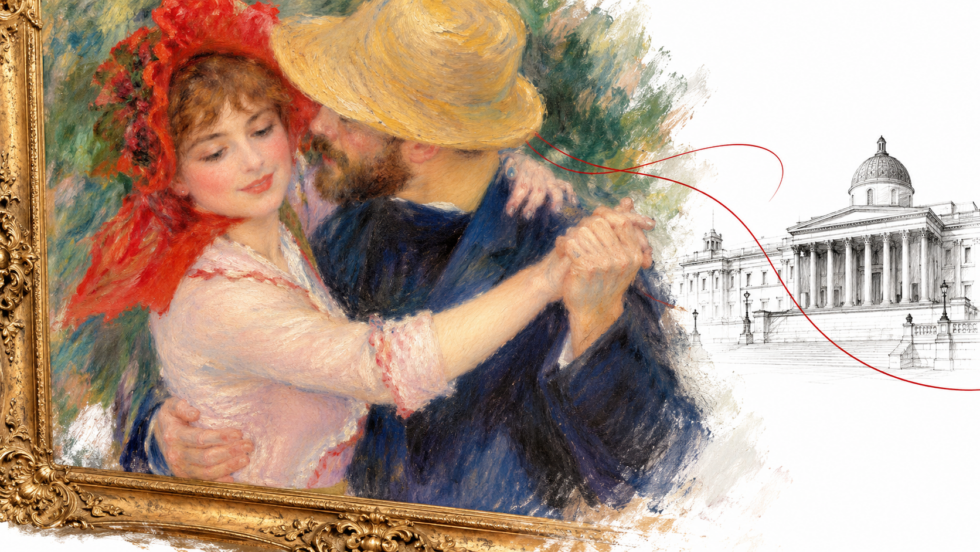
Dance at Bougival, painted in 1883, is particularly direct. Two almost life-size figures dominate the canvas, the couple’s physical closeness set against a much less sharply defined background. The work belongs to a trio of celebrated dance compositions from this period, and the London exhibition places it in dialogue with Dance in the Country.
That transition also helps visitors see Renoir moving beyond the broken surfaces normally associated with his high Impressionist period. Bodies become firmer and more volumetric during the early 1880s. The subject of connection remains, but the means used to construct figures and space are changing.
Family affection replaces public flirtation in room five
The fifth room narrows the social circle. Instead of streets, dances and restaurants, it focuses on family life and children. The works include Sketches of Heads (The Berard Children) of 1881 from the Clark Art Institute and Children’s Afternoon at Wargemont of 1884 from Berlin’s Alte Nationalgalerie.
One of the most personal paintings is Motherhood of 1885 from the Musée d’Orsay. It shows Aline Charigot, Renoir’s future wife, nursing their first son, Pierre. That makes the exhibition’s idea of love substantially wider than the flirtations and dances of the earlier rooms. Physical closeness now belongs to parenthood and domestic life rather than courtship.
The National Gallery exhibition page also highlights Young Mother of 1881 from the Barnes Foundation among its featured loans. Seen within the wider sequence, such works show how Renoir repeatedly built pictures around relationships rather than isolated portrait sitters.
Conversation and theatre occupy the sixth room
Room six deals with intellectual intimacy and physical proximity. The Conversation of 1878 from Nationalmuseum in Stockholm and At Renoir’s Home, rue St-Georges of 1876 from the Norton Simon Museum in Pasadena are among its main paintings. The room also contains a smaller group of theatre-box images, including A Box at the Theatre (At the Concert) of 1880 from the Clark Art Institute.
The theatre box is an especially suitable setting for the exhibition’s argument because it is simultaneously private and public. People sit closely together while also being visible to the rest of the audience. Nineteenth-century theatre-going involved looking across the auditorium as well as towards the stage, giving painters a setting in which fashion, attraction and social observation could occupy the same image. Christopher Riopelle, the exhibition’s other London co-curator, places friendship at the centre of Renoir’s modern subject matter rather than treating it as secondary to romantic love. The paintings here reinforce that distinction. Two figures sharing space or conversation need not be part of a romantic narrative to become central to the exhibition’s subject.
The final room shows Renoir leaving his Impressionist season
The exhibition does not finish by repeating the visual language of Moulin de la Galette. From around 1883, Renoir increasingly moved away from the Impressionist emphasis on transient light towards more solid, sculptural figures and subjects less closely tied to contemporary Paris. The final room makes that shift part of the exhibition rather than ending at the moment of his greatest Impressionist fame. Its major painting is The Great Bathers, dated 1884–87 and lent by the Philadelphia Museum of Art. The National Gallery describes it as marking the end of Renoir’s Impressionist period and the start of another phase of his career. The social specificity of cafés, streets and suburban dances gives way to a more timeless and classical conception of the figure.
That ending changes the meaning of the rooms that precede it. Renoir and Love is therefore also an exhibition about artistic development: the same painter who dissolved a Montmartre dance into spots of light later sought greater firmness and monumentality. The emotional themes continue, but the painting itself changes underneath them.
Why The Umbrellas matters in a show built largely from loans
One work does not have to travel far. The Umbrellas, begun in about 1881 and reworked around 1885, belongs to the National Gallery itself. Its presence is useful because the painting contains evidence of Renoir’s stylistic transition within a single canvas: revisions made over several years produce visible differences in the handling of figures.
The National Gallery specifically identifies the picture as an example of Renoir developing modern social themes on a large scale. Crowded urban life replaces the open dance floor of Moulin de la Galette, yet the painting is again organised through bodies, glances, proximity and movement.
For London visitors familiar with The Umbrellas from the permanent collection, the temporary exhibition changes its context. Instead of encountering it alongside the Gallery’s wider nineteenth-century holdings, visitors can read it among works made during the same concentrated period of Renoir’s development and against loans that are normally separated between Paris, Boston, Philadelphia, Stockholm, Chicago and other collections.
How much are Renoir and Love tickets and when can visitors pay £1
The headline price for Renoir and Love tickets is £20 or £25 for standard adult admission, depending on the date. Off-peak admission costs £20 from Sunday to Thursday. The standard price rises to £25 on Fridays and Saturdays, and the National Gallery also charges £25 on every day during the exhibition’s first two weeks. Since the exhibition opens on Saturday 3 October 2026, visitors attending during that initial two-week period should expect the £25 standard price regardless of the weekday.
Under-18s go free. National Gallery Members also receive free exhibition admission, with membership providing unlimited entry to the Gallery’s paid exhibitions rather than a one-off Renoir ticket. Booking is already open through the National Gallery.
| Ticket or visit type | Price | What the National Gallery states |
|---|---|---|
| Standard off-peak | £20 | Sunday-Thursday after the first two weeks |
| Standard peak | £25 | Friday and Saturday |
| First two weeks | £25 | Standard price on all days |
| Under 18 | Free | Free exhibition admission |
| National Gallery Members | Free | Unlimited admission to paid exhibitions |
| Pay What You Wish Fridays | From £1 | Selected Friday evenings, 23 October 2026-15 January 2027 |
| Renoir audio tour | £5 | English, French, BSL and Audio Described versions |
| Relaxed Session, standard | £20 | 23 November, 5-6pm |
| Relaxed Session concession | £14 | Full-time students, jobseekers and disabled adults |
| Relaxed Session under 18 | Free | Free |
| Relaxed Session disabled visitor companion | Free | One free companion ticket available |
The main exhibition page does not currently list a general concession price alongside its £20 and £25 standard admission. A separate Relaxed Session scheduled for 23 November does carry a £14 concession rate for full-time students, jobseekers and disabled adults, alongside a £20 standard ticket, free admission for Members and under-18s and a free companion ticket for a disabled visitor. That £14 figure belongs specifically to the Relaxed Session and should not be presented as the normal concession rate for every standard exhibition slot.
The simplest distinction is £20 off-peak, £25 peak and during the first two weeks, with under-18s and Members free.
How does the £1 Pay What You Wish offer work
The most significant lower-cost option begins three weeks after the exhibition opens. Every Friday evening from 23 October 2026 through 15 January 2027, the National Gallery is offering Pay What You Wish admission to Renoir and Love. Visitors can choose their price, starting at £1.
Visitors can “pay as little as £1 or as much as you’d like” on the designated Friday evenings. (National Gallery)
The scheme does not apply to every Friday from opening day. The published starting date is 23 October, so the first three Fridays of the exhibition period should not be assumed to carry the £1 option. The final listed Pay What You Wish date is 15 January 2027, two weeks before the exhibition closes on 31 January.
Friday is also the National Gallery’s regular late-opening night. The building normally opens from 10am until 6pm each day and until 9pm on Fridays, making the Pay What You Wish period part of an established Friday-evening programme rather than a special extension created solely for Renoir.
The Gallery also runs Friday Lates around its wider collection and Sainsbury Wing foyer, with some related Renoir-season events appearing in the programme. On 23 October, for example, pianist Karim Kamar is scheduled for a free Friday Lates performance titled Love song reimagined, while other talks and events linked to the broader autumn programme carry their own separate booking arrangements.
Is the National Gallery itself still free
Yes. The £20 or £25 ticket is for the temporary exhibition, not the National Gallery’s permanent collection. General admission remains free, with donations welcomed. Visitors can therefore enter the Gallery and see the main collection without buying a Renoir and Love ticket, although the Gallery recommends booking a free general-admission ticket for fast-track entry. Walk-up general admission is also available.
That distinction is particularly relevant for a Trafalgar Square institution where many visitors reasonably associate the National Gallery with free entry. Paid temporary exhibitions operate inside the free museum, and Renoir and Love is one of them.
The permanent collection includes more than 1,000 paintings on display at any one time, ranging from the early Renaissance to the beginning of the twentieth century. A Renoir exhibition ticket is therefore not required simply to enter the building and see the national collection.
Does the exhibition ticket include an audio guide
The exhibition audio tour costs an additional £5 per person. It is available in English and French, as well as British Sign Language and an Audio Described version. Visitors use their own mobile device and headphones rather than receiving a traditional dedicated handset. The tour is designed specifically for Renoir and Love, with curatorial commentary on the paintings, their stories and Renoir’s techniques. The National Gallery’s wider Smartify digital material for the permanent collection is a separate offer, and some collection information can be accessed free. Anyone planning to use the exhibition audio tour therefore needs to account for two separate costs: the exhibition ticket, unless eligible for free admission or Pay What You Wish, and the £5 audio element. The practical requirement is equally straightforward: bring a charged phone or tablet and headphones.
What does membership change
National Gallery Members enter Renoir and Love free and receive unlimited admission to the Gallery’s paid exhibitions. Membership is therefore structured differently from purchasing a standard £20 or £25 ticket for a particular timed visit.
There are also events reserved for Members. Ahead of the public opening, curators Christopher Riopelle and Chiara Di Stefano gave a Members’ introduction in the Pigott Theatre on 2 October, with an online version also available to Members. Other exhibition-related tours and events continue throughout the run and carry separate prices even where exhibition admission is covered by membership.
The Gallery’s Supporters’ House membership is a different tier, beginning at £130 annually according to its current page and including exhibition access alongside use of Supporters’ House and its programme. That is separate from the straightforward question of a standard Renoir ticket and should not be confused with the £20 or £25 admission price.
Is there a quieter way to see Renoir and Love
A dedicated Relaxed Session is scheduled for Monday 23 November from 5pm to 6pm in the Sainsbury Wing exhibition space. The Gallery says attendance will be limited to no more than half the exhibition’s usual capacity. It is intended for people who would benefit from a calmer and less crowded environment, including autistic and neurodivergent visitors, people with sensory processing differences, SEND, dementia or other access needs, as well as accompanying families, friends and carers. The session includes a calm space, a visual story and Access Packs containing items such as noise-cancelling headphones, a magnifying sheet, large-print guide and stress ball. There is no prescribed route through the exhibition.
Tickets for that session are £20 standard and £14 concession, while Members and under-18s go free. A companion for a disabled visitor is also free. The Gallery defines the concessions for this event as full-time students, jobseekers and disabled adults.
Are talks and related events included in the exhibition ticket
Not automatically. The National Gallery has built a substantial events programme around Renoir and Love, but individual talks, tours and courses have their own ticketing conditions. A lecture titled Painting large as an Impressionist: Renoir and the full-length format on 5 October, for example, is priced at £10 standard and £8 concession, while a curatorial introduction on 16 November is listed as free. The programme also includes The Renoir Girls book talk with Catherine Ostler and Christopher Riopelle, a companion walking tour, a British Sign Language introduction, an online course on Renoir and modern France, family activities during October half-term and an online exhibition tour for Members in December. Some are free, some paid and some restricted to Members.
This is useful when comparing advertised “from” prices around the exhibition. A £10 talk ticket, a £20 exhibition ticket and a £5 audio tour refer to different products rather than different prices for the same admission.
When is Renoir and Love open and how should a National Gallery visit be planned
The Renoir exhibition London run begins on Saturday 3 October 2026 and closes on Sunday 31 January 2027. It is installed in the Sainsbury Wing at the National Gallery, Trafalgar Square, London WC2N 5DN. The Gallery’s normal public hours are 10am-6pm every day, with Friday opening extended until 9pm. It closes on 24, 25 and 26 December and on 1 January. The Sainsbury Wing is now the main entrance for visitors, including ticket holders and Members, and provides step-free access. Its entrance faces Trafalgar Square close to Whitcomb Street. Visitors with access requirements that make queueing difficult are advised to speak to a member of staff. The National Gallery recommends advance booking for exhibitions. General-admission visitors can also reserve free entry for the main collection, although walk-up access to the free Gallery is available. Paid exhibitions operate through their own ticket bookings.
For a standard visit, the crucial distinction is between free entry to the National Gallery and a separately booked ticket for Renoir and Love.
What are the practical opening hours
For most days, the building operates from 10am until 6pm. Fridays run until 9pm, creating the evening window used by the Gallery’s Friday Lates and the Pay What You Wish Renoir scheme from 23 October.
There can be date-specific changes. The Gallery has, for example, published a notice for 6 October stating that its east wing will close from 5pm that day while the rest of the Gallery, including Renoir and Love, remains open until 6pm. That kind of operational detail is why the Gallery recommends checking current visitor information before travelling for a specific timed slot. Visitors should also distinguish Gallery opening hours from restaurant, café and bar hours. The catering venues have individual schedules, and some run later on Fridays or Saturdays.
Where do visitors enter
The National Gallery identifies the Sainsbury Wing as its main entrance for everyone. It has step-free access and is used by exhibition ticket holders and Members. The wing reopened after redevelopment in May 2025 and now forms the principal arrival route from Trafalgar Square.
The Gallery’s current visual information also identifies the Getty Entrance for paid exhibition ticket holders. It has access from Trafalgar Square and includes a lift route into the Gallery. The precise entrance shown on a ticket and any instructions issued with a booking should therefore take priority on the day. Security checks operate at the entrances. Visitors pass through a security arch and staff may inspect bags. The Gallery encourages visitors to bring minimal belongings, particularly because larger items can create difficulties around the cloakroom and exhibition spaces.
Can bags be taken into Renoir and Love
Backpacks and large bags are not permitted inside paid exhibitions. The National Gallery has a cloakroom on Level -1 of the Sainsbury Wing, charging £3 per coat or bag; Members use it free. The maximum bag size accepted by the cloakroom is 56 x 25 x 45cm.
The cloakroom is normally open from 10am to 5.45pm daily and until 8.45pm on Fridays. Staff can inspect items before accepting them and may refuse an item. Adult scooters and oversized objects are not allowed in the building, and large umbrellas cannot be taken into picture galleries but may be checked into the cloakroom. These rules matter more for a paid exhibition than for somebody simply moving through the foyer. A visitor arriving with a large backpack should expect to use the cloakroom rather than carry it through Renoir and Love.
Is the exhibition accessible
The Sainsbury Wing main entrance has step-free access. The National Gallery allows visitors booking an access exhibition ticket to add a free companion ticket, and staff can assist visitors whose access requirements make queueing difficult. The Gallery provides accessible toilets and lifts, and its access information gives a telephone number for visitors who want to discuss specific requirements before booking. The dedicated Relaxed Session on 23 November adds a lower-capacity option for people who require a quieter environment.
The Renoir audio tour is available in BSL and Audio Described formats as well as spoken English and French. Those options cost £5 per person under the current audio-guide pricing.
Can visitors photograph the exhibition
The National Gallery generally allows personal, non-commercial photography unless signage says otherwise, but its group-visiting guidance specifically states that photographs are not permitted inside exhibitions. Visitors should therefore follow the rules displayed at Renoir and Love rather than assuming the Gallery’s general photography policy applies to loan exhibitions. The distinction exists partly because temporary exhibitions contain works lent by many different institutions and private collections, each potentially subject to separate rights and loan conditions. The Gallery’s Visitor Admissions Policy allows restrictions where necessary to protect loans, copyright, privacy and the visitor experience.
Sketching is also specifically prohibited inside exhibition spaces under the current Visitor Admissions Policy, even though sketching is permitted under defined conditions elsewhere in the Gallery.
How much time should be allowed for Renoir and Love
The National Gallery does not prescribe a fixed visit duration on the exhibition page. With 45 works arranged across seven thematic rooms, a visitor’s time will depend on whether the aim is a straightforward viewing, detailed label reading or use of the £5 audio tour. The room-by-room arrangement has a clear chronological element but is also thematic, moving through early sociability, courtship, streets and cafés, suburban leisure, family life, conversation and Renoir’s eventual stylistic transition. That makes it possible to follow the exhibition as a continuous argument rather than treating the works as a checklist of famous paintings.
Visitors combining the exhibition with the free permanent collection should allow for the fact that the National Gallery contains more than 1,000 paintings on display. There is no need to attempt both as a single continuous circuit; the temporary exhibition ticket and free collection serve different purposes.
Which paintings are the main works to look for?
The National Gallery itself highlights six works on the public exhibition page: Dance at the Moulin de la Galette of 1876, Mother Antony’s Tavern of 1866, a Self-Portrait from about 1875, Lunch at Restaurant Fournaise (The Rowers’ Lunch) of 1875, Young Mother of 1881 and Dance at Bougival of 1883. The detailed press material adds several paintings that are central to the room sequence:
- The Promenade, 1870, J. Paul Getty Museum, Los Angeles;
- Leaving the Conservatory, 1876–77, Barnes Foundation, Philadelphia;
- La Place Clichy, 1880, Fitzwilliam Museum, Cambridge;
- Oarsmen at Chatou, 1879, National Gallery of Art, Washington;
- Dance in the Country, 1883, Musée d’Orsay, Paris;
- The Luncheon, 1875, Barnes Foundation;
- Children’s Afternoon at Wargemont, 1884, Alte Nationalgalerie, Berlin;
- Motherhood, 1885, Musée d’Orsay;
- The Conversation, 1878, Nationalmuseum, Stockholm;
- A Box at the Theatre (At the Concert), 1880, Clark Art Institute;
- The Great Bathers, 1884–87, Philadelphia Museum of Art;
- The Umbrellas, begun 1881 and reworked 1885, National Gallery.
The range of lenders is part of the exhibition’s substance. Several of these paintings normally live thousands of miles apart, and the London display places works from Paris, Boston, Los Angeles, Philadelphia, Washington, Chicago, Stockholm and other collections into a single sequence centred on Renoir’s changing treatment of relationships.
Why is Dance at the Moulin de la Galette central to the exhibition
The painting condenses several of the exhibition’s major ideas into one composition. It is a scene of public leisure, but its subject is constructed from numerous smaller relationships: dancers, seated friends, conversations and glances. Sunlight passes through trees and breaks across clothing and faces while the crowd remains in motion. It also belongs firmly to the period in which Renoir was developing Impressionism rather than the more sculptural style represented near the end of the exhibition. By placing it between his earlier gallant scenes and the later dance pictures, the curators can show both continuity of subject and change in technique.
The loan from the Musée d’Orsay is therefore more than a famous image used to market the show. It sits at the point where an older French tradition of courtship imagery intersects with new urban leisure and Renoir’s experiments with transient light.
Why does the exhibition end with The Great Bathers
By the mid-1880s, Renoir had begun to question elements of the Impressionist method. The fleeting urban spaces and broken effects of light that dominate much of his 1870s production were giving way to an interest in more durable, classically structured figures.
The Great Bathers extends over several years, from 1884 to 1887, and the National Gallery uses it as the endpoint of the exhibition because it marks that artistic change. The subject is not located in a clearly modern café, theatre or Parisian street. It is deliberately less tied to a particular moment. This means the final room does not simply offer more scenes of romance. It establishes where the two-decade period selected by the curators leads and why the exhibition ends in the mid-1880s rather than continuing through the remaining three decades of Renoir’s life.
What else is happening at the National Gallery during the exhibition
Renoir and Love runs alongside other autumn programming rather than taking over the whole Gallery. Yinka Shonibare and Thomas Gainsborough: A Conversation opens on 15 October 2026 as a free exhibition, while Van Eyck: The Portraits opens on 21 November as another paid exhibition.
This matters for visitors planning more than one exhibition on the same day. A Renoir ticket does not automatically function as a ticket for another paid temporary show, and free displays remain separate from both. The National Gallery also continues to display its permanent collection free of charge. That gives visitors the option of placing Renoir within a broader nineteenth-century visit rather than treating the temporary exhibition as an isolated attraction.
Where is the National Gallery and what should visitors know before travelling
The National Gallery is on Trafalgar Square, London WC2N 5DN. The Sainsbury Wing entrance is on the north side of the square close to Whitcomb Street. The Gallery does not publish rail or Underground recommendations on the Renoir exhibition page itself, so visitors travelling across London should use live Transport for London or rail information for their chosen date rather than relying on a static exhibition timetable. Charing Cross is immediately beside Trafalgar Square, while Leicester Square and Embankment are also within central-London walking distance.
Security screening applies on arrival, and the Gallery recommends bringing as few items as possible. Large bags should be avoided, particularly because backpacks and large bags are prohibited within paid exhibitions. Anyone arriving specifically for a timed Renoir and Love booking should allow for entrance procedures rather than treating the booked time as the moment to reach Trafalgar Square. The Gallery explicitly advises visitors to arrive in good time for ticketed events elsewhere in its programme, and the same practical consideration applies when security and cloakroom use are involved.
FAQ about Renoir and Love at the National Gallery
What is Renoir and Love?
Renoir and Love is a National Gallery exhibition examining Pierre-Auguste Renoir’s paintings of love, friendship, flirtation, family bonds and social interaction from the mid-1860s to the mid-1880s. The London exhibition contains 45 works and runs in the Sainsbury Wing from 3 October 2026 to 31 January 2027.
How much are Renoir and Love tickets?
Standard National Gallery tickets for the exhibition cost £20 off-peak from Sunday to Thursday and £25 on Fridays and Saturdays. The £25 rate applies on every day during the first two weeks. Under-18s and National Gallery Members enter free.
Can Renoir and Love really be seen for £1?
Yes, on designated Friday evenings. The Pay What You Wish programme runs every Friday evening from 23 October 2026 until 15 January 2027, and visitors can choose a price starting at £1. It does not apply to every standard daytime ticket.
Is the National Gallery free?
General admission to the National Gallery’s permanent collection is free. Renoir and Love is a separately charged temporary exhibition. Free general-admission tickets can be booked for faster entry, while walk-up general admission is also available.
When does Renoir and Love close?
The final day is Sunday 31 January 2027. The exhibition opens to the public on Saturday 3 October 2026.
Where is the exhibition?
It is in the Sainsbury Wing of the National Gallery on Trafalgar Square, London WC2N 5DN. The Sainsbury Wing is the Gallery’s main visitor entrance and provides step-free access.
What are the National Gallery opening hours?
The Gallery normally opens daily from 10am until 6pm and stays open until 9pm on Fridays. It is closed on 24-26 December and 1 January. Date-specific changes can occur, so current visitor information should be checked for the day of travel.
What is the most famous painting in Renoir and Love?
The exhibition includes several of Renoir’s best-known works, with Dance at the Moulin de la Galette from the Musée d’Orsay serving as one of its principal loans. Dance at Bougival, The Promenade, The Umbrellas and The Great Bathersare also central to the exhibition’s room-by-room argument.
How many paintings are in Renoir and Love?
The National Gallery’s detailed 2026 press release gives the exhibition total as 45 works. Its public visitor page describes around 40 paintings brought together from international collections.
Are children free?
Under-18s receive free admission to Renoir and Love. The exhibition’s standard ticket page does not attach a charge to under-18 entry.
Is there an audio guide?
Yes. The Renoir exhibition audio tour costs £5 and is available in English, French, British Sign Language and Audio Described formats. Visitors need their own mobile device and headphones.
Is there step-free access?
Yes. The Sainsbury Wing main entrance has step-free access, and a free companion ticket can be booked with an access exhibition ticket.
Can large bags be taken into the exhibition?
No. Backpacks and large bags are not permitted in paid exhibitions. The Sainsbury Wing cloakroom charges £3 per item and accepts bags only up to 56 x 25 x 45cm; cloakroom use is free for Members.
Is photography allowed inside Renoir and Love?
The Gallery’s group-visiting guidance states that photographs are not permitted inside exhibitions, despite photography generally being allowed for personal use in the permanent galleries unless signage says otherwise. Visitors should follow the exhibition-specific signs and staff instructions.
Is there a quieter session for visitors with access needs?
Yes. A Relaxed Session takes place on Monday 23 November from 5pm to 6pm with attendance capped at no more than half the exhibition’s usual capacity. Standard admission for that session is £20, concessions are £14, and under-18s, Members and a companion for a disabled visitor go free.
Which museums organised Renoir and Love?
The exhibition is organised jointly by the Musée d’Orsay in Paris, the National Gallery in London and the Museum of Fine Arts, Boston. It was shown in Paris from 17 March to 19 July 2026, runs in London from 3 October 2026 to 31 January 2027 and is scheduled for Boston from 20 February to 13 June 2027.
Who curated the London exhibition?
The London curators are Christopher Riopelle, formerly Curator of Post-1800 Paintings at the National Gallery, and Chiara Di Stefano, Associate Curator of Post-1800 Paintings. The wider project also involves Paul Perrin of the Musée d’Orsay and the curatorial team associated with the Boston presentation.
What is the cheapest way to see Renoir and Love?
The lowest publicly advertised paid rate is the Pay What You Wish offer, which starts at £1 on Friday evenings from 23 October 2026 to 15 January 2027. Under-18s and National Gallery Members enter the exhibition free under the Gallery’s published ticket structure.
Materials used: The National Gallery exhibition page, The National Gallery Renoir and Love press materials, The National Gallery visitor, access, cloakroom and audio-guide information.
Read about the life of Westminster and Pimlico district, London and the world. 24/7 news with fresh and useful updates on culture, business, technology and city life: When will Oasis 2027 tour dates be announced and could 12 Etihad nights define Manchester next summer