
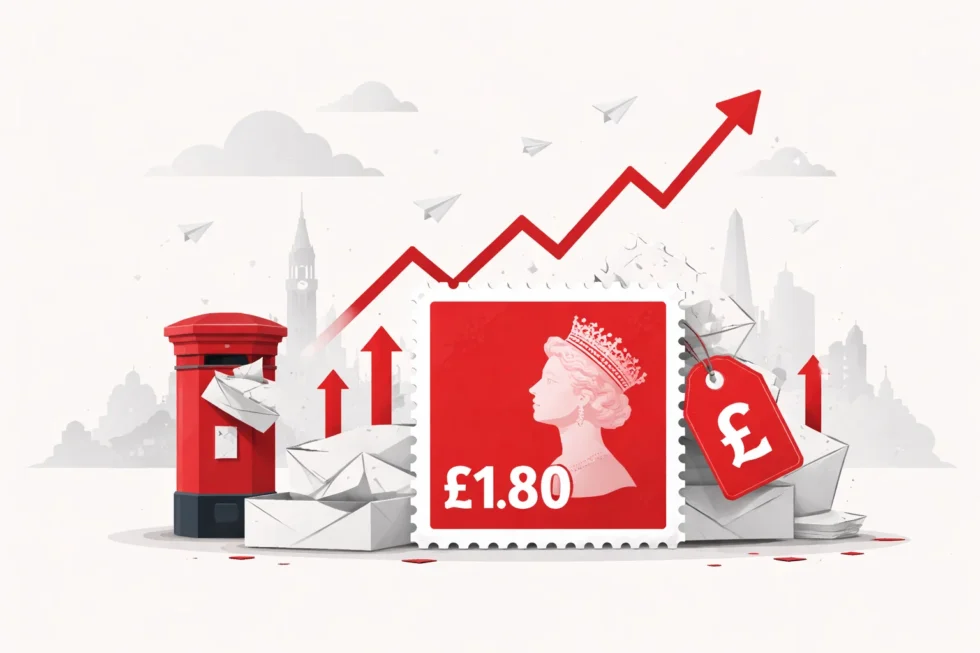
The royal mail price increase took effect on Tuesday 7 April 2026, lifting the price of a standard first-class stamp from £1.70 to £1.80 and a standard second-class stamp from 87p to 91p, reported The WP Times, as Royal Mail pushes through its eighth price rise in five years despite sustained criticism over missed delivery targets, with only around 77% of first-class letters arriving on time against a 93% target, alongside slower services and growing scepticism from consumers, small businesses and MPs.
The broader significance of the royal mail price increase is that it is no longer treated as a routine annual adjustment but as a structural signal of pressure within the UK postal system, where letter volumes have fallen by around 70% over two decades while the number of delivery addresses has risen to roughly 32 million, increasing cost per item and exposing the limits of the universal service model under regulatory scrutiny from Ofcom, turning what was once a technical pricing update into a systemic question about long-term financial sustainability, service reliability and public trust in a shrinking but still essential national network.
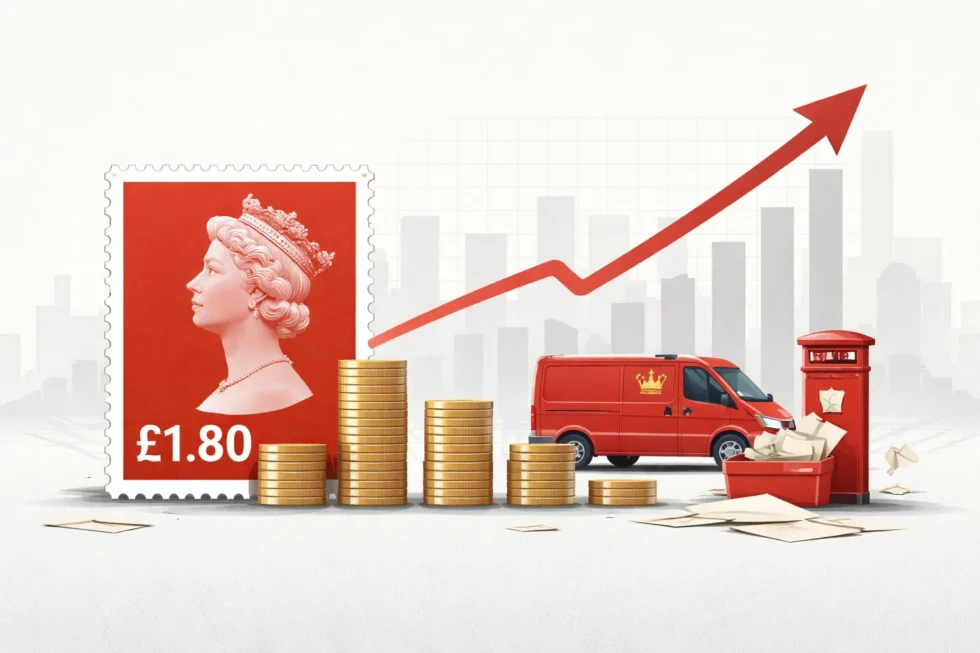
What has changed after the royal mail price increase
From April 2026, the immediate headline figures are clear: a first-class stamp now costs £1.80, a second-class stamp 91p, and a large first-class letter £3.30. Royal Mail’s official 2026 price guide confirms that the rise is not confined to ordinary letters, but extends across a wider set of personal and marketplace postal products, showing that this is a broader pricing reset rather than a single symbolic increase.
The scale of the change matters because it shows how quickly the economics of stamped mail have shifted. BBC and ITV reporting both note that a decade ago a first-class stamp cost 64p, meaning the current £1.80 price is close to three times higher than ten years ago. That sharp rise has turned stamp pricing into a visible cost-of-living issue rather than a niche postal story.
| Postal product | New price from 7 April 2026 | Change |
|---|---|---|
| First-class stamp | £1.80 | +10p |
| Second-class stamp | 91p | +4p |
| Large first-class letter | £3.30 | +15p |
| Large second-class letter | £1.55 | No change |
This price table shows that the royal mail price increase is system-wide in tone even if the rises are uneven by product. In practical terms, the burden falls most visibly on first-class users, who are paying materially more for the fastest standard letter service at a time when delivery performance remains under close scrutiny.
Why the royal mail price increase is happening now
Royal Mail’s explanation is built around a long-running structural problem: Britain is sending far fewer letters, but the network still has to reach more homes and businesses. According to Royal Mail and BBC reporting, letter volumes are down by about 70% over the past 20 years, while the number of addresses the company delivers to has risen by around four million to roughly 32 million. That means the cost of maintaining a nationwide service is being spread across far fewer traditional mail items.
This is why the present royal mail price increase is best understood not as demand-led pricing, but as cost-recovery pricing. The postal operator still has to fund routes, staffing, sorting, transport and nationwide coverage even though the old volume base that once supported those costs has eroded. In effect, each remaining stamped letter now has to carry a larger share of the system’s overhead. The main cost pressures behind the increase are increasingly clear:
- a long-term collapse in letter volumes
- a larger national delivery footprint
- high labour and logistics costs
- rising fuel and energy pressure in transport
- the need to maintain universal service obligations while parcels grow in relative importance
Together, these pressures explain why Royal Mail keeps pushing prices higher even though usage is falling. The company’s argument is that the economics of the network have fundamentally changed; critics respond that this may be true, but it does not automatically justify higher charges without stronger performance.
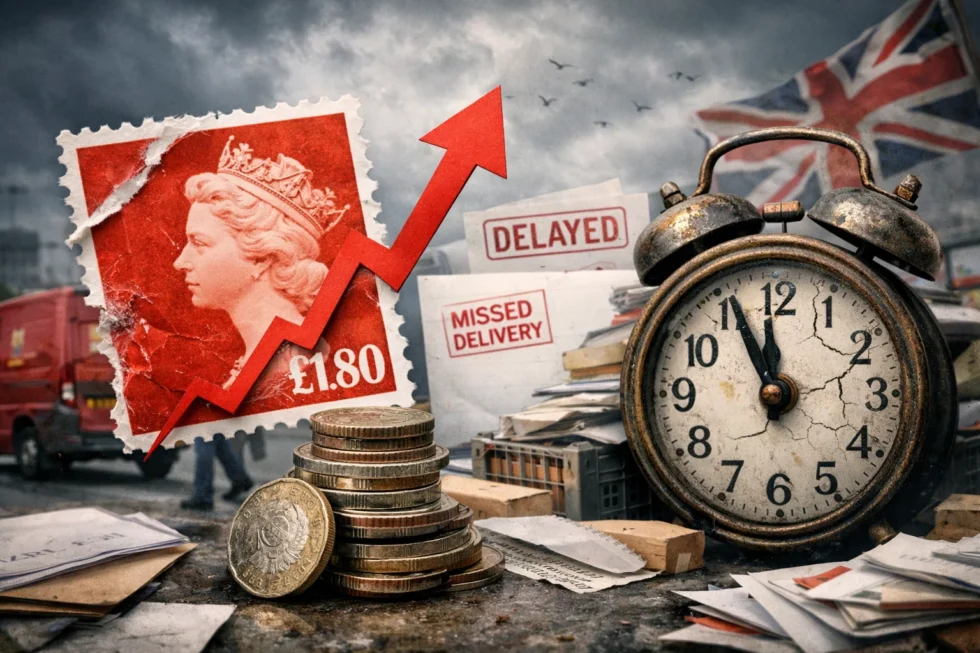
Why criticism is increasing alongside higher prices
The most politically damaging fact in this debate is that Royal Mail is raising prices while still missing key delivery benchmarks. BBC reporting says only about 77% of first-class letters are being delivered within one working day, well short of the 93% target. That gap has become the centre of the criticism because it turns the issue from pure pricing into a question of value for money.
For households, that matters when the post contains medical appointments, legal correspondence, banking documents or time-sensitive paperwork. For businesses, especially smaller firms, the problem is often reputational rather than purely financial: customers blame the seller, not the system, when delivery is late. That is why the royal mail price increase is being judged not just against inflation or costs, but against the basic promise that first-class post should arrive quickly and reliably.
| Metric | Reported current level | Target |
|---|---|---|
| First-class letters delivered within one working day | 77% | 93% |
| Second-class letters delivery aim | Within 3 working days | Regulatory target remains |
The numbers explain why public frustration has become harder for Royal Mail to contain. When a service is becoming more expensive and simultaneously less trusted, each further rise becomes more controversial than the last.
What Royal Mail says in response
Royal Mail has defended the increase by arguing that affordability has to be balanced against the real cost of running the network. Richard Travers, managing director of letters, said: “We always consider price changes very carefully, balancing affordability with the rising cost of delivering mail.” He also pointed to the fact that the average UK adult now spends only about £6.50 a year on stamps, while the system continues to serve an expanding national address base.
That defence is economically rational, but politically difficult. Consumers do not assess the postal service through network theory; they assess it by whether a birthday card, legal form or hospital letter arrives when expected. So while Royal Mail frames the royal mail price increase as a necessary adjustment to a changed market, the public often experiences it as a demand for more money from a service that still feels unreliable.
What Martin Lewis warned and why consumers reacted
Martin Lewis pushed the issue into the mainstream by urging people to buy stamps before the rise came into force. On MoneySavingExpert, he said: “For years, every time stamps go up in price I’ve suggested people stock up and bulk-buy in advance, as provided the stamp doesn’t have a price on it and instead just says the postage class, it’s still valid after the rise.” That made the story practical for households, because it turned a postal pricing notice into an immediate money-saving action.
His warning mattered because it highlighted a detail many consumers still misunderstand: non-denominated class stamps remain valid even after prices change. That means anyone who bought first-class or second-class stamps before 7 April can still use them now without topping up. In effect, Martin Lewis reframed the royal mail price increase as a consumer behaviour story as much as a postal policy story. The consumer response can be summed up in four points:
- buying stamps in bulk before the rise
- using physical mail more selectively
- relying more heavily on digital alternatives
- watching postal prices more closely than before
This matters for the future because it suggests the next price increase may itself accelerate further declines in usage. In other words, higher prices may protect short-term revenue but still worsen the long-term shrinkage of the letters market. That is one of the central contradictions inside the current Royal Mail model.
What changes to service mean for everyday users
The pricing shift is happening alongside a reworked service model. Ofcom announced reforms in July 2025 allowing Royal Mail to deliver second-class and other non-first-class letters on alternate weekdays, rather than maintaining the traditional six-day rhythm, and to remove Saturday delivery for those services. Royal Mail’s own guidance now says second-class and other non-first-class letters will be delivered every other weekday Monday to Friday, with a delivery aim within three weekdays.
That matters because the royal mail price increase is not arriving in a stable service environment. It is arriving at the same time as consumers are being asked to adjust to a less frequent second-class model, a more openly parcel-oriented postal market and a service that regulators themselves believe needs reform to remain viable. For everyday users, the perception is straightforward: post is becoming dearer, while the old pattern of service is becoming less generous.
What happens next for the UK postal system
Further increases now look plausible, because the pressures driving the current rise are structural rather than temporary. If letter volumes keep falling, and if Royal Mail continues to operate a universal service with high fixed costs, pricing pressure will not disappear. Ofcom’s reforms were explicitly framed as a way to support a sustainable postal service while trying to improve reliability and protect users from severe delays.
The deeper question is whether Britain still wants to fund a universal letters network in something close to its traditional form, or whether the system is gradually evolving into a parcel-led service with letters treated as a shrinking legacy function. That is the real significance of the royal mail price increase in 2026: it is not merely another stamp story, but a sign that the economics, expectations and social role of the UK postal system are being fundamentally renegotiated.
Read about the life of Westminster and Pimlico district, London and the world. 24/7 news with fresh and useful updates on culture, business, technology and city life: Fuel prices surge: what is the jet fuel price impact airlines and what happens next for travellers