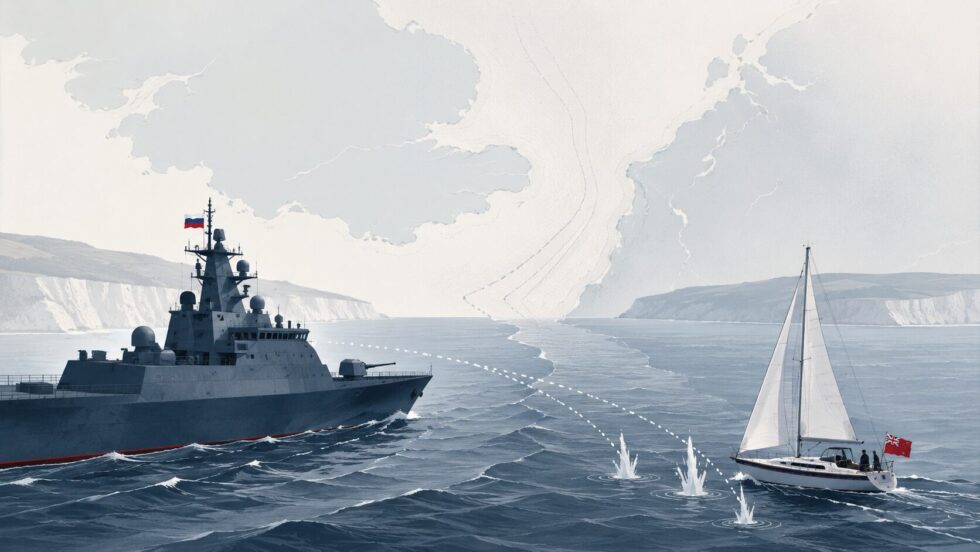
Russian navy British yacht confrontation in the English Channel has become one of the most sensitive maritime incidents between the United Kingdom and Russia in recent years after the Russian frigate Admiral Grigorovich fired warning shots near a UK-registered yacht south of the Isle of Wight. The incident happened on Tuesday, 16 June 2026, outside British territorial waters, when the yacht Bright Future reportedly drifted or sailed close to the Russian warship in foggy conditions, prompting alerts, flares, sound signals and then small-arms warning fire, The WP Times reports.
The immediate facts are serious but also precise: there were no reported injuries, no damage to the yacht and no evidence that the shots were intended to hit the civilian vessel. Yet the episode matters because it took place in one of Europe’s busiest sea lanes, involved a Russian warship already being watched by the Royal Navy, and came only days after British forces boarded the sanctioned Russian-linked tanker Smyrtos in the Channel. For Britain, the confrontation raises questions about maritime safety, Russian naval signalling, the limits of military conduct near civilian vessels and the growing pressure on UK waters as the war in Ukraine continues to shape European security.
Russian warship warning shots: what is known about the Channel incident
The incident took place around 20 nautical miles south of the Isle of Wight, in waters outside the United Kingdom’s territorial sea but within a strategically important part of the English Channel. The Russian ship involved was the Admiral Grigorovich, a frigate of Russia’s Black Sea Fleet that has been repeatedly mentioned in recent monitoring of Russian naval activity near the UK. The civilian vessel was a UK-registered yacht named Bright Future, described in reports as a small recreational yacht rather than a state or military craft. British and Russian accounts agree on the broad sequence: the yacht came close to the Russian frigate, the frigate attempted to warn it, and warning shots were then fired.
The distance between the two vessels remains one of the most important disputed details. Russian officials said the yacht approached to about 150 metres, while UK-linked accounts have referred to roughly 500 yards, or about 457 metres. That difference matters because it affects how the incident is understood: a very close approach can be framed as an urgent collision risk, while a greater distance makes the decision to fire appear more aggressive. Foggy conditions and limited manoeuvrability also appear central to the story, especially if the yacht had difficulty changing direction quickly.
| Key point | Reported detail |
|---|---|
| Date | Tuesday, 16 June 2026 |
| Location | English Channel, about 20 nautical miles south of the Isle of Wight |
| Russian vessel | Admiral Grigorovich |
| Civilian vessel | UK-registered yacht Bright Future |
| Reported action | Signal flares, audible warnings and warning shots |
| Casualties | No injuries reported |
| Damage | No damage reported |
| UK naval response | HMS Mersey monitored the Russian ship; HMS Tyne checked on the yacht crew |
For readers in Britain, the most important distinction is that the incident did not happen inside UK territorial waters. Territorial waters normally extend up to 12 nautical miles from the coast, while the confrontation took place farther out. That does not make the event irrelevant to the United Kingdom, because the yacht was UK-registered, the area is close to British waters and Royal Navy vessels were already monitoring the Russian frigate. It does, however, limit the immediate legal tools available to London and places more weight on investigation, diplomacy and naval tracking.
Russian ship in UK waters or near UK waters: why the location changes the legal picture
The phrase “Russian ship in UK waters” is likely to dominate searches, but the reported location requires care. The Admiral Grigorovich was near British waters, not clearly inside UK territorial waters at the time of the warning shots. That difference is crucial because warships enjoy sovereign immunity under international law and may pass through international waters, provided they respect navigation rules and avoid endangering other vessels. The English Channel is not a quiet maritime zone; it is a dense corridor used by cargo ships, ferries, naval vessels, fishing boats and private yachts.
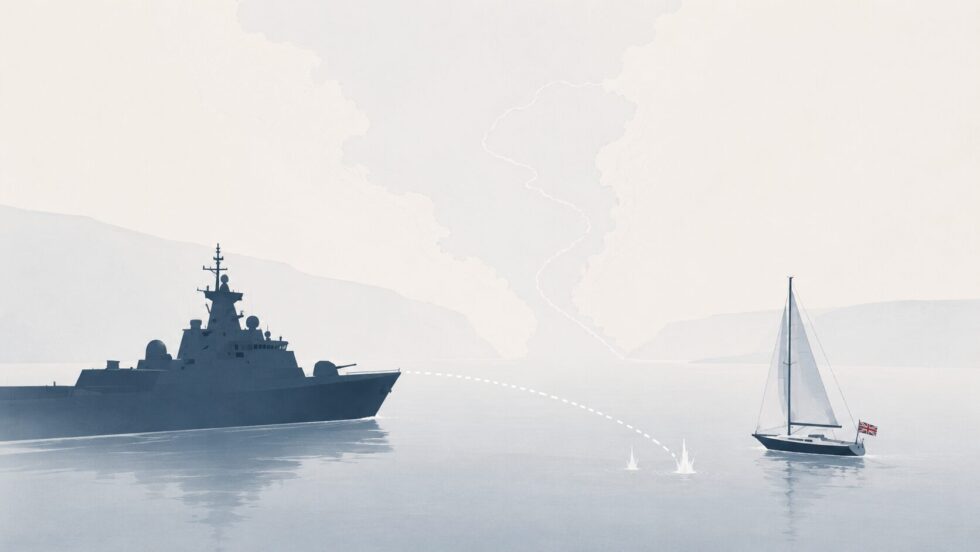
The incident therefore sits between two questions. The first is practical: did the yacht create a real collision risk, and did the Russian frigate follow proper escalation steps before firing? The second is political: was the use of warning shots proportionate in a tense environment where Russia and Britain are already in conflict over sanctions, Ukraine and shadow-fleet enforcement? Even if the shots were not aimed to cause harm, firing from a military vessel near a civilian yacht is a dramatic action. It changes a navigational problem into a diplomatic and security story.
British officials are treating the episode as an incident under investigation rather than as a confirmed deliberate attack. That language matters. It avoids overstating what is known while allowing the Ministry of Defence and Royal Navy to gather accounts from the yacht crew, naval personnel and available tracking data. For a serious news report, the safest formulation is not “Russian warship fires at British yacht” as a claim of attack, but “Russian warship fires warning shots near British yacht” unless later evidence shows direct targeting.
Admiral Grigorovich and the English Channel: why this warship was being watched
The Admiral Grigorovich is not just any Russian ship. It is a frigate designed for escort, patrol and combat roles, and its presence near the English Channel has attracted attention because Russian naval movements around the UK have become more politically charged since the full-scale invasion of Ukraine. Royal Navy monitoring of Russian vessels in and near UK waters is routine, but the wider context is no longer routine. Russian naval activity is now read through the lens of sanctions evasion, energy routes, military signalling and Moscow’s willingness to test Western responses.
In this case, HMS Mersey was reportedly monitoring the Russian frigate when the confrontation with the yacht occurred. HMS Tyne later became involved in checking the welfare of the yacht crew. That response suggests the UK was already aware of the Russian vessel’s movement and had assets close enough to gather information after the episode. It also shows why the Channel is not simply a civilian shipping corridor but a live security space where naval tracking, coastguard reporting and political decision-making overlap.
A useful way to understand the issue is to separate the military facts from the political meaning:
- The military fact is that a Russian frigate fired warning shots near a UK-registered civilian yacht.
- The safety fact is that no one was injured and no damage was reported.
- The legal fact is that the incident occurred outside UK territorial waters.
- The political fact is that it happened amid heightened UK-Russia tension.
- The strategic fact is that Russian naval presence near Britain is now watched as part of a broader pattern, not as an isolated maritime curiosity.
This is why the confrontation is being treated seriously even though the physical outcome was limited. A warning shot that causes no damage can still carry diplomatic weight. In the Channel, where accidents can escalate quickly and where military vessels move close to civilian traffic, restraint and communication are not secondary issues. They are the line between a navigational scare and a crisis.
Russian warship fires at British yacht: what both sides are saying
Russia’s account presents the warning shots as a safety measure. According to Moscow’s explanation, the yacht was on a dangerous course, the frigate attempted to establish contact, signal flares and sound warnings were used, and small-arms warning shots were fired only after the yacht continued approaching. In that version, the commander acted to prevent a possible collision rather than to threaten the yacht. It is the classic language of maritime de-escalation: warnings first, weapons only as a last resort, and no intention to damage the civilian vessel.
The British side has been more cautious. The Ministry of Defence confirmed that it was investigating reports of an incident in the Channel, while officials and defence sources have stressed that no injuries or damage were reported. British reporting also points to fog and possible difficulty in manoeuvring, which could explain why a small yacht did not move away quickly. That detail is important because a civilian yacht is not a naval craft; it may lack speed, power or situational awareness in poor visibility.
The central question is proportionality. Warning shots at sea are not automatically unlawful or unprecedented, but they are extreme when used near a civilian vessel, especially in a crowded corridor close to a NATO country. Before firing, a warship would normally be expected to exhaust less dangerous measures: radio calls, horn signals, visual warnings, changes in speed, course adjustment and communication through nearby authorities if possible. If the yacht was genuinely on a collision course, the commander may argue that time was limited. If the yacht was farther away and not an immediate danger, the decision becomes harder to justify.
Why the Smyrtos tanker operation matters in the background
The yacht confrontation happened shortly after British forces boarded the sanctioned Russian-linked tanker Smyrtos in the English Channel. That operation has become part of the wider background because the tanker is described as connected to Russia’s shadow fleet, the network of vessels used to move oil while avoiding or complicating sanctions enforcement. British officials have treated the yacht incident as separate, and there is no confirmed evidence that the warning shots were retaliation. Still, the timing is politically impossible to ignore.
For Moscow, Western action against shadow-fleet vessels is not just a technical sanctions issue. It is a direct challenge to Russia’s ability to move energy exports and finance its war economy. For London, those same vessels are part of a sanctions-enforcement problem with safety, insurance and environmental risks. The Channel has therefore become more than a passageway; it is a place where economic warfare, naval signalling and legal enforcement meet.
The British concern is that Russian naval escorts or Russian-linked vessels could use presence near the UK to test response times, create uncertainty or send political messages. The Russian concern, as publicly framed by Moscow, is that its vessels face hostile or unlawful interference. Between those two positions sits the practical danger: civilian ships, yachts and crews can suddenly find themselves close to military manoeuvres they are not equipped to interpret.
What this means for UK maritime security and civilian sailors
For the United Kingdom, the most immediate lesson is that civilian sailors in the Channel need to treat naval movements as a serious navigational hazard. The English Channel is already demanding because of traffic density, weather changes, tides and commercial shipping lanes. The addition of heightened military tension makes communication and route planning even more important. A yacht that drifts close to a warship, even accidentally, may be interpreted through a security lens rather than as a simple navigational mistake.
For yacht crews, the practical guidance is straightforward:
- Maintain a continuous watch, especially in fog or reduced visibility.
- Monitor VHF radio channels and respond quickly to warnings.
- Keep AIS and navigation lights functioning where required.
- Avoid crossing close ahead of large military or commercial vessels.
- Assume that naval ships may have restricted manoeuvrability or security protocols.
- Contact coastguard services if unsure about a vessel’s intentions or course.
- Do not rely on the assumption that a warship will simply move away.
For the Royal Navy, the incident reinforces the importance of shadowing and rapid welfare checks. HMS Mersey’s monitoring role and HMS Tyne’s reported follow-up with the yacht crew show how the UK can manage risk without escalating militarily. That approach allows Britain to document Russian behaviour, support British civilians and avoid giving Moscow an easy pretext for a wider confrontation.
Could the Russian navy British yacht confrontation escalate further?
The incident is unlikely by itself to trigger a military confrontation between Britain and Russia, especially because there were no injuries and the event happened outside UK territorial waters. But it can still deepen mistrust and add pressure on ministers to explain how Britain protects its maritime approaches. It also gives defence analysts another example of how quickly routine naval monitoring can become politically explosive when Russian ships, civilian vessels and poor visibility converge.
The more serious risk is repetition. One warning-shot incident can be investigated and contained. A pattern of such incidents would be much harder to treat as accidental or isolated. If Russian warships repeatedly fire near civilian vessels, or if civilian sailors begin to feel unsafe in waters close to the UK, the political pressure on London would rise sharply. That could lead to stronger naval shadowing, diplomatic protests, public warnings to sailors or new measures around Russian-linked vessels.
For now, the responsible conclusion is narrow but firm. A Russian warship fired warning shots near a British yacht in the English Channel; the yacht was not hit, no injuries were reported and the UK is investigating. The incident took place close to British waters, not clearly inside them, and it occurred during a period of intense UK-Russia tension over Ukraine, sanctions and shadow-fleet shipping. That combination makes the confrontation more than a maritime misunderstanding, even if the final investigation concludes that the immediate trigger was a collision risk.
Questions and answers about the Russian warship and British yacht incident
What happened in the Russian navy British yacht confrontation?
A Russian frigate, Admiral Grigorovich, fired warning shots near a UK-registered yacht named Bright Future in the English Channel on 16 June 2026. The incident happened roughly 20 nautical miles south of the Isle of Wight. No injuries or damage were reported.
Was the Russian ship in UK waters?
Reports place the confrontation outside UK territorial waters, though close to the British coast and inside a strategically sensitive Channel area. That is why the phrase “Russian ship in UK waters” needs careful handling. It is more accurate to say the Russian warship was near UK waters.
Did the Russian warship fire at the British yacht?
The confirmed formulation is that the Russian warship fired warning shots near or in the direction of the yacht. Reports do not show that the yacht was hit. The UK side says there were no injuries or damage, while Russia says the shots were intended to prevent a collision.
Why was Admiral Grigorovich in the English Channel?
Russian warships can transit international waters, including the Channel, but their presence is closely monitored by the Royal Navy. Admiral Grigorovich had already drawn attention because of Russian naval movements around the UK and the broader issue of shadow-fleet shipping linked to sanctions on Russia.
Is this connected to the Smyrtos tanker boarding?
British officials have treated the yacht incident as separate from the earlier boarding of the sanctioned tanker Smyrtos. However, the timing matters politically because both events occurred in the same wider context of UK-Russia confrontation over sanctions, shipping and the war in Ukraine.
Why is the incident important for the United Kingdom?
It matters because a Russian warship used warning fire near a British civilian vessel close to UK waters. Even without casualties, such an incident raises questions about maritime safety, Russian naval conduct, Royal Navy monitoring and the risks facing civilian sailors in the English Channel.
Read about the life of Westminster and Pimlico district, London and the world. 24/7 news with fresh and useful updates on culture, business, technology and city life: London Traffic, 15–20 June 2026: The Week's Closures, Hour by Hour and Day by Day